17.05.2026
364
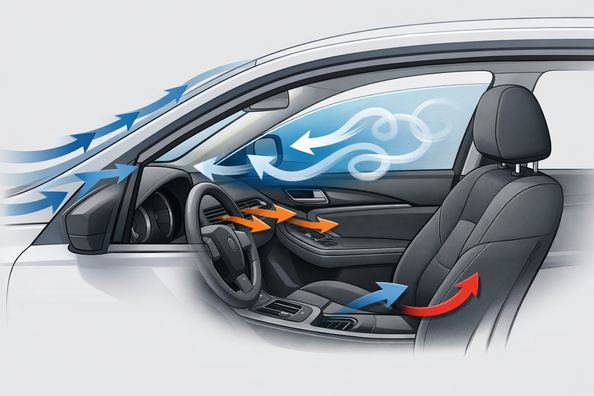

When you get ear pressure, a booming noise, or a “helicopter” feeling in the cabin with a slightly open window, it’s most often not a failure. Usually it’s cabin resonance: the airflow hits the window opening, and the sealed body amplifies the oscillations. On some cars it’s noticeable already at city speeds; on others — closer to highway speeds.
The quickest check is simple: crack open another window by 1–2 cm, or let a little air out through the sunroof. If the pressure and booming disappear almost immediately, it’s normal buffeting, not a malfunction. But if the noise is present even with the windows closed, you need to look for a leak, window misalignment, or a sunroof issue.
The car interior works like a closed chamber. When only one window or the sunroof is open, the outside flow doesn’t just enter — it starts rocking the air in the cabin with low-frequency waves. That’s why it doesn’t feel like a normal whistle, but like pressure hits on the ears, a boom, and vibration.
The effect is stronger in more airtight and streamlined cars. The flow runs along the body, separates near the window frame, mirror, or A-pillar, and resonates with the cabin volume. That’s why the same 2–3 cm gap can produce completely different results on different models.
It’s important not to confuse resonance with air being sucked in through a leak. Resonance usually appears only with an open window in a certain speed range and at a certain opening. A leak causes noise even with the glass closed, often from one specific corner of the door or roof.
Start with the simplest road test: at the same speed, slightly crack open the second window. If the booming disappears right away, the cause is cabin resonance. If nothing changes, don’t look for resonance — look for the specific spot where air is getting through.
Next, change not the speed but the opening position. If the noise appears sharply at one glass position, and becomes weaker with a smaller or larger gap, that’s a typical buffeting scenario. But if there’s a constant whistle in almost any position, or even with the window closed, suspicion falls on the seal, the glass edge, the guide, or the sunroof.
Another practical clue is localization. Resonance is felt throughout the cabin: pressure on the ears, booming, the air “pulsing.” A leak is more often heard at a point: near the upper door corner, along the pillar, near the sunroof. If after rain or a car wash there’s moisture near the frame, that’s also an argument for a fitment problem rather than normal aerodynamics.
DD Tuning expert comment: Most often the driver tries to treat resonance like a breakdown and wastes time going to replace half a door. The second common mistake is installing the first random deflector and expecting complete silence at any speed. If the noise appears only with the window open, first check the ventilation scheme; if the noise is present with the window closed, then diagnose sealing and window seating.
| Symptom | Likely cause | What to do |
|---|---|---|
| Ear pressure and booming with one slightly open window | Cabin resonance | Crack open the second window or the sunroof by 1–2 cm; change the opening position of the first window |
| Noise appears only after 50–70 km/h | Buffeting in a specific speed range | Try a different window position; don’t keep one window open in the peak range |
| Whistling or a draft even with the windows closed | Seal, window misalignment, guide, sunroof | Inspect glass fitment and rubber condition; seek adjustment or replacement |
| Noise comes from one upper corner of the door | Local gap at the frame or glass | Check window seating and the seal; don’t mask the problem with accessories only |
| A new whistle appeared after installing deflectors | Incorrect installation or an unsuitable deflector shape | Check accessory seating, fastening, and fit; if needed, reinstall or remove |
| With the sunroof open, the whole cabin booms | The same resonance, but through the roof | Change the sunroof opening position or provide an additional air outlet via a side window |
If the issue happens only when you intentionally open the window for ventilation, it makes sense to start with deflectors. They redirect the flow along the top edge of the door and let you keep a small gap without a direct blast of wind into the cabin.
When you need a solution specifically for daily opening of side windows, look at window deflectors. Not only the shape matters, but also the installation: if the accessory sits unevenly, the window may move stiffly or even bounce against the guard, and instead of improvement you’ll get a new whistle.
If air passes even with the window closed, spending money on a deflector is irrational. In that case you need to check seals, glass clamping, guides, and the sunroof assembly. Here an accessory may only partially mask the symptom, but it won’t remove the cause.
| Solution | When it works | When it’s not worth spending money |
|---|---|---|
| Crack open a second window | When there’s typical resonance from one open window | When the noise doesn’t disappear even with two openings, or it’s present with closed windows |
| Change the opening position of the first window | When the noise appears only at a certain glass position | When there’s a constant whistle from one point regardless of the gap |
| Side window deflectors | When you need regular ventilation, to drive in rain, and reduce direct airflow | When the cause is window misalignment, a peeled seal, or a deformed guide |
| Sunroof deflector | When the main booming occurs specifically with the sunroof open | When the noise is present even with the sunroof closed, or there are signs of leakage |
| Window adjustment, seal replacement, guide repair | When the noise occurs with closed windows or from one specific joint | When the problem happens only with one slightly open window and disappears after opening the second |
From a customer’s experience: A driver was looking for the cause of a “draft” at speed and was sure the problem was in the door. After a simple check with a second slightly open window, it became clear it was resonance, not a malfunction. For daily ventilation he chose model-specific deflectors, and the cabin stopped booming in the mode he used every day.
In most cases, a draft and booming with a slightly open window is not a broken door, but normal cabin resonance from a single opening. It’s easy to tell: give the air a second outlet or change the gap; if the effect disappears, you’ve found the cause. But if the noise is present with the window closed, you need not to fight the symptom but to check the seals, window seating, guides, or sunroof. This material is based on real selection experience, practice, and real usage scenarios, so the logic is simple: first distinguish resonance from leakage, and only then spend money on accessories or repairs.
Shipping to EU
Wholesale and retail
Own warehouse
Опис продукту
Подарунки не надаються при оформленні покупки у кредит під 0,01% або при покупці частинами.