31.03.2026
296
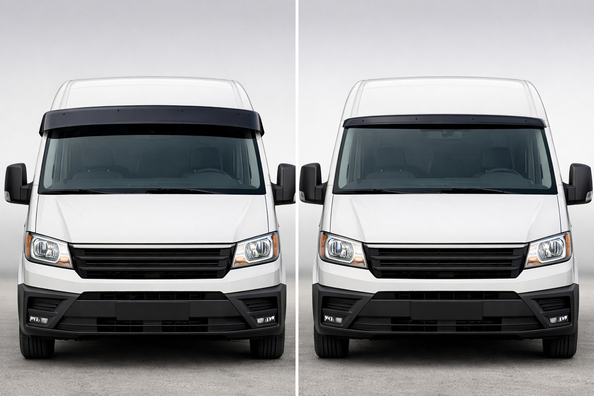

For a van, the choice almost never comes down to a literal “wide or compact.” In practice, you’re choosing between a higher-profile wind deflector with greater coverage and a low-profile one that sticks out less and changes the airflow in front of the windshield less. If the van often runs on the highway and collects insects and fine gravel, a higher profile makes sense. If silence, a more restrained look, and minimal visual bulk matter more, the compact option is the more logical choice.
The main mistake is expecting any deflector to fully protect the glass. It only partially changes the aerodynamics and directs some dirt higher, but it doesn’t eliminate the risk of chips. So you should compare not by catalog photos, but by profile, mounting, behavior at speed, durability, and the van’s real operating conditions.
In van catalogs, “wide” usually means a higher profile and a larger coverage area. “Compact” means a lower profile that protrudes less and dominates the vehicle’s appearance less. In other words, the key difference isn’t the actual width of the part, but how actively it interferes with the airflow in front of the windshield.
Because of this, sellers’ labels often vary: the same product may be called wide, tall, or reinforced. For the buyer, what matters is different: a larger profile works better on the highway, while a compact one is usually easier to live with day to day—especially if the van sees more city driving than long hauls.
For a van, these are truly practical criteria. On a long body and high daily mileage, small installation or aerodynamic drawbacks show up sooner and annoy more.
| Option | Strengths | Weaknesses | Who it suits |
|---|---|---|---|
| Wide, higher profile | More coverage, better directs airflow over the front end, logical for highways, insects, and fine gravel | More noticeable externally, can sometimes add noise or vibration if installed poorly, depends more on precise fit | Those who drive between cities a lot, work daily, or often catch dirt and debris at speed |
| Compact, low profile | Less impact on appearance and airflow, more often quieter, looks more restrained | Smaller impact zone, can feel almost decorative if you expect protection at a high-profile level | Those who drive more in the city, want a neat look, and don’t need maximum coverage |
DD Tuning expert comment: Most often, van owners pick the tallest deflector “just in case,” then are surprised by noise or a changed washer spray pattern. If the vehicle is mainly urban, the extra profile often doesn’t pay off. A second common misstep is installing in the cold or without checking gaps—after which vibrations and edge marks appear.
Its advantage is that it catches the airflow higher in front of the van and provides a larger coverage zone. That’s why this option makes sense for intercity routes, delivery service, bypasses, and country roads where the front end and glass collect a lot of dirt, insects, and small stones.
The downsides are also typical: it’s more noticeable, sometimes affects wind noise more, and with poor installation it shows vibration sooner. If the mounting has contact points, you should periodically check that the edge isn’t rubbing and that abrasive dirt hasn’t accumulated underneath.
It’s not chosen “just for looks.” It interferes less with aerodynamics, looks more modest on a tall body, and often delivers a more predictable everyday result—without the feeling that the vehicle has gained another bulky add-on.
The weak point is obvious: the impact zone is smaller. If you expect the same level of dirt deflection as a higher profile, you’ll be disappointed. For those who run the highway daily, the compact option often turns out to be too restrained.
Separately, it’s worth looking at the material. Acrylic usually holds its appearance and sun exposure better; polycarbonate is more impact-resistant but scratches faster; and budget plastic depends more on heat, frost, and the accuracy of the part’s forming.
For a courier or service van that works mostly in the city and only occasionally goes on the highway, a compact profile is most often the smarter choice. It provides basic protection, doesn’t make the front end look heavier, and is less likely to raise noise concerns.
For a passenger shuttle, intercity runs, or a work vehicle that constantly sees higher speeds, a wider and higher profile makes more sense. The key here isn’t maximum size by itself, but quality model-specific geometry and calm behavior at speed.
If the van runs in mixed conditions, what’s decisive isn’t the body class but the routes. One vehicle sits in the city almost all day; another does 300–400 km per day on the highway. For the first, overpaying for a massive option often makes no sense; for the second, it’s the opposite.
| Scenario | What to choose | Why |
|---|---|---|
| Daily intercity trips, lots of insects and fine debris | Wide, higher profile | Provides a larger airflow impact zone and works more practically on the highway |
| City deliveries, short routes, lower speeds | Compact, low profile | Less chance of unnecessary noise, more restrained look, sufficient basic effect |
| Passenger van where a tidy appearance matters | Compact, low profile | Visually loads the front end less and stays closer to an OEM look |
| Highway work, bypasses, country roads | Wide, higher profile | Justifies itself better where dirt and small stones fly constantly |
| Mixed use without a clear highway bias | Compact or moderately high | Better not to chase maximum size, but choose an option without excessive profile |
A more expensive deflector is justified not when it’s simply bigger, but when it has precise model-specific mounting without drilling, straight geometry, a stable washing gap, and predictable behavior at speed. For a high-mileage work van, this matters more than one-time savings, because a cheap, poorly chosen option quickly becomes annoying due to noise, play, or edge marks.
Before buying, it’s worth confirming the basic selection logic in the article about a windshield deflector. And if you’re choosing a solution for a popular work van, it’s useful to look at model-specific categories right away: windshield deflectors for Ford Transit and hood deflectors for Ford Transit. This helps you understand whether you specifically need a deflector above the glass or whether it’s better to combine it with front edge protection.
From a customer’s experience: For a work van that carries tools between city and highway, they initially wanted the biggest possible deflector because they expected near-complete glass protection. After clarifying routes and speeds, they chose a higher—but not extreme—model-specific option with proper mounting. As a result, there was less dirt on the front end, and the driver didn’t get the extra wind roar he was worried about.
For a van, the wide option is worth taking when you need more coverage and the vehicle truly lives on the highway. The compact one is better where silence, a restrained look, and calm daily use matter. The worst decision is to buy the largest deflector without considering mounting and geometry—or, conversely, to pick an almost decorative option and expect high-profile-level protection from it.
If you boil it down to one rule: first look at your driving scenario, then at profile and mounting, and only then at price. This material is based on real selection experience, practice, and real-world use cases, so the choice is simple: highway and debris—higher profile; city and restraint—compact.
| ✔ | The deflector does not provide full protection for the windshield, so you should not expect it to eliminate the risk of chips. It only partially changes the airflow and deflects some of the dirt upward. |
| ✔ | The taller profile may add noise, slight vibration, or change the washer spray if the fit is chosen poorly. On some body styles, these effects are more noticeable than expected. |
| ✔ | The compact version has a smaller area of influence, so on the highway it may turn out to be too restrained. If you expect the same level of performance as from the taller profile, you will be disappointed. |
| ✔ | Improper installation, cold fitting, or weak fastening quickly lead to vibrations, misalignment, and even marks along the edge. For a van, this is especially noticeable due to high mileage and frequent use. |
| ✘ | The wide, taller profile works better on the highway: it catches the airflow higher and provides a larger overlap area in front of the windshield. This is useful for vans that often collect insects, small gravel, and road dirt. |
| ✘ | The compact version interferes less with aerodynamics and usually looks more discreet on a tall body. For city driving, this is more practical, because there is less chance of extra noise or visual bulkiness. |
| ✘ | For a work van, the article recommends evaluating not only the size, but also the installation, durability, fasteners, and behavior at speed. This helps avoid choosing something that looks good in the catalog but performs poorly in real-world use. |
| ✘ | There is a clear link to use cases: for intercity trips and everyday highway driving, the taller profile is the more logical choice, while for short urban routes, the compact one is better. This division makes it easier to choose for a specific van task. |
| ✘ | The article separately emphasizes that the more expensive model makes sense only with proper geometry, vehicle-specific mounting, and stable fit. In other words, you are paying extra for practical things, not just a larger size. |
Shipping to EU
Wholesale and retail
Own warehouse
Опис продукту
Подарунки не надаються при оформленні покупки у кредит під 0,01% або при покупці частинами.