31.03.2026
287
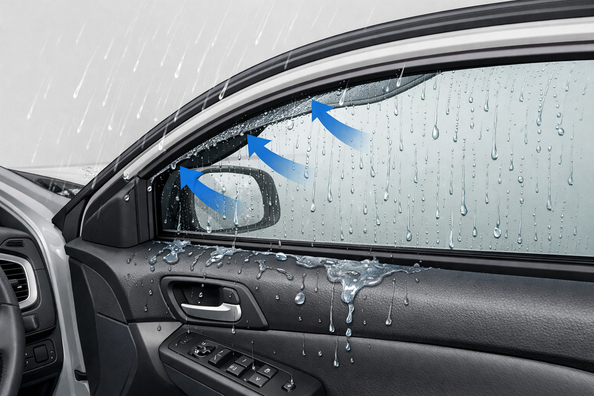
If, with a slightly cracked side window, rain and spray get into the cabin, it’s most often not a door failure. Usually the problem is aerodynamics: the airflow near the A-pillar and mirror swirls, pressure pulsations appear at the window opening, and droplets get pulled inside.
So first you need to distinguish a normal aerodynamic effect typical for many cars from a real leak. If water gets in only with the window open, work with the ventilation mode or deflectors. If it’s wet even with the glass fully closed, then you need to check the seals, door drains, and the inner membrane.
When only one side window is open, the cabin starts acting like a cavity with unstable pressure. That’s why you get not only the characteristic booming “buffeting” in your ears, but also suction that pulls droplets inside. This shows up especially often at speed, in a crosswind, and on cars where the mirror and A-pillar create a strong turbulent flow right along the front edge of the door glass.
It also matters how far the window is open. The same car can behave differently with a minimal gap versus a larger opening. On some body styles the front window “starts up” more, on others—the rear. So there’s no universal glass position that works every time.
DD Tuning expert comment: The most common mistake is buying a universal deflector and expecting it to completely eliminate water at speed. The second typical mistake is cycling the window up and down right after installation without letting the part seat properly. If the deflector is vehicle-specific and installed straight, spray and noise usually decrease, but you still need to choose the opening position for your specific body.
| Symptom | Likely cause | What to do |
|---|---|---|
| Rain gets in only when one front window is open | Pressure pulsations and turbulence near the A-pillar | Reduce the gap, crack the opposite window slightly, test at a different speed |
| Less spray, but strong “buffeting” in the cabin | Cabin cavity resonance | Don’t open just one window in isolation; try a different pair of windows or a smaller opening |
| On the highway in rain, water gets in even through a small gap | Strong crossflow, high speed, unfavorable airflow angle | Reduce speed, change the opening position, use a deflector as a supporting measure |
| After installing a deflector, a whistle appears or the window bounces back | Wrong type or installation mistakes | Reinstall, check seating in the channel, let the part adapt, replace with a vehicle-specific one if needed |
| Water gets into the cabin even with the window closed | Issues with the seal, door drains, or membrane | Don’t spend money on accessories—diagnose the door instead |
First: crack another window slightly, preferably on the opposite side. This often removes the worst pulsations and immediately shows that the issue is airflow.
Second: don’t aim for “more open,” aim for the right gap. In practice, sometimes just a few millimeters of difference is enough to noticeably reduce spray.
Third: if you regularly ventilate the cabin in the rain, vehicle-specific window deflectors work well. They block part of the direct water stream and reduce noise, but they won’t guarantee 100% dryness in a heavy downpour or at high speed.
Fourth: after installing a deflector, you need to let it settle in place. At first it’s better not to move the window unless necessary, and in cool weather adaptation can take longer.
If you need to ventilate the cabin in the rain without constantly closing the windows, it makes sense to look at window deflectors. This is the accessory that actually works with airflow rather than masking a symptom.
To avoid whistling, misalignment, or window regulator issues, it’s worth immediately checking how to choose deflectors, and separately verifying how to install deflectors correctly. A vehicle-specific solution is almost always more predictable than a universal one.
Replacing seals or repairing the door is needed when water gets through even with the glass up, moisture appears on the door card, or water stands at the bottom of the door. In that situation, accessories don’t treat the cause.
| Solution | When it works | When it’s not worth spending money |
|---|---|---|
| Crack the opposite window slightly | When the issue is caused by one open window and buffeting | When water enters the cabin even with the glass fully closed |
| Choose a different window opening position | When there are one or two “bad” positions where noise and spray rise sharply | When the cause is a damaged seal or clogged/failed drain |
| Vehicle-specific deflector | When you need to regularly drive with a slightly open window in the rain | When you expect complete dryness on the highway in a downpour, or you buy a universal option without precise fitment |
| Reinstalling or replacing the deflector | When the current part whistles, comes loose, or interferes with the window | When the deflector is installed correctly but water gets in through the door with the window closed |
| Repairing seals, drains, door membrane | When there’s leakage regardless of whether the window is open or not | When the issue appears only while driving with the glass slightly open |
From a customer’s experience: a person was looking for a way to ventilate the cabin in the rain on a daily route, because with the driver’s window open on the bypass road, spray flew straight onto the door card. At first they simply opened the window more, but it only got worse. After installing vehicle-specific deflectors and getting into the habit of slightly cracking the opposite rear window, the cabin ventilates more calmly, and in a heavy downpour they just reduce the gap or close the window completely.
In most cases, rain gets into the cabin with a cracked window because of aerodynamics, not because of “bad doors.” The quickest check is simple: see whether the effect changes with speed, window position, and a second slightly open window. This almost immediately shows whether it’s airflow or a repair issue.
If the cause really is turbulence, specific things help: a different opening position, a small opening of the opposite window, and a correctly selected and properly installed deflector. But if water gets through even with the window closed, don’t spend money on accessories instead of diagnosing the door. This material is based on real fitment experience, hands-on practice, and real-world use cases.
Shipping to EU
Wholesale and retail
Own warehouse
Опис продукту
Подарунки не надаються при оформленні покупки у кредит під 0,01% або при покупці частинами.