06.07.2026
201
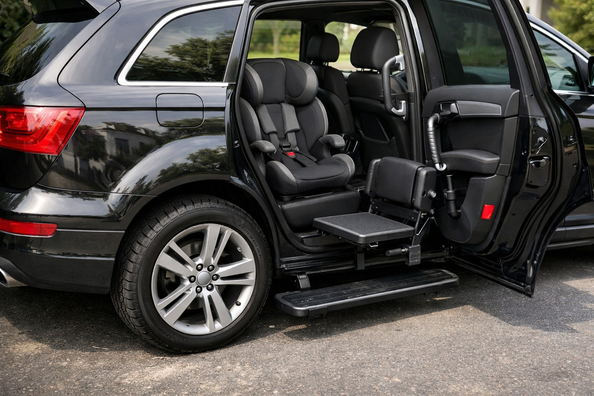
This upgrade plan is for an Audi Q7 2005-2015 owner who regularly drives kids, parents, or elderly passengers and wants to make getting into a tall crossover easier. The key here isn’t visual impact, but a clear foothold, less risk of slipping, and normal access to the second and third rows.
On the Q7 4L, everything depends heavily on the configuration: 5 or 7 seats, the type of second row, whether air suspension is fitted, and the S line package. So the right approach is: first determine the real entry height, then don’t break the cabin logic, and only after that think about what’s simply nice to have.
For kids and older passengers, the Q7’s problem isn’t small doors—it’s the high body and the big step into the cabin. The upgrade should provide an intermediate step with a proper standing area, not a decorative tube that’s awkward to step on.
The second task is not to ruin cabin access. If you have the 7-seat version, it’s important to preserve second-row easy-entry and the passage to the back. On this kind of vehicle, poorly chosen side steps can cancel out the whole point of the upgrade, even if they look convincing from the outside.
The third task is not to duplicate what the car already does. If the vehicle has air suspension, it already provides a real benefit for entry height and loading. In that case, accessories should complement the scenario, not mask the lack of thoughtful day-to-day use.
The first candidate is wide fixed side steps with an anti-slip surface. Specifically wide ones, not narrow tubular bars. For a child or an elderly person, the difference between “there’s somewhere to place your foot” and “you have to step over some unclear tube” is critical.
Look for a kit that mounts to factory mounting points without drilling. This reduces the risk of crooked installation and usually means a more predictable fit to the body. But before buying, separately check compatibility with the 3rd row, comfort second row, S line, and any related underbody equipment.
If you have a 7-seat Q7, the first step is not ordering side steps—it’s checking whether you’ll lose normal second-row forward movement. In this configuration, ease of access to the back is sometimes more important than any exterior accessory.
| Upgrade | Why it’s needed | Who really benefits |
|---|---|---|
| Wide fixed side steps | Reduce the height of the first step, provide a foothold when getting in and out | Families with kids, elderly passengers, drivers who drop off passengers daily at school or home |
| Compatibility check with the 7-seat configuration and second row | Helps you avoid losing easy-entry and access to the third row | Q7 owners with three rows of seats or frequent use of the rear seats |
| Second-row setup for child seats | Keeps one convenient passage and prevents you from constantly rearranging seats | Those who carry children in child seats and occasionally seat an extra passenger in the back |
| Using the factory body-lowering function if air suspension is fitted | Makes entry easier without additional exterior parts | Owners of vehicles with air suspension where the issue is more about body height than the lack of a step |
| Rubber floor mats in the cabin | Less slippery moisture and dirt where kids place their feet after getting in | Families who often drive in rain, snow, or with kids’ shoes after being outdoors |
DD Tuning expert comment: The most common mistake on the Audi Q7 is choosing side steps by photo rather than by use case and configuration. People overpay for narrow or decorative solutions that don’t provide a proper stepping area and sometimes even obstruct access to the third row. Before ordering, you need to verify not only the year, but also whether it’s a 5- or 7-seat version, the type of second row, and the body package.
In the second stage, it’s worth addressing not the entry height but the everyday details that make daily entry calmer. First of all, proper second-row organization: if you have child seats, it’s better to immediately keep a logical side for access instead of constantly shifting things and folding seats at random.
For a 7-seat Q7, this is especially important because second-row forward movement truly affects how convenient it is to reach the back. If the third row is used even occasionally, you shouldn’t install an upgrade that formally helps you step up but in practice makes it harder to get deeper into the cabin.
If the vehicle has air suspension, learn to use its capabilities specifically for a family scenario. For many owners, that delivers a bigger day-to-day effect than yet another exterior part.
In this group, I’d include decorative trims, chrome, body kits, and narrow side tubes. They may look good visually, but for getting kids and elderly passengers in and out, their benefit is either zero or very conditional.
Even side steps differ in substance. If there’s a wide platform and a non-slip surface, it’s a functional upgrade. If the emphasis is only on shine, shape, or a “sporty” look, then for your scenario it’s no longer a top priority.
Separately, remember dirt. A step that sticks out too far or sits at an unfortunate height can make stepping easier for one person but dirty another person’s pants. For a family Q7, that’s not a small thing—it’s a daily annoyance.
Most often, people waste money on expensive decorative side steps or tubular solutions without a proper stepping area. They look good in photos, but they don’t solve the main task: giving a child or an older person a short and clear intermediate step.
The second mistake is buying an OEM or expensive kit without checking the configuration. For the Q7, this is critical because some solutions have limitations with the 3rd row and the comfort second row. It’s easy to pay more and get less convenience.
The third bad idea is trying to convert a 5-seat vehicle into a 7-seat one just for family convenience. That’s complex, questionable, and not the path you should take to solve an entry problem.
And one more trap: buying side steps when the real problem isn’t them. If mostly adults ride with you and the vehicle has air suspension, the real gain from expensive steps may be smaller than expected.
| What to install first | What you can postpone | What is not required |
|---|---|---|
|
|
|
A more expensive kit is justified when you need not just an accessory but a predictable result: a proper stepping area, sensible height, installation without drilling, and clear compatibility with your Q7. If it’s a family vehicle and entry happens every day, a cheap compromise quickly becomes annoying.
It makes sense to look at the specific Alliance kit if you already know your configuration and want a ready-made solution for this body. If you need to compare formats and not get fixated on one option, it’s more practical to start with the category of side steps for Audi Q7. And when the problem isn’t only entry height but also a wet floor after kids’ shoes, it’s logical to pair the steps with rubber floor mats for the cabin.
You shouldn’t overpay just for the “OEM” status if in your specific configuration it brings limitations or doesn’t improve entry as much as you expect. In the case of the Q7, what should be expensive is not the logo, but the accuracy of the fit to your scenario.
From a customer’s experience: the owner of a 7-seat Q7 was looking for side steps to make it easier for two kids and an older female passenger to get in, but at first he was looking at narrow tubes because they were cheaper. After checking the configuration, they gave them up so as not to compromise access to the back, and chose a wide fixed solution with a proper platform. As a result, the kids started getting in on their own, and access to the third row did not get worse.
For an Audi Q7 2005-2015 in a kids-and-older-passengers scenario, the smartest logic is: first a wide anti-slip step—but only after checking compatibility with your cabin and seat rows; second—organizing the second row, child seats, and day-to-day routine; everything decorative—last.
If you have a 7-seat vehicle, don’t sacrifice easy-entry for the sake of a nice-looking part. If air suspension is fitted, use it as part of the solution. And most importantly: don’t overpay for looks where you need simple convenience. This material is based on real selection experience, hands-on practice, and real usage scenarios—not an abstract list of accessories.
| ✔ | Wide fixed side steps with an anti-slip surface really make it easier to take the first step into the tall Q7. For children and elderly passengers, this is more convenient than narrow tubular solutions without a proper platform. |
| ✔ | If the side steps are installed in the factory mounting points without drilling, the installation is more predictable and less risky. This also reduces the chance that the part will sit crooked or interfere with body elements. |
| ✔ | In the 7-seat version, it is important to check the compatibility of the upgrade with access to the third row, and this helps avoid ruining easy-entry. This approach preserves real family convenience rather than just adding an accessory on the outside. |
| ✔ | The factory air suspension can noticeably make getting in and out easier without additional exterior parts. This is especially useful if the main issue is the body height itself. |
| ✔ | Rubber floor mats help keep the floor cleaner and less slippery after children with wet shoes. This is a practical addition to the family use case, especially in rain or snow. |
| ✘ | Narrow tubular side steps without a wide platform do a poor job of helping children and elderly passengers get in. They may look effective, but they do not provide proper support for the foot. |
| ✘ | Incorrectly chosen side steps can interfere with access to the third row or the operation of the second row. For the 7-seat Q7, this is especially critical, because you can lose the point of easy-entry. |
| ✘ | An expensive or original kit without checking the configuration can easily turn out to be a bad choice. In the Q7, it is important not only the model year, but also the 5- or 7-seat version, the type of second row, and the body package. |
| ✘ | Decorative body kits, chrome, and solutions that work more for appearance do not provide noticeable benefit for everyday entry. If the car is a family one, it is better to leave such upgrades for the last stage or skip them. |
Shipping to EU
Wholesale and retail
Own warehouse
Опис продукту
Подарунки не надаються при оформленні покупки у кредит під 0,01% або при покупці частинами.