06.05.2026
416
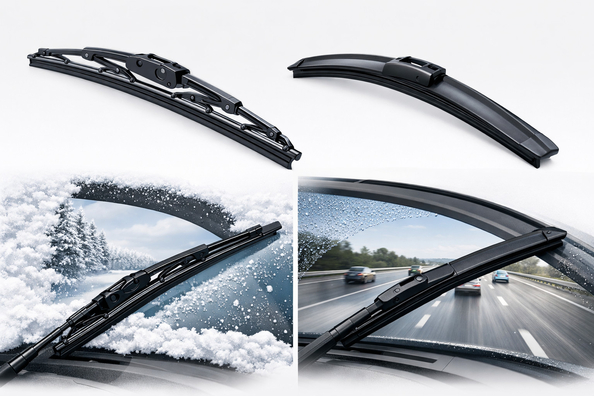
In the “framed or beam” debate, there isn’t one universal answer for all cars and conditions. On the highway, quality beam (frameless) blades more often win: they’re less likely to lift from airflow and they press more evenly against the glass. In snow, ice, and slush, winter framed blades with a rubber cover—or good beam blades from a winter series—are often better, because the main issue there isn’t rain, but frozen mechanisms and a hardened wiping edge.
What makes it confusing is that the same symptom—streaks or missed spots—can have different causes. If a blade works poorly only at speed, frost isn’t to blame. If it happens only after overnight parking or in wet snow, the cause is often ice in the frame or stiff rubber. And sometimes the blade type has nothing to do with it at all: the problem is the size, the mount, or the wiper arm pressure.
Drivers often compare construction names, but a wiper doesn’t work in a catalog—it works on a specific windshield. The result is affected by the glass curvature, blade length, adapter type, wiper arm spring force, and even the winter parking position of the blades. That’s why on one car beam blades are stable on the highway, while on another they can lift at the edges, whereas framed or winter blades sit more evenly.
The second reason is the season. In freezing weather, rubber hardens, and snow and ice build up in framed joints. If you run the wipers over an ice crust or on a frozen windshield, any design will quickly start smearing, chattering, and making noise.
DD Tuning expert comment: The most common mistake is buying “winter” or “beam” blades at random and not checking the length, mounting, and edge fit on the windshield. The second typical mistake is judging blades on a frozen windshield: first you need to clean the glass and the blade itself from ice—otherwise even a good set will seem like a bad choice.
| Symptom | Likely cause | What to do |
|---|---|---|
| Fine in the city, but streaks appear on the highway | Aerodynamic lift, weak pressure | Check length and fit, consider quality beam blades, assess the condition of the wiper arm |
| After snow, the blade chatters and leaves “islands” | Ice in the frame or on the edge | Defrost the windshield, clean the blade, don’t try to break ice with the wiping stroke; for harsh winters consider a winter set with a cover |
| Doesn’t clean the edges, center is clean | Unfavorable windshield geometry, blade too long, adapter misalignment | Check size and mounting; sometimes switching to a different blade design helps |
| Squeaking and streaks even on wet glass | Worn or hardened rubber | Replace the set; a rule of thumb is every 6–12 months, in harsh winter closer to 6 |
| One blade wipes well, the other constantly smears | Adapter or wiper arm pressure issue | Check fit, play, and pressure force instead of simply buying another identical set |
Accessories make sense only after you understand the source of the problem. If the blade is physically worn, replace it; if it’s fine but struggles in frost or at highway speed, then related solutions are appropriate.
| Solution | When it works | When it’s not worth spending money |
|---|---|---|
| Quality beam (frameless) blades | Highway, rain, high speeds, even contact on your windshield | If the main issue is ice in the blades after overnight parking, or the edges lift due to windshield geometry |
| Winter framed blades with a rubber cover | Constant snow, icy slush, the car parks outdoors | If most trips are in above-freezing rain and you need the quietest possible highway operation |
| Premium silicone or frost-resistant blades | Large temperature swings, desire for longer service life | If size, adapter, wiper arm pressure, or installation misalignment aren’t resolved |
| Winter washer fluid | Frost, dirty salt film, frequent winter highway driving | If the blade is already cracked or not making contact—fluid won’t fix that |
| Rain repellent | Long drives in rain, good glass and working blades | If blades are worn, the glass is icy, or the issue is specifically mechanical pressure |
From a customer’s experience: A driver who commuted on the highway daily and parked outside complained that framed blades started smearing specifically at speed and iced up quickly in snow. After checking, it turned out the length was correct, but the rubber had already lost elasticity, and in freezing weather he ran the wipers on a cold windshield. After switching to quality beam blades for the rainy season and proper winter washer fluid, the highway problem disappeared, and in winter the habit of first cleaning the windshield and the blades themselves helped.
In short: for highway driving, beam blades are more often better; for harsh winter—winter framed blades with a cover or quality winter beam blades. But what decides the outcome isn’t the design name itself, it’s the combination of driving conditions, windshield geometry, correct size, mounting, and rubber condition.
So first, separate the symptom: speed, snow, icing, edges, or the entire length. This approach delivers real results and doesn’t force you to waste money at random.
| Blade type | Strengths | Weaknesses |
|---|---|---|
| Framed | Affordable, simple, in winter versions can handle snow and ice better | Joints collect ice; at speed they are more often affected by wind lift |
| Beam (frameless) | Better on the highway, more even pressure, less vulnerable to wind | Not always ideal on very curved windshields and can be more expensive in the premium segment |
| Winter framed with a cover | Protect the mechanism from snow and ice, work well in harsh winter conditions | Not always the best for quiet operation in rain and at high speed |
The material is based on real selection experience and practical use—not marketing labels on the packaging.
For winter, the most reliable options are either dedicated winter framed blades with a rubber cover, or quality beam blades; for the highway, beam blades are usually better because they resist wind lift and press more evenly against the glass, but on some cars with very curved windshields or an unfavorable blade parking position, framed or winter blades can work more consistently.
In winter conditions, it’s not only the blade that helps, but also winter washer fluid with antifreeze components and pre-cleaning the windshield.
Correctly chosen length and the right mounting type are more important than the blade type name itself.
| ✔ | On the highway, frameless wipers usually perform better: they are less lifted by airflow and press against the glass more evenly. This is especially noticeable at high speeds, when conventional framed wipers are more likely to start streaking. |
| ✔ | For snow, ice, and slush, winter framed wipers with a rubber cover or high-quality winter frameless ones are useful. They better protect the mechanism from icing up and handle harsh winter conditions better. |
| ✔ | The article rightly emphasizes that it’s not only the wiper type that matters, but also the size, mounting, and arm pressure. This helps avoid replacing the set at random and instead first find the real cause of streaks or skips. |
| ✔ | There is practical advice to check the condition of the glass and the wipers themselves before drawing conclusions. If you clear off the ice and the edge, it’s easier to tell whether the problem is the design or icing or worn rubber. |
| ✔ | It is separately noted that winter washer fluid really helps in frost and on the salty film. This is a useful addition for winter use, but not a replacement for faulty wipers. |
| ✘ | Frameless wipers are not always better: on very curved glass, they can lift at the edges. In that case, framed or winter wipers sometimes sit more evenly. |
| ✘ | Framed wipers perform worse on the highway because the joints collect ice and they are more often affected by wind lift. In normal winter slush, this can quickly cause streaks and jerking. |
| ✘ | Winter framed wipers are not a universal year-round option. In regular rain, they are not always the best, and at high speeds they can work noisier and worse than frameless ones. |
| ✘ | Even a good wiper won’t help if it is already worn, hardened, or installed incorrectly. That is, the design type itself does not solve the problem without checking the length, adapter, and pressure. |
Shipping to EU
Wholesale and retail
Own warehouse
Опис продукту
Подарунки не надаються при оформленні покупки у кредит під 0,01% або при покупці частинами.