21.05.2026
424
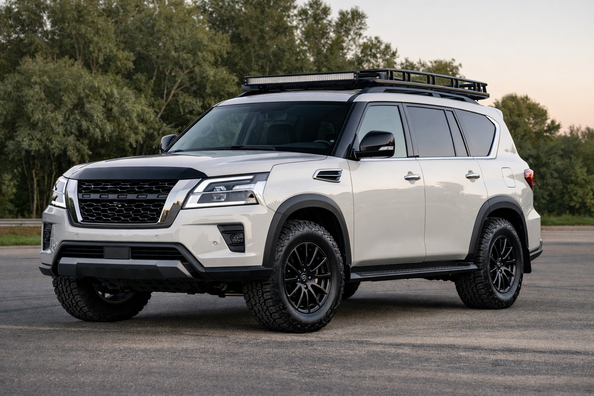
This upgrade plan is for a Nissan Patrol Y62 owner who isn’t planning to change cars anytime soon and wants to understand whether it’s worth moving the vehicle to a newer visual style. The key here is not to make it “look like a new one”, but to avoid spending the budget on cosmetics where you first need to resolve bodywork, protection, tires, or sensor compatibility.
For the Y62, the healthiest starting point is the factory Patrol 2020 style: a different front end, different headlight graphics, an updated rear, and a fresher perception of the vehicle without trying to pretend it’s a different generation. Chasing the Y63 look is already a story about a very expensive and not always convincing project, because it’s essentially a different generation with different body logic and equipment.
A Y62 restyle makes sense when the body is straight, the car doesn’t look like a candidate for hiding accident traces, and the owner wants to visually refresh the vehicle for a few more years. The right goal of such an upgrade is to make the Patrol look more modern without worsening geometry, parking sensor operation, access to towing equipment, and normal use off the asphalt.
If the scenario is different—sand, dirt, towing, expedition load—then a newer front end by itself adds almost no benefit. In that case, the restyle is only a final touch, not the foundation of the build.
Start not with bumpers and headlights, but with a sober base check: condition of the front-end mounts, panel gaps, sensor operation, presence of a tow bar, condition of the lower body. If the car already has signs of sloppy repairs, a restyle will only mask the problem for a while, but won’t make the vehicle better.
Next, the priority depends on the scenario. For real off-asphalt driving, underbody protection should come first, along with more appropriate tires and wheels with a taller sidewall, plus a careful front and rear bumper solution so you don’t lose capability. For a city Patrol that you simply want to freshen up, the top priorities are still body geometry and compatibility of lighting and sensors—not decor.
| Modification | Why it’s needed | Who it truly benefits |
|---|---|---|
| Underbody protection | Reduces the risk of damage on dirt, rocks, sand, and during long trips | Those who actually leave the asphalt, go hunting, fishing, on expeditions |
| Tires and wheels with a sensible profile | Improve wheel durability, control on uneven surfaces, and practicality under load | Owners who drive beyond the city and don’t want to risk cheap decorative wheels |
| Front and rear bumper correction | Provides proper geometry for outings and prepares the vehicle for further changes without unnecessary conflicts | Those who go off-road or have already hit the bumper where the vehicle could still keep going |
| Suspension for real load | Needed not for looks, but when weight appears: equipment, trailer, or regular long routes | Those who already understand their mass, driving style, and version specifics—especially if the vehicle isn’t in standard configuration |
| Front-end restyle in the 2020 style | Refreshes the exterior and increases the feeling of the vehicle’s “freshness” | Those whose technical base is in order and who keep the Y62 long-term specifically as a big road-going SUV |
| Multimedia upgrade | Makes daily use more convenient without a mandatory full interior rebuild | Those who drive city and highway daily and feel the interior is aging faster than the body |
DD Tuning expert comment: the most typical mistake with the Y62 is buying an exterior kit before checking the condition of the front end, mounts, and sensor compatibility. The second mistake is installing suspension blindly without understanding whether the car will be driven empty, with cargo, or with a trailer. For versions with HBMC this is especially critical: you can’t pick parts “based on internet advice” without tying them to a specific configuration.
The second stage starts when basic practicality no longer suffers. If the vehicle gets heavier due to a roof rack, extra equipment, or regular towing, then you can move on to suspension. But it’s better to do this after a few real trips or a season of use—not immediately after purchase. On the Y62 this is especially important because different versions respond differently to load, and configurations with HBMC require a separate approach.
If the vehicle remains primarily road-focused, it’s more logical as a second stage to install a multimedia upgrade, improve lighting, or add neat body elements in the 2020 style. This delivers a noticeable daily effect and doesn’t interfere with the power/structural part of the project.
This is where things begin that don’t make the Patrol more capable or durable, but change how the vehicle is perceived. This includes multimedia, interior trim pieces, decorative exterior elements, rear bumper protectors, side steps for easier entry, small front-end details. All of this only makes sense after it’s clear that the base mechanicals and body are in good shape.
If you want a truly “newer Patrol”, what works best is not an excess of decor but a coherent logic: a 2020-style front end, clean optics, a refreshed interior without visual noise. When the vehicle is simultaneously made to resemble 2020 and 2024 and then random chrome is added, the result almost always looks cheaper than a stock Y62.
First—cheap restyle kits as a way to hide a tired or damaged front end. It’s a short-term solution: over time you’ll see gaps, paint mismatch, mounting and wiring issues. Second—copying the Y63 onto a Y62. It rarely looks convincing, and costs as if you’re already building a separate show project.
Third—large decorative wheels with low-profile tires for a vehicle that leaves the asphalt. Fourth—a loud exhaust, which on a daily vehicle and under towing often gets annoying faster than it pleases. Fifth—suspension bought before it became clear how much the vehicle actually weighs and how it’s driven.
| Scenario | What to install first | What can be postponed | What is not mandatory |
|---|---|---|---|
| I only want to freshen up the look and I drive in the city | Check the body, mounts, sensors, front-end condition; only then restyle | Multimedia, small interior decor, rear elements | Suspension, heavy-duty solutions, aggressive exterior tuning |
| There are trips to sand, dirt, the cottage | Protection, tires, a practical bumper or its correction | Front-end restyle, lighting, multimedia upgrades | Chrome, decorative tips, excessively expensive facade elements |
| There’s a trailer, cargo, long trips | Assess load, tires, basic technical preparation, only then suspension | Cosmetic restyle and interior small items | Loud exhaust, copying another generation, random exterior accessories |
A more expensive restyle is justified in three cases: the body is alive and straight, you’re keeping the vehicle for a long time, and you need not just a “body kit” but a neat result without a homemade-conversion feel. Then it makes sense to look not at scattered decorative pieces, but at a logical kit: 2020 restyle kit, separately check the radiator grille and, if needed, select front headlights.
But more expensive doesn’t automatically mean more correct. If the vehicle often sees dirt, has a tow bar, or depends on correct sensor operation, first calculate not the price of parts but the full cost of installation, painting, fitment, and resolving small conflicts. This is exactly where many projects become unprofitable.
From a customer’s experience: a Y62 owner wanted to make the vehicle “almost like new”, but after inspection it turned out the biggest irritations were not the old shapes, but tired tires, a scratched lower bumper, and an outdated interior interface. In the end, he first put the practical part in order and only then moved to a neat front-end update in the 2020 style. The result worked precisely because the vehicle started to look fresher and drive more logically for his scenario.
Restyling the Nissan Patrol Y62 to a newer style makes sense when the vehicle is mechanically and structurally healthy, you’re not trying to mask problems, and you clearly understand that what you need is a visual update. If the priority is off-road driving, towing, or heavy load, invest first in protection, tires, bumpers—and only then in appearance. The smartest reference point for such a project is the factory Patrol 2020 logic, not an attempt to turn a Y62 into another generation. This material is based on real selection experience, practice, and real usage scenarios—not an abstract list of “trendy” mods.
| ✔ | The Patrol 2020-style restyling really refreshes the look of the Y62 without trying to imitate a different generation. For a healthy body, it gives the car a more modern appearance for several years ahead. |
| ✔ | Such an upgrade can be done in stages: first check the body, mounts, and sensors, and only then move on to the body kit or headlights. This reduces the risk of spending money on cosmetics that won’t solve the basic problems. |
| ✔ | If the car is used daily in the city or on the highway, multimedia and lighting can be improved alongside the restyling. This gives a noticeable practical effect without вмешання in the powertrain of the project. |
| ✔ | For a car that is planned to be kept for a long time, a neat 2020-style kit looks more logical than random decorative modifications. This approach better preserves the cohesive look of the Patrol. |
| ✘ | If the body has signs of careless repairs or problems with the mounts, the restyling will only hide them for a while. In such a case, the money spent on appearance will not give a real improvement in the car’s condition. |
| ✘ | For cars that often drive on dirt, sand, or are used with a trailer, a newer front end adds almost no benefit. Protection, tires, bumpers, and suspension for load are more important here. |
| ✘ | Copying the Y63 style onto the Y62 looks like an expensive and not always convincing solution. For this money, you often get a project with questionable body logic and fitment. |
| ✘ | Cheap restyling kits or large decorative low-profile wheels can create new problems with gaps, electrics, or off-road usability. The author directly calls such purchases often wasted money. |
Shipping to EU
Wholesale and retail
Own warehouse
Опис продукту
Подарунки не надаються при оформленні покупки у кредит під 0,01% або при покупці частинами.