06.05.2026
416
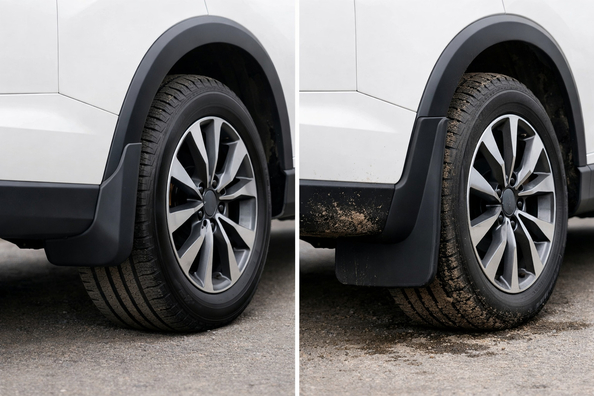
If the car runs on stock wheels, spends most of its time in the city and on the highway, and you care about precise fitment and a factory look, OEM mud flaps usually win. A different format is worth considering when the car often drives through snow, slush, gravel, has wider tires, a different wheel offset, or simply needs more side coverage.
The main mistake here is simple: comparing only “original” and “non-original.” In reality, what matters is installation, clearance to the wheel, winter behavior, material durability, everyday practicality, and the real price once modifications are factored in.
The point isn’t which option is “better overall,” but what exactly you want to get. An OEM set gives predictable compatibility, clean geometry, and minimal visual conflict with the body. But that doesn’t always mean the best protection: a shorter, stiffer piece can lose out in snow, slush, and on gravel.
By “another format,” people usually mean three different things: precise aftermarket sets for a specific model, flexible extended flaps, and universal solutions for custom installation. Each has its own balance of fitment, coverage, lifespan, and the number of compromises.
| Option | Strengths | Weaknesses | Best for |
|---|---|---|---|
| OEM mud flaps | Precise fit, factory look, predictable compatibility on stock wheels | Not always maximum protection, sometimes requires drilling, possible reduction in ground clearance | Those who want a tidy solution without surprises on a standard car setup |
| Model-specific aftermarket without drilling | Installs into factory points, neat geometry, less interference with the body | Often tied to stock tires and wheels, more expensive than universal | Those who want a clean install and don’t want to drill |
| Flexible extended | More side coverage, better in snow, slush, and on gravel, better impact resistance | Less factory look, you must carefully set height and setback | Those who often drive in winter, mud, ruts, or have wider wheels |
| Universal | Lower entry budget, can be adapted to a non-standard task | Custom installation, higher risk of misalignment, rubbing, and extra modifications | Those ready to fit and tweak for savings or a specific setup |
DD Tuning expert comment: Most often, owners make mistakes when they look only at the mud flap’s shape and don’t cross-check tire size, wheel offset, and full steering lock. In practice, this is exactly where squeaks, tire contact, and unnecessary rework appear. If the car is no longer in a stock configuration, checking clearances is more important than the brand name.
OEM mud flaps. This is the easiest path when you want precise geometry and an exterior look without a “tuned” feel. They make sense on cars with stock wheels, without a lift or lowering, when minimal mounting risk and predictable compatibility matter. But you still need to check the specific kit: OEM doesn’t always mean installation without drilling.
Model-specific aftermarket sets. This is a solid compromise between a clean fit and less interference with the body. They’re appealing to those who don’t want new holes but also don’t want to live with a universal shape. There’s one weak point: these kits are often designed around the stock wheel setup, so after changing wheels or tires you may run into clearance questions.
Flexible extended flaps. This is a choice driven not by “looks,” but by real driving conditions. If winter means constant slush in the wheel wells, if gravel flies, if you need to better protect the rocker panel and the lower part of the doors, a longer flexible piece is more practical. It’s also more often justified on cars with wider tires, different offset, or on roads where a short rigid mud flap starts to fall short.
Universal options. This isn’t for everyone—it’s for those who understand they’re buying a blank, not a ready-made fit. They can help when you need a non-standard length or a budget solution, but without templates, brackets, and proper test fitting, it’s easy to end up with misalignment, extra holes, and rubbing at full lock.
For a standard city car with no changes to the wheels, the OEM format is usually enough. It doesn’t require unnecessary compromises in appearance, and the level of protection from water, dirt, and small stones in typical city use is generally fine.
If the car often drives in winter, through ruts, slush, or gravel sections, the logic changes. Here, what matters more than neat integration into the body is material flexibility and a larger coverage area. That’s why longer flexible options are often more practical, even if they look less “OEM.”
If you want a tidy install without drilling but don’t want to go full OEM, look at model-specific aftermarket kits. But for cars with non-standard wheels, different wheel offset, or a changed suspension height, an honest answer is only possible after checking the actual clearances.
| Scenario | Best choice | Why |
|---|---|---|
| City, stock wheels, normal driving | OEM mud flaps | Provide sufficient protection without extra modifications and best preserve the factory look |
| Highway and rainy weather, but no off-road | OEM or model-specific aftermarket | Clean fitment and stability matter here, not maximum length |
| Winter, slush, frequent snow buildup | Flexible extended | Less chance of hard ice buildup and more protection for the body’s sides |
| Gravel, country roads, mud | Flexible extended | Better coverage and higher resistance to impacts and deformation |
| Wider tires or different wheel offset | Flexible or custom-selected model-specific | The OEM format may not provide the clearance and coverage you need |
| Minimum budget and willingness to fit | Universal | You can save money, but only if you’re ready for custom installation |
A more expensive option is justified not when you simply want “the best,” but when a mistake will cost more. If precise fitment, preserving the factory look, and minimal compatibility risk matter, paying extra for original mud flaps is often logical. If appearance is secondary to protection in harsh conditions, the more expensive choice may be a flexible or model-specific kit that saves you from rework and rubbing.
To avoid paying twice, compare not just a single product but the solution format: check the overall mud flaps catalog and separately assess universal options if you have a non-standard setup or need extra length. A pricier solution makes sense when it removes a specific risk: drilling, poor compatibility, weak coverage, or fast wear in tough conditions.
From a customer’s experience: The owner of a crossover with a stock suspension first chose a short kit for a tidy look, but in winter on country roads he got snow buildup and dirty rocker panels. After switching to a longer flexible format, protection became noticeably better and ice catching decreased. In the end, it wasn’t a “more expensive brand” that worked—it was the right choice for real driving conditions.
OEM mud flaps are better when you need precise fitment, a factory look, and predictable compatibility on a standard vehicle. A different format is worth looking for when the car often sees snow, slush, gravel, has non-standard wheels, or needs more side protection than a short OEM piece provides.
The smartest order is: first evaluate your wheels, ground clearance, mounting type, and the roads you drive on—then look at shape and price. This material is based on real selection experience, installation practice, and real-world use cases, so the main takeaway is simple: don’t look for the “best mud flap overall,” look for the format that won’t force you to redo your purchase a week later.
| ✔ | OEM mud flaps fit a standard car with factory wheels well: they provide a precise fit, predictable compatibility, and do not spoil the factory look. For city and highway use, this is usually enough. |
| ✔ | Exact aftermarket kits can be a compromise between a neat installation and no drilling. This is convenient when you want a clean fit without unnecessary bodywork modifications. |
| ✔ | Flexible extended flaps are more practical for winter, slush, gravel, and dirt. They better cover the side of the body and are more resistant to impacts from ice and stones. |
| ✔ | For cars with wider tires or a different wheel offset, another format often provides the needed clearance and coverage where the OEM option may no longer fit. This reduces the risk of rubbing and noise in the wheel arches. |
| ✔ | Universal options are useful when you need a budget or non-standard solution. They can be adapted to a specific task if you are ready for fitting. |
| ✘ | OEM mud flaps do not always provide maximum protection, especially in snow, slush, or on gravel. A short and rigid element may offer less coverage. |
| ✘ | Even an OEM kit does not guarantee easy installation without drilling. The mounting method can vary across different OEM solutions. |
| ✘ | Universal mud flaps often require trimming, brackets, and careful test fitting. This increases the risk of misalignment, rubbing, and extra modifications. |
| ✘ | Longer or more flexible options may look less factory-like and require precise height and offset adjustment. Also, after installation, ground clearance may drop slightly. |
Shipping to EU
Wholesale and retail
Own warehouse
Опис продукту
Подарунки не надаються при оформленні покупки у кредит під 0,01% або при покупці частинами.