26.07.2026
498
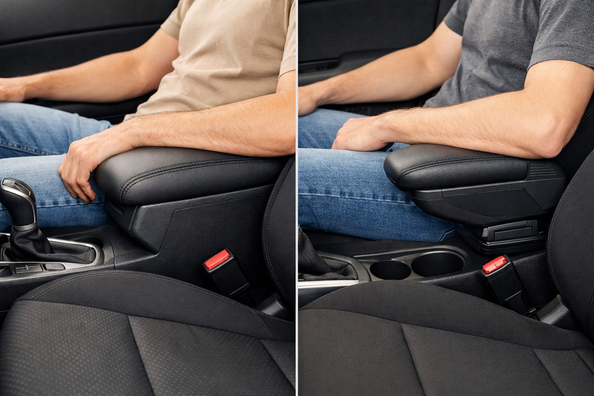

If your car lives in the city every day, a vehicle-specific armrest usually turns out to be more convenient. It fits the interior more precisely, rubs against the seats less often, changes your seating position less, and is less likely to develop play or start tapping over bumps.
A universal armrest is worth considering when a lower starting price matters more, you want the option to move the armrest to another car, or you need extra features like a sliding lid, a cup holder, or USB ports. But in city driving, these solutions depend most on accurate measurements and mounting rigidity.
The difference isn’t only whether the armrest is “for your car.” A vehicle-specific option is designed around the exact geometry of the console, seats, and driver position. A universal one is adapted through adjustments, so it can work well, but it almost always requires more checks before purchase.
In the city this is especially important because your hand often moves from the steering wheel to the selector, handbrake, buttons, or phone pocket. If the armrest is too large, too high, or offset, it starts to annoy faster than it helps.
Separately, check the support height for your elbow. Even if the width between the seats fits, an armrest that’s too high changes your arm angle, and one that’s too low becomes just a box between the seats with no real benefit.
| Option | Strengths | Weaknesses | Who it suits |
|---|---|---|---|
| Vehicle-specific | Precise fit, better interior compatibility, fewer chances of rubbing and play, more familiar city ergonomics | Usually more expensive, sometimes not a 10-minute install, some kits have more complex installation than it seems | Those who drive daily, are sensitive to noise, and want results without compromises in seating position |
| Universal | Lower budget, can be moved to another car, often includes a sliding lid, compartment, cup holder, USB | Highly dependent on measurements, may interfere with the handbrake or gearbox, play and tapping appear more often | Those for whom price, flexibility, or extra features matter more than maximum integration into the interior |
DD Tuning expert comment: the most common mistake is measuring only the distance between the seats and not checking elbow height and handbrake travel. The second typical story is when someone buys a universal armrest with lots of options, but after a week starts looking for ways to eliminate play and squeaks. If the car is a daily city car, geometry and mounting rigidity matter more than extra small features.
Its main advantage in the city is predictability. If the solution is made specifically for your interior, it usually hits the right height better and doesn’t conflict with the seats or console. That’s why a vehicle-specific option more often looks like an OEM part rather than a separate accessory that was simply placed between the seats.
The weak points are price and installation. Some kits are sold in parts, so the final budget grows. Also, “vehicle-specific” doesn’t always mean easy: there are versions where you need to remove console elements, mark holes, and tighten fasteners to a specific torque. If you have a manual gearbox or a tight cabin, the vehicle-specific format more often delivers the right ergonomics, but you need to approach installation carefully.
The strong side of a universal solution is flexibility. These models often have adjustable mounting, and on some products the lid also slides forward to fine-tune forearm support. For a calm city car with an automatic and a wide tunnel, this can be enough—especially if you also want a small storage compartment.
But this is where everything depends most on measurements. Even if the mount technically fits within the range between the seats, the armrest may turn out too high, too wide, or shifted rearward. Then it starts rubbing the seat bolsters, interfering with the handbrake, catching your elbow during gear changes, and loosening faster. The service life of a universal option depends especially on hinge quality and base stiffness.
For daily city driving with frequent stops, parking, and maneuvers, a vehicle-specific armrest works better. It interferes less with the driver’s habits and doesn’t require you to constantly adjust your arm position or work around it with your elbow.
A universal armrest makes sense when the car is temporary, the budget is limited, or you need not so much an arm support as extra space for small items. It also makes sense if you knowingly accept the need to test-fit, verify geometry, and don’t expect OEM-level integration.
On the highway, both options can be useful, but the deciding factor there is not the mere presence of an armrest, but mounting stability. If it moves even slightly or squeaks, on a long trip it becomes more irritating than in the city.
| Scenario | What to choose | Why |
|---|---|---|
| Compact car, manual gearbox, active city driving | Vehicle-specific | Less chance the armrest will interfere with shifting and the handbrake |
| Crossover or sedan with an automatic, wide tunnel | Universal or vehicle-specific | If the interior geometry allows, a universal can deliver decent comfort without a big budget |
| Need to move the accessory between cars | Universal | A vehicle-specific one is tied to a particular interior; a universal is more flexible |
| Daily trips, sensitive to squeaks and play | Vehicle-specific | Holds better, less likely to start tapping over bumps |
| Need extra options: compartment, cup holder, USB | Universal | This segment usually offers more of these features |
| Don’t want to drill or intervene in the interior | Universal | Some vehicle-specific kits require more complex installation |
A more expensive armrest makes sense when the car will stay with you for a long time, you drive every day, and even small cabin noises annoy you. In those conditions, a better fit, stiffer mounting, and correct height pay off not in “premium feel,” but in the fact that you don’t have to tolerate or rework the accessory.
It’s best to start with the armrest catalog to understand the difference between formats. If you need extra functions, look at the universal armrest with USB. If your priority is rigid mounting for a specific interior, a good example is the vehicle-specific armrest mounted to the seat rail.
Overpaying isn’t always justified. If you need an armrest mostly for occasional highway trips or you’ll be changing cars soon, a well-chosen universal option can be a smarter investment.
From a customer’s experience: the owner of a compact hatchback initially wanted a universal armrest with a compartment because the price was lower. After measuring, it turned out that with his seating position this option blocks the handbrake and gets in the way with a manual transmission. In the end, he chose a vehicle-specific mount, and after a few weeks the main advantage he named wasn’t the look, but the quietness over bumps and the familiar seating position in daily city driving.
For the city, the basic advice is simple: if there’s a good vehicle-specific armrest for your car and you’re okay with the budget and installation, it’s usually the more comfortable option. It works better with the interior, makes noise less often, and interferes less in everyday maneuvers.
A universal one makes sense when price, flexibility, or extra functions matter more—but only after accurate measurements and a clear understanding of how exactly it will sit between the seats. This material is based on real selection experience, installation practice, and real usage scenarios—not on nice descriptions in a product card.
| ✔ | A model-specific armrest usually fits the interior more precisely and matches the height better, so it interferes less during everyday city maneuvers. It also rubs against the seat less often and is less likely to develop play or rattling on rough roads. |
| ✔ | A universal option is usually cheaper upfront, so it’s easier to choose when the budget is limited. This is convenient if you need basic comfort without big expenses. |
| ✔ | A universal armrest can be moved to another car, so it is more flexible for a temporary vehicle or when changing cars. For those who do not want to tie the accessory to one interior, this is a practical advantage. |
| ✔ | Many universal models also have extra features such as a sliding lid, cup holder, small storage compartment, or USB. This is useful if the armrest is meant to do more than just support the arm. |
| ✔ | A model-specific armrest usually matches the console geometry and driving position better, so it conflicts less with the handbrake, gear lever, and seat adjustment. In a compact car, this is especially noticeable. |
| ✘ | A model-specific armrest is often more expensive, and the final cost may rise because of separate parts and more complicated installation. In other words, it is not a cheap solution even when it looks simple. |
| ✘ | A universal armrest depends heavily on exact measurements: if it is too high, shifted, or too wide, it starts to interfere with the arm, handbrake, or gear shifting. In the city, such shortcomings quickly become annoying. |
| ✘ | Universal models more often have mounting rigidity issues, which can lead to rattling or minor play on speed bumps and cobblestones. For everyday city driving, this is a noticeable drawback. |
| ✘ | Even a model-specific armrest is not always hassle-free to install: sometimes you need to remove console parts, drill, or precisely fit the bracket. So before buying, it is worth considering not only compatibility but also installation difficulty. |
Shipping to EU
Wholesale and retail
Own warehouse
Опис продукту
Подарунки не надаються при оформленні покупки у кредит під 0,01% або при покупці частинами.