
 Author: Radomskyi Maksym Vasyliovych
In winter, three things come together on exhaust tips and the rear diffuser: condensation from the exhaust, road salt, and soot. Water dripping from the pipe in freezing weather is a normal combustion byproduct, but on short trips it stays inside the muffler and eats it away from the inside. Salty spray leaves rusty “tea stains” on stainless steel, and soot sticks to the diffuser’s damp plastic. All of this can be removed with a gentle wash without abrasives or acids — step by step below, based on what material manufacturers say.
Contents
- Why water drips from the exhaust pipe in winter
- How short trips harm the muffler
- Why rusty spots appear on stainless exhaust tips
- How to wash soot off tips and the diffuser
- Will exhaust heat damage a plastic diffuser
- What to check on tips and the diffuser before winter
Why water drips from the exhaust pipe in winter
When fuel burns, water vapor is produced. While the exhaust system is cold, the vapor condenses on its walls and comes out as drops from the pipe, and in freezing weather — also as a thick white “cloud.” This is normal and most noticeable right after a cold start. The warning signs are different: a sweetish smell and persistent thick white smoke on a warmed-up engine can indicate coolant getting in — that is a job for a service shop, not a car wash.
For exhaust tuning, what matters is something else: this water, together with soot, comes out right onto the tip and the lower part of the bumper. That is why in winter the tips and diffuser get dirty faster than in summer, and dried streaks are especially visible on black gloss.
How short trips harm the muffler
The technical journal for auto mechanics Professional Motor Mechanic explains: internal rust in mufflers appears from contact with water, chemicals, and deposits that form when exhaust gases condense in a cold system. Cars that only drive short distances suffer the most: the exhaust never warms up to the temperature at which the water accumulated inside fully evaporates. From the outside, corrosion is accelerated by water and the salt used to treat roads in winter.
Practical takeaway: if in winter your car only does a few kilometers a day, once every week or two give it a longer drive so the exhaust can warm up fully. A stainless-steel tip will not save you from internal muffler rust — it is only a decorative end piece on the pipe.
Why rusty spots appear on stainless exhaust tips
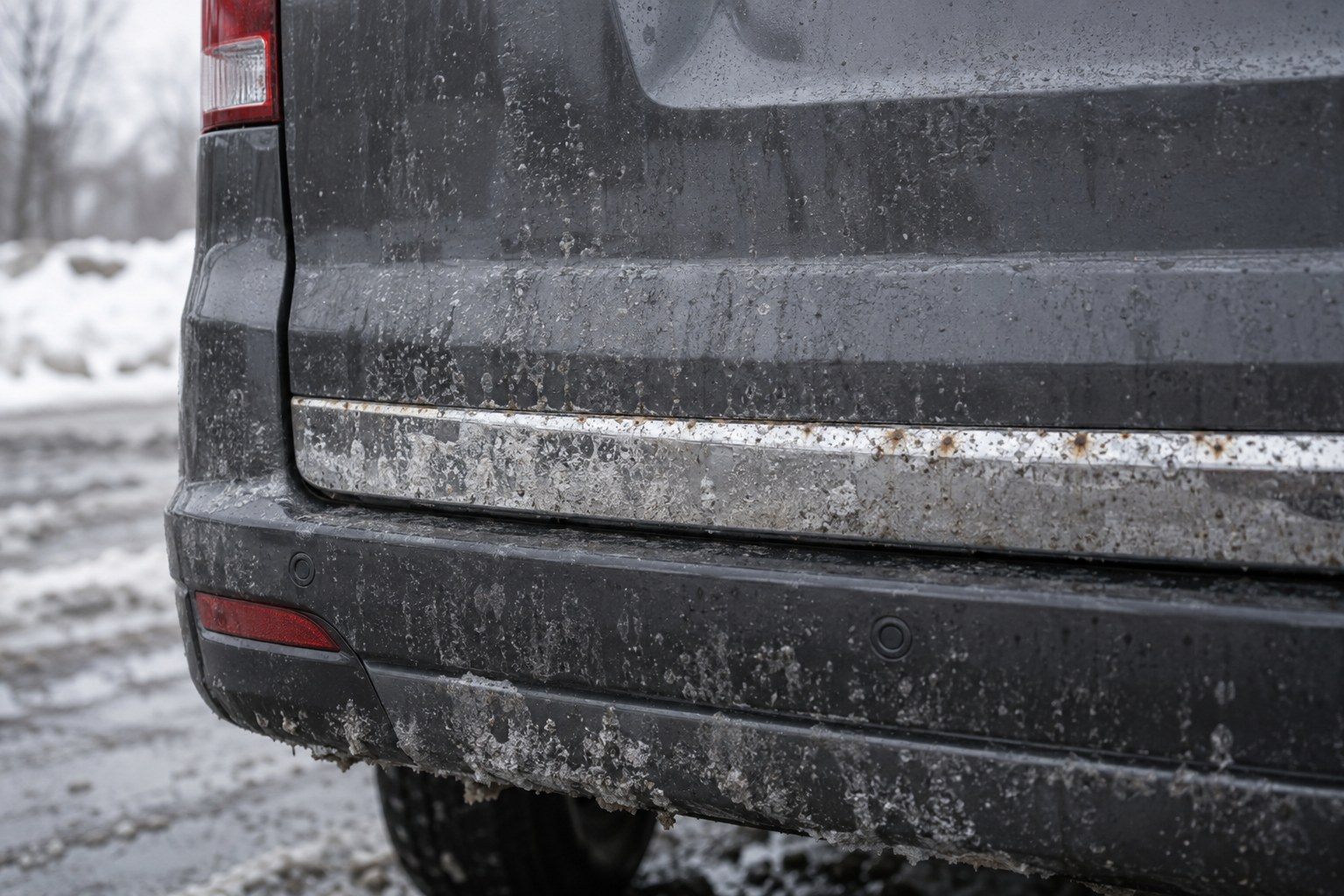
Most tips in our catalog are made of stainless steel, and it really does not rot like ordinary metal. But “stainless” does not mean “won’t stain.” The Australian Stainless Steel Development Association (ASSDA) describes so-called “tea staining” — a rusty or brown discoloration caused by chlorides. It is a cosmetic defect, and it shows up more strongly in gaps, corners, and areas that rain does not wash, while a rougher surface holds salts longer than a polished one. Sodium chloride from road salt acts the same way as sea air.
What ASSDA and the British Stainless Steel Association recommend:
- wash with warm water and a mild detergent and обязательно rinse;
- for spots and light rusty film — a non-abrasive stainless-steel paste;
- do not use abrasive pads, chloride-containing products, or bleach, and never use hydrochloric acid: it leaves dull marks and pitting on the surface.
If a tip is black, it is also steel, but with a coating, so abrasives and aggressive cleaners damage it even faster — only gentle washing. In conversations with customers, we also see: inexpensive universal tips are sometimes not stainless, and those are exactly the ones that rust and peel within a year or two. The material is always listed in the product specifications. More on caring for stainless steel in winter — in the article “Bull bar in winter: salt, corrosion, and stainless-steel care”.
How to wash soot off tips and the diffuser
Soot is carbon from exhaust gases that settles on the edge of the tip and on the diffuser around the cutouts for the pipes. On a surface damp from condensation, it sticks faster, and mixed with salt it forms a gray crust. The order is as follows:
- Let the exhaust cool down — do not wash a hot tip with cold water and do not touch it with bare hands.
- First soak and rinse off sand and salt with water so you do not rub them across the surface.
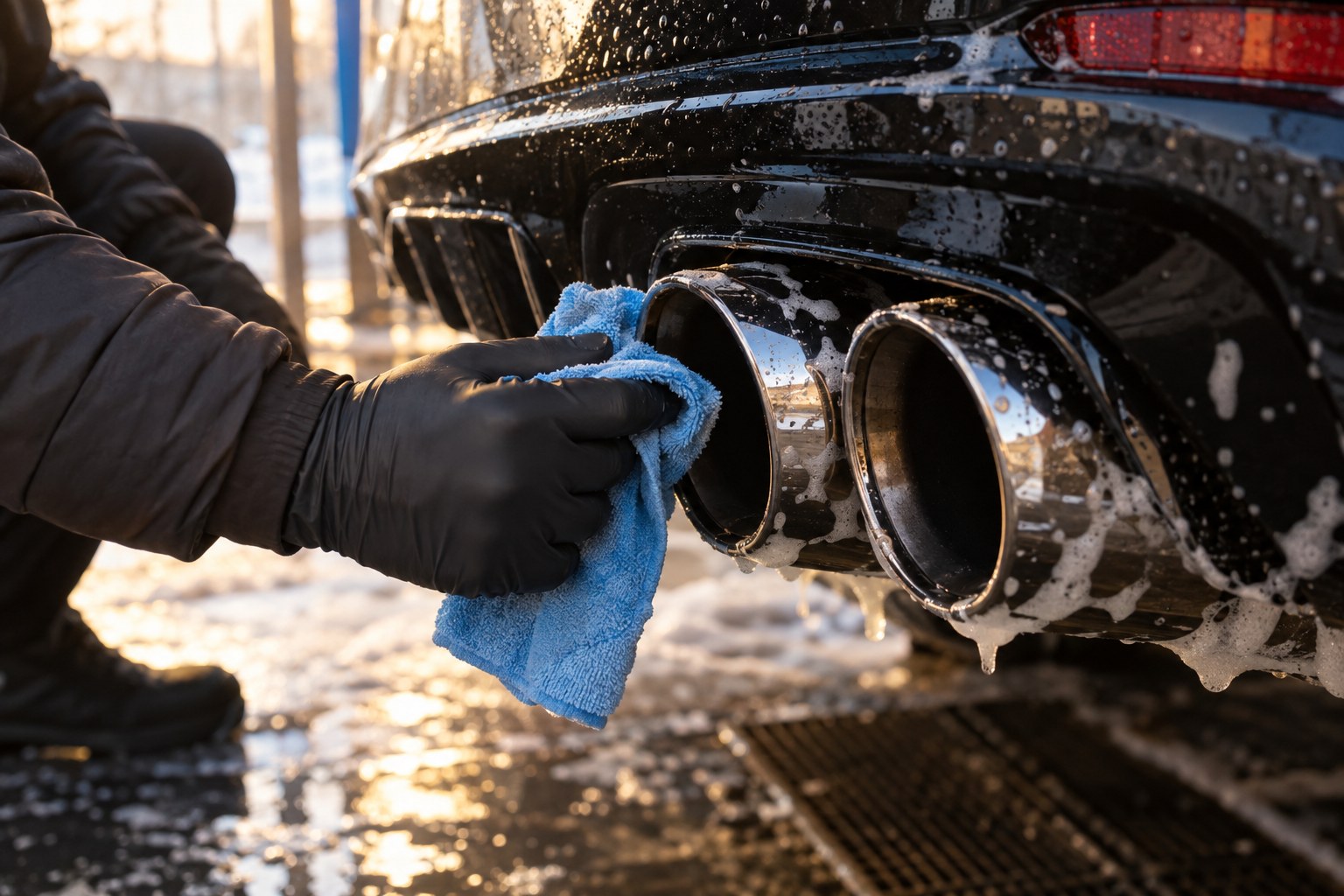
- Apply a mild car shampoo, wipe with microfiber or a soft brush, rinse.
- Remove remaining soot on stainless steel with a non-abrasive stainless-steel paste; on the diffuser’s plastic — only shampoo and microfiber.
- Wipe dry: drops with dissolved salt leave streaks on gloss.
General rules for winter washing of tuning parts — in the article “Car wash in winter and tuning”.
Will exhaust heat damage a plastic diffuser
DPT model-specific diffusers and most diffuser-with-tip sets in the catalog are made of ABS plastic — as stated on their product pages. Reference data for ABS: operating range approximately from −20 to +80 °C, glass transition temperature around +105 °C, and with prolonged UV exposure and overheating it yellows and becomes brittle. That is why the critical thing for a diffuser is the clearance to the exhaust pipe: the plastic must not touch the pipe and must not sit directly in the stream of hot gases.
The tips integrated into a plastic diffuser can be real outlets, or they can be a decorative imitation that gases do not pass through. Before buying, find out which design the chosen diffuser has, and whether it will fit your exhaust: single, dual, with outlets on both sides. We covered how to install a diffuser correctly in the article “How to properly install a diffuser on a BMW”.
What to check on tips and the diffuser before winter
| What to check | Why |
|---|---|
| Tip mounting (clamp, fastener, bolts) | In winter the exhaust heats up and cools down every day; a loosened tip rattles and can get lost |
| Clearance between the tip and the bumper or diffuser cutout | The plastic must not touch the hot pipe |
| Diffuser adhesive seam | DPT model-specific diffusers are installed with automotive glass adhesive-sealant; a detached edge draws in salty water |
| Chips and scratches on a coated tip | Through a chip, salt reaches the metal faster |
| Parking sensor holes near the diffuser | The diffuser and spray from the wheels must not block the sensors |
Model-specific tips for BMW and Mercedes are in the muffler tips section, rear diffusers, including ones with tips for dual exhaust, are in the rear diffusers section. What a tip on the pipe gives you in general, we wrote about in the piece “Car muffler tips: importance, function, and choosing”.
We deliver via Nova Poshta across all of Ukraine.
How it works
- Let the exhaust cool down Wash the tips and diffuser only after the pipe has cooled down: on hot metal, shampoo dries in spots, and a sudden temperature change damages the coating.
- Rinse off salt and sand with water First, soak and rinse off the dirt thoroughly so you don’t rub sand and salt crystals across the stainless steel and glossy plastic.
- Wash with a gentle cleaner Apply car shampoo, wipe with microfiber or a soft brush, and rinse with clean water.
- Remove stains from stainless steel Wipe off rust-colored tea stains and soot residue on the stainless steel tip with a non-abrasive stainless steel paste, then rinse once more.
- Dry the surface Wipe the tips and diffuser dry so drops with dissolved salt don’t leave streaks.
- Inspect the fasteners and seam Check whether the tip clamp is loose, whether the pipe touches the plastic, and whether the edge of the diffuser has come unstuck.