Bull bar in winter: salt, corrosion and stainless care

A stainless bull bar won’t rot through in a single winter, but over the season road salt and de-icing chemicals can cover it with rusty specks—especially near welds, clamps, and brackets. For the bar to get through winter without stains or “seized” bolts, three things are enough: rinse off salt regularly, wipe it dry, and inspect the mounting points once before the season. There’s no need to remove the bull bar for winter.
Contents
- In short
- Why a stainless bull bar gets rusty spots
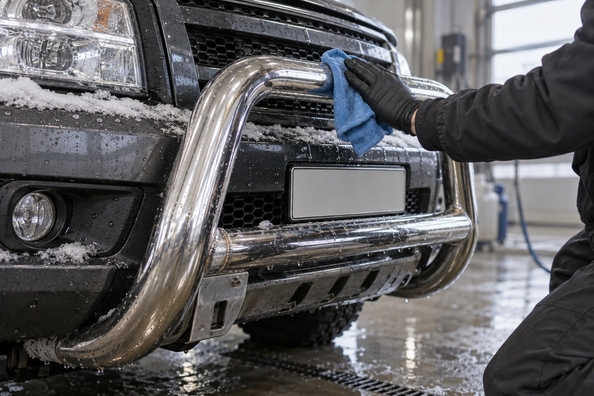
- How to wash a bull bar in winter
- What to do about mounts and bolts
- Does the bar interfere with parking sensors in winter?
- Black bars: what changes
- Should you remove the bull bar for winter?
In short
- Stainless steel won’t rust through, but from salt it can develop reddish “tea stains”—a cosmetic defect that can be washed off at an early stage.
- The most vulnerable areas are welds, tube joints, lamp clamps, and brackets: salt lingers there the longest.
- The weak point isn’t the bar but the mounting hardware: the bolts and the points on the body or frame where salt and moisture sit under the bracket.
- Black bars are maintained like a painted part: the key is touching up chips in time.
- No need to remove it for winter—there’s more harm from repeatedly undoing the fasteners than benefit.
Why a stainless bull bar gets rusty spots
Most bull bars in our bull bar catalog are vehicle-specific CAN (Turkey) stainless-steel bars that mount to factory points. Stainless steel is protected by a thin chromium-oxide film on the surface. De-icing mixtures are chlorides (technical road salt, calcium and magnesium chlorides), and chlorides are exactly what locally break down this film. Where salty solution dries and gets wet again for weeks, reddish specks appear—stainless specialists call them “tea stains.” They don’t reduce the bar’s strength, but they spoil the look and, if left untouched for months, can leave tiny pits on the surface.
A bull bar has its own “hot spots” that flat chrome trims don’t:
- Welds. During welding, the metal next to the seam heats up, and the protective layer there is weaker than on the rest of the tube. That’s why rusty specks usually show up near welds first.
- Joints, crossbars, and the plate with the lettering. In gaps, salt with moisture sits longer than on an open tube, and rain doesn’t rinse them out.
- The underside of the tubes and the lower bar. This is where salty slush from the vehicle ahead gets thrown.
- Lamp clamps and additional parts. Metal dust and particles of ordinary steel that settle on stainless can rust on their own and leave a reddish trace even though the bar underneath is intact.
We covered in detail how salt damages stainless and chrome-plated plastic in the article does salt ruin chrome trims—here we’ll focus on what relates specifically to the bar.
How to wash a bull bar in winter
You can and should wash your car in winter; the only question is how (more details in the article can you wash a car in winter). For a bull bar, the rules are:
- Water first, sponge second. Rinse off salt and sand with a jet first, and only then touch the bar: salt crystals scratch polished metal, and a scratch holds salt even better.
- Neutral car shampoo and warm water. That’s enough for stainless; then rinse with clean water.
- Rinse everything that’s usually overlooked: seams, tube joints, the space behind the lettering plate, the underside of the bar, and the places where it comes close to the bumper.
- Wipe dry with microfiber. Drops that dry on their own leave stains, and in freezing weather they turn to ice in gaps.
- Consistency matters more than perfection: roughly once every two weeks, and more often after heavily salted roads.
If specks have already appeared, remove them with a non-abrasive stainless polishing paste and a soft cloth, then rinse and wipe dry. What you must not use to clean a stainless bar: a metal scouring pad and abrasive powders; chlorine products and bleach; and acidic cleaners based on hydrochloric acid—it can leave stains itself and trigger deeper corrosion. General stainless-care rules are collected in the article how to care for stainless-steel tuning parts.
Before the de-icer season, wash and degrease the bar and apply wax or a polymer sealant: salt solution won’t cling as well to the surface, and grime will rinse off more easily later. Renew the coating according to the product instructions.
What to do about mounts and bolts
A vehicle-specific bar is fastened with brackets and bolts into factory points—under the bumper, on the frame, or on the longitudinal members. This is exactly where most winter problems occur: under the bracket, salt and moisture can sit for weeks, and where a stainless part is tightly pressed against ordinary steel of the body or frame, corrosion in salty water progresses faster than on exposed metal.
- Inspect the mounts before winter and in spring. A rusty streak under a bracket or a paint bubble nearby is a reason to remove the mount, clean it up, and treat the metal while it’s still minor.
- Check tightness. A bar that “moves” slightly enlarges holes and damages the paint around them, letting salt get into the metal.
- Treat the threads. If you undo the fasteners, apply an anti-seize lubricant for stainless hardware—without copper: in salty environments, copper pastes next to stainless aren’t recommended. This way the bolts won’t seize up by spring.
- Protect the mounting points with a preservative. A wax-based anti-corrosion coating on the brackets and around them keeps salt away from the body metal.
The same spray also hits the side steps and bumper—how to protect them, we discussed in the articles how to protect side steps from salt and bumper and de-icers.
Does the bar interfere with parking sensors in winter?
A bull bar is selected so it doesn’t block the license plate, camera, or sensors, but in winter dirt gets added to the geometry. Ultrasonic parking sensors give false alerts when they’re covered with snow, slush, or a thin ice crust, and even a salt film—barely visible—prevents the sensor from “reading” an obstacle correctly. Snow packs especially easily between the bar and the bumper.
- After washing and before driving, wipe the sensors with a soft cloth—no scraper and no aggressive chemicals, so you don’t damage the sensor surface.
- Knock out snow packed between the tubes and the bumper: it covers the sensors and the plate.
- If the system beeps for no reason, first check sensor cleanliness, and then check whether the bar has shifted after hitting a snowbank.
Black bars: what changes
The catalog also includes black versions of the same models—for example, WT004 Black for Hyundai Tucson, the lower bar Shark Black for Mercedes Sprinter W907/W910, ST085 Black for Volkswagen Crafter. In these product pages the material is stainless steel and the color is black, meaning it’s stainless with a black coating. Caring for it is closer to caring for a painted part:
- The main enemy is chips. Sand and gravel chip the coating, and around a chip it can start peeling when salty water gets underneath. Touch up chips before freezes and in spring.
- No polishing pastes or abrasives—they wear through the coating. Only shampoo, water, and soft microfiber.
- Wipe dry: white salt residue is visible immediately on black, and it ruins the look more than on shiny stainless.
- Wax or sealant for painted surfaces makes rinsing off salt easier.
The advantage of a black bar is that the base under the coating is the same stainless steel, so a chip won’t turn into through-rust as it would on painted ordinary steel. But stains and peeling around the chip can still remain, so it’s worth sealing them in time.
Should you remove the bull bar for winter?
No. A stainless bar is designed for year-round use, and every removal means undoing bolts that may seize over the season, the risk of damaging paint and threads, and having to realign the bar by center and gaps. In winter, the bull bar also does a job: it protects the front end from snowbanks and branches on country roads. About who really needs a bar—see the article bull bar on a car: when it makes sense.
Removal only makes sense when the mounts already need servicing: cleaning and treating the points under the brackets. If you do that, it’s better in autumn, in a warm, dry space, with anti-seize on the threads. Rear bars and corner bars are maintained the same way; you can choose them in the rear bars section.
We deliver with Nova Poshta across Ukraine.
How it works
- Rinse off the salt with water
- First, rinse the bull bar with a stream of water to remove sand and salt crystals, and only then touch the bar with a sponge.
- Wash with shampoo
- Using a neutral car shampoo and warm water, wash the bar, paying special attention to the weld seams, pipe joints, the space behind the nameplate, and the underside of the bar.
- Wipe dry
- Rinse with clean water and wipe the bar with a microfiber cloth, leaving no drops in the gaps or on the seams.
- Remove rust spots
- If ‘tea stains’ appear, remove them with a non-abrasive stainless steel paste using a soft cloth, then rinse and wipe dry. For black bars, the paste is not suitable — only washing.
- Inspect the fasteners
- Check the bolt tightness and the condition of the metal under the brackets. Clean and treat any rusty areas, apply a copper-free anti-seize compound to the threads, and coat the brackets with wax-based corrosion protection.
- Apply a protective coating
- Apply wax or a polymer sealant to the clean, dry bar so that salt solution adheres less to the surface. Renew the coating according to the product instructions.