25.09.2026
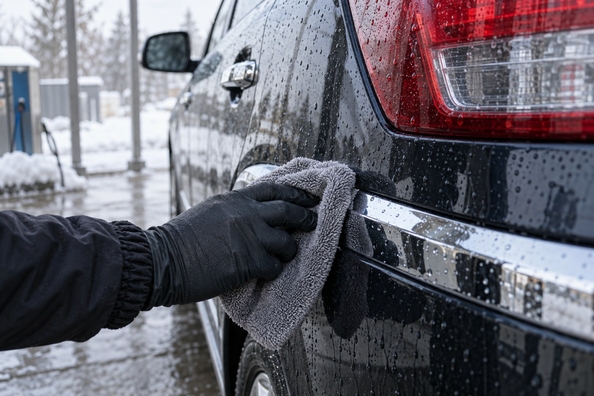
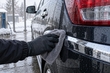
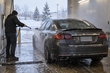
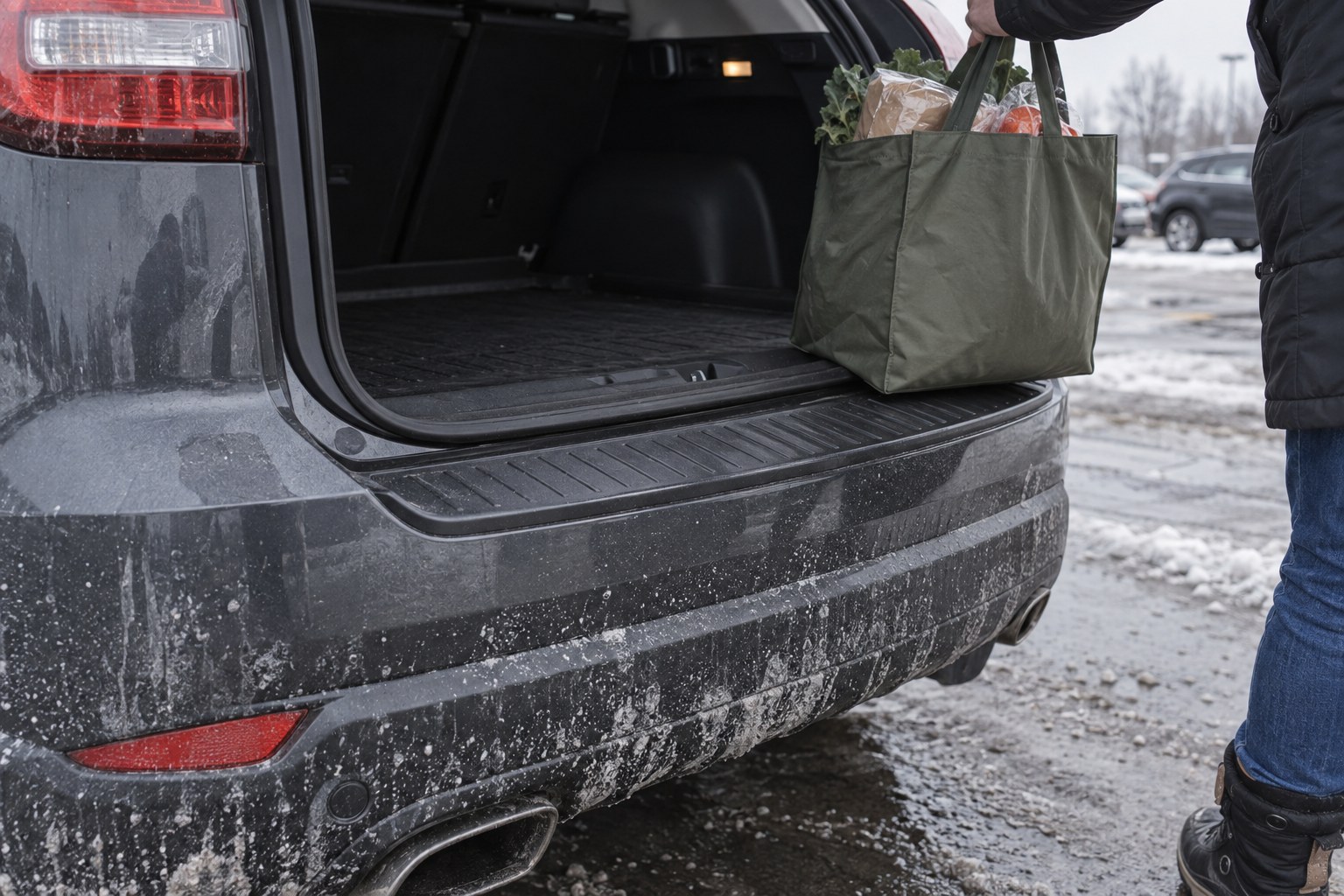
You can and should wash a car with a body kit, chrome trims, and a spoiler in winter — road salt damages them more than water does. The danger is not the wash itself but three things: the brushes of a gantry wash that catch the spoiler and front lip, a high-pressure jet aimed into the edge of a trim attached with tape, and water left in joints that freezes as you drive out. So the rules are simple: touchless wash or self-service instead of brush wash, keep the nozzle no closer than 30 cm and at a sharp angle, do not wash when it is colder than −10 °C, and after washing — wipe all seams and edges dry.
Contents
For a car with tuning, what matters is not so much which wash is “best in general” as what exactly touches the trims, spoiler, and lip.
| Type of wash | Risk to body kit, trims, and spoiler | What to do |
|---|---|---|
| Gantry or tunnel with brushes | Brushes catch protruding parts: a spoiler on the trunk lid, the lip, trims with a raised edge. A dirty brush leaves scratches on gloss black plastic and chrome | Do not go with a tall spoiler, freshly bonded parts, or a peeling edge. If you do go — only where there is a manual pre-wash |
| Touchless (automatic) | Nothing touches the parts, but the chemicals are stronger, and the nozzles spray at a fixed angle | Suitable for most tuned cars if the trims are firmly bonded |
| Self-service | Everything depends on how you hold the gun | The best control: distance, angle, avoiding joints — follow the rules below |
| Hand wash with a sponge | Sand and salt under the sponge scratch chrome and gloss black plastic | First rinse dirt off with water, then use soft microfiber and a neutral shampoo |
There is a telling detail about brush washes and spoilers: many car washes post a warning that the owner is not responsible for damage to cars with spoilers, mirrors, wipers, and antennas. In other words, the wash shifts the risk of a torn-off spoiler to you in advance. ADAC, for its part, recommends tunnel washes with a manual pre-wash: an employee rinses sand and salt off with a pressure gun, and then the brushes do not act like sandpaper. We covered the general rules of winter body washing in the article can you wash a car in winter, and here — only what concerns tuning.
A touchless wash cleans without brushes, so its chemistry is, by definition, stronger: these are alkaline pre-wash agents, and in two-phase programs — acidic ones as well. A trade publication for car wash owners writes that glass and chrome are cleaned better with an acidic agent, while paint is cleaned with an alkaline one, and that the optimal dwell time for pre-wash is 30–45 seconds per pass. For an owner of a tuned car, three rules follow from this:
STIHL, a manufacturer of high-pressure washers, recommends for bodywork a fan nozzle, the lowest pressure that still cleans, a distance of at least 30 cm, and a jet at a sharp angle to the surface; rubber seals should not be sprayed with a strong jet. Near tuning parts, you also need to add direction:
ADAC considers washing in light frost safe, but advises refusing the car wash at temperatures below −10 °C. The reason is thermal shock: water at 10–30 °C on a frozen surface stresses paint, rubber, and plastic, and already damaged or repainted parts suffer the most. For tuning this is especially relevant: a painted spoiler or a trim with microcracks in the clear coat is exactly that case.
Water left under the edge of a trim or in a spoiler seam turns into ice in cold weather, and ice expands and pushes the part away from the body. After a few such cycles, the edge of a trim lifts even without an impact. Therefore, after washing:
If after washing you notice that the edge of a trim has come away, do not press it back while it is wet: there is water underneath, and it will come away again. The part needs to be dried, cleaned, and re-bonded in a warm place — we covered how to do this using the example of sill trims that come off after washing.
Most often, trims come off right after the first wash. According to 3M technical data for VHB tapes, the tape reaches about 50% strength in 20 minutes, 90% in 24 hours, and 100% in 72 hours at room temperature. The ideal bonding temperature is from +21 to +38 °C; the minimum for most tapes is +10…+15 °C; on a cold surface the adhesive does not flow and does not bond.
Spoilers, lips, and trims come in three versions, and each has its own specifics at the car wash.
| Version | Example | What to consider at the car wash |
|---|---|---|
| For painting, painted in body color | DPT spoiler for BMW E36 (ABS, for painting) | Washed like the body. But fresh paint is vulnerable: PPG, a paint manufacturer, recommends washing the car by hand with cold water and a mild shampoo for the first 30 days and not waxing for 90 days. That means one month after painting — no brushes and no harsh chemicals |
| Gloss black without painting | Sunplex lip spoiler for BMW F10, DPT V-1 lip (ABS, black) | On gloss black, scratches from a dirty brush or sponge are the most visible. Touchless washing or a mandatory pre-rinse to remove sand is required |
| Chrome: stainless steel or chrome-plated plastic | OmsaLine and Carmos rear bumper and door handle trims | No abrasives and no acidic cleaners; after washing — wipe dry so no spots remain |
If a part has already cracked, in freezing temperatures at the car wash the crack grows faster: water gets inside and freezes. We explained what to do about a crack in a bumper or trim in the article why plastic body kits crack in мороз. A step-by-step scheme for washing a tuned car is in the block below, and you can choose a trim or spoiler for your model in the sections rear bumper trims and spoilers.
We deliver with Nova Poshta throughout Ukraine.
Shipping to EU
Wholesale and retail
Own warehouse
Опис продукту
Подарунки не надаються при оформленні покупки у кредит під 0,01% або при покупці частинами.