04.10.2026
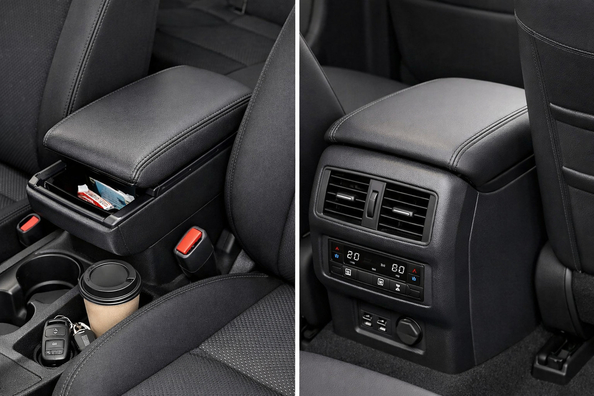
For everyday driving, a regular universal armrest more often wins: it’s cheaper, easier to install, and doesn’t depend on whether the car has real airflow to that area. The ventilated version makes sense not on its own, but only under specific conditions: frequent driving in heat, longer trips, proper air supply, and a willingness to pay about a third more than the base option.
The main mistake here is simple: treating ventilation as full-fledged cooling. In reality, it’s about supplying or circulating air, not a “refrigerator” in the cabin. That’s why in one car this feature gives a noticeable benefit, while in another it remains almost decorative.
Both options solve the basic task the same way: they support your right arm, add space for small items, and often include a cup holder. The difference starts when you want extra comfort in hot weather. That’s exactly what you pay extra for.
If you look at it realistically, the choice comes down to practicality. For the city, short routes, winter, daily taxi work, or a work vehicle, the logic is simple: less complexity means fewer chances of disappointment. But if the car is genuinely used on summer highway trips and the cabin is well ventilated, then ventilation can be considered a useful option rather than a nice-looking bullet point in the description.
| Option | Strengths | Weaknesses | Who it’s for |
|---|---|---|---|
| Universal armrest | Lower price, simpler selection logic, less dependent on cabin design, usually quieter operation | No extra comfort in heat, can interfere with the handbrake or shifter if fitment isn’t measured | City driving, daily routine, manual transmission, work vehicle, drivers who don’t need extra options |
| Ventilated armrest | More pleasant in heat, relevant for long summer trips, adds a sense of higher comfort when there’s real airflow | More expensive, potentially noisier, more complex to install, may not deliver the expected effect without an air channel | Highway driving, summer trips, cars with proper airflow to this area, drivers willing to pay extra for comfort |
DD Tuning expert comment: The most common mistake is choosing the ventilated version without checking whether there is real airflow to the central area in the car. The second typical issue is relying on photos instead of dimensions, handbrake travel, and mounting fitment. If the base sits “on the edge,” even a decent armrest will start wobbling on bad roads and become annoying.
This is the basic solution for those who want arm support and added practicality without extra conditions. Its strength isn’t that it’s “better at everything,” but predictability: you pay less, install it more easily, and use it daily without being tied to the car’s climate system.
From a durability standpoint, it’s calmer because the design has fewer dependent elements. But that doesn’t mean you can ignore installation. If the armrest is mounted on weak fasteners or installed without accounting for load, you’ll get play, misalignment, and squeaks.
Its weak point is compatibility with a specific car. In a manual car with frequent handbrake use, a poorly chosen armrest starts getting in the way faster than it brings benefit.
Here you’re not paying for a different basic function, but for extra comfort in hot weather. If trips are long, the cabin heats up, and air actually reaches this part of the console, this option can feel nicer in daily use.
The key nuance is that ventilation is not full cooling. It works only as well as the car provides a real path for air to reach that area. If there’s no such airflow, paying extra for the function loses its point.
The second point is complexity. With a ventilated version you’re more dependent on build quality, precise fitment, and careful installation. That’s why this option more often requires a measured approach: take measurements, assess the airflow route, and don’t expect what the design can’t deliver.
For most short daily trips, a regular universal armrest is the better choice. In the city, the main thing is that it doesn’t interfere with driving, doesn’t wobble, and doesn’t demand extra attention. On these points, the simpler design more often wins.
For those who drive a lot on summer highways, the picture is different. If the cabin has normal air circulation and the driver truly feels overheating in the central area, ventilation has more practical value. But even in this scenario, it shouldn’t be the first criterion—compatibility and installation first, then options.
For commercial use, taxi work, a family car with different drivers, or an older vehicle, it’s more logical to choose the base option. It’s less dependent on cabin design nuances and handles the “install it and forget it” mode more easily.
| Scenario | What to choose | Why |
|---|---|---|
| Short daily city trips | Regular universal | Less overpaying, basic comfort is enough, no dependence on air ducts |
| Long summer highway trips | Ventilated armrest | Worth paying extra if air truly reaches this area and comfort in heat matters |
| Manual car with frequent handbrake use | More often a regular universal | Easier to find an option that doesn’t interfere with driving and avoid overpaying for a secondary function |
| Work vehicle or taxi | Regular universal | Silence, predictability, and lower price matter more than an extra option |
| Car without real airflow in the central area | Regular universal | Ventilation in this setup won’t provide the expected benefit |
| Driver is sensitive to heat and spends a lot of time behind the wheel | Ventilated armrest | When implemented correctly, adds noticeable comfort on long trips |
The more expensive option is worth choosing not when you “want the maximum,” but when you have a specific scenario: summer, long trips, a heated cabin, and real airflow to the armrest area. In that configuration, the ventilated version looks logical and can deliver the difference that makes the extra cost worthwhile.
If what you primarily need is arm support, space for small items, and calm operation without extra questions, it’s more practical to look at the basic universal armrest. And when it’s still unclear which mounting format will fit your car best, it’s worth first checking the armrest category and comparing dimensions, base shape, and compatibility.
From a customer’s experience: in a compact hatchback, the owner initially wanted ventilation, but after measuring it turned out there was no real airflow to that area, and the handbrake operates close to the armrest. As a result, he chose the regular universal option and was happy to get comfortable support without extra noise or modifications. In another case, for a car that regularly drives highways in the heat, the ventilated version turned out to be a justified upgrade.
For everyday driving, a universal armrest is in most cases the smarter choice: cheaper, simpler, quieter, and not dependent on airflow nuances in the cabin. The ventilated version is worth buying only when you clearly understand your scenario and know that the function won’t be just a formality.
The key to a good purchase here isn’t the option name, but checking compatibility, installation, and real benefit specifically in your car. This material is based on real selection experience, practice, and real usage scenarios, so the conclusion is simple: function and fitment first, then paying extra for comfort.
| ✔ | A standard universal armrest is cheaper and easier to install, so for everyday driving it is less likely to disappoint. It also does not depend on whether the car has real airflow to this area. |
| ✔ | The basic version has fewer components that could cause problems over time, so it looks safer in terms of service life. It is practical for a “fit it and forget it” setup. |
| ✔ | An armrest with ventilation can provide noticeably more comfort in hot weather on long summer trips. This works especially well if the cabin is well ventilated and air actually reaches the center area. |
| ✔ | Both versions perform the basic task equally: they support the arm, add space for small items, and often include a cup holder. So the choice is not about functionality in general, but about extra comfort. |
| ✔ | For drivers who spend a lot of time on the highway in summer and are sensitive to heat, the ventilated version may justify the extra cost. In such a scenario, the benefit no longer looks purely decorative. |
| ✘ | An armrest with ventilation is more expensive: the extra cost is about one third of the price of the basic version. If the function does not work because of weak airflow, that money does not bring a noticeable return. |
| ✘ | Ventilation is not full cooling, but only air supply or circulation. If you expect a “refrigerator” effect, expectations will be too high. |
| ✘ | The ventilated version is more complex to install and depends more heavily on fit quality and careful mounting. If the fastening is weak, it can also add background noise and play. |
| ✘ | A standard armrest may interfere with the handbrake or gear selector if compatibility and dimensions are not checked. On manual cars, this is especially noticeable. |
Shipping to EU
Wholesale and retail
Own warehouse
Опис продукту
Подарунки не надаються при оформленні покупки у кредит під 0,01% або при покупці частинами.