23.09.2026
128
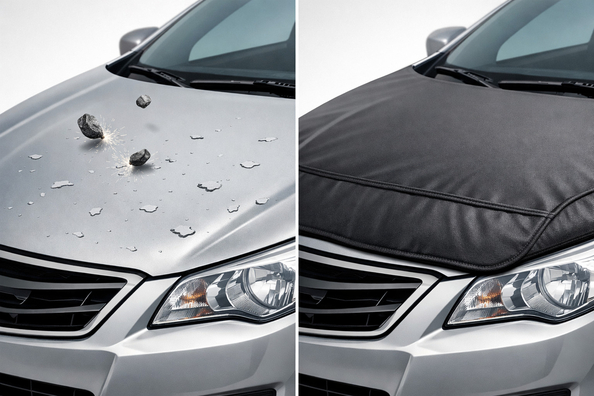

Chips on the hood after highway driving almost always appear not because of “weak paint,” but because of impacts from small crushed stone, gravel, and hard road grime at speed. The front edge of the hood and the area where debris flies up from the wheels of the vehicle ahead take the most hits, and in winter the risk rises sharply due to grit and abrasive material on the road.
The key mistake here is simple: confusing care with protection. Wax and ceramic coatings can make washing easier, but they don’t absorb the impact of a stone. A hood bra sometimes helps, but not always and not on every car. To avoid wasting money, you first need to understand exactly where the chips are coming from and which area suffers the most.
On the highway, even a tiny stone turns into a hard abrasive strike. When a truck, crossover, or passenger car drives ahead on a rough section, its wheels fling debris backward, and the front of your car takes the hit. If the hood has a pronounced leading edge, that edge catches the first and most frequent impacts.
The problem gets worse in winter, when there’s lots of grit, salt, and small stones on the road. If a chip has already reached the primer or metal, it’s no longer just about looks: moisture and salt trigger corrosion, and a small dot gradually turns into a bigger defect.
First, wash and dry the hood thoroughly. If new dots appear after 1–2 highway trips and are concentrated on the leading edge or in the central direct-airflow zone, the cause is almost certainly stones. If the damage is random, but under a soft hood bra you see dull streaks, haze, or fine scuffing near the edges, the issue may no longer be impact—it may be dirt rubbing under the accessory.
Next, look at the depth. If you only see the clear coat, it’s unpleasant but not critical. If gray primer or metal shows through, you need to seal that chip quickly. One more simple test: compare the hood with the bumper and mirrors. When they also have fresh “peppering” after the highway, it’s a typical impact scenario—not a problem with one paint layer.
DD Tuning expert comment: most often people make two mistakes: they put a soft bra on an already dirty hood, or they expect ceramic to protect against stone strikes. If the car regularly drives on the highway, first determine the impact zone, and only then choose between film, a deflector, or a seasonal bra. Otherwise, you have an accessory, but new chips still appear.
| Symptom | Likely cause | What to do |
|---|---|---|
| Many small dots on the leading edge of the hood after the highway | Crushed stone and gravel from the wheels of the vehicle ahead | Seal fresh chips, consider PPF on the edge or the entire hood, increase following distance |
| More chips in winter than in the warm season | Grit, salt, and road abrasives | Inspect the hood more often, don’t delay touch-ups, prepare protection before the season |
| Occasional deep chips with visible primer or metal | Direct strong impacts from larger stones | Seal the damage quickly to prevent rust; for prevention choose physical protection |
| Dull streaks or scuffs under the edges of a soft hood bra | Dirt and moisture between the bra and the hood | Remove the accessory, wash and dry the surface; don’t use a bra as a permanent solution without maintenance |
| The hood is coated with ceramic or wax, but new chips still appear | The coating is too thin for impact protection | Don’t treat cosmetic coatings as armor—switch to film or a properly selected deflector |
The best physical protection against chips is clear protective film. Its thickness is many times greater than that of a ceramic coating, so it can actually take some of the impact. For cars that do a lot of highway miles, the logical minimum is protecting the leading edge, and in higher-risk conditions it makes sense to cover the entire hood.
The second viable option is a rigid hood deflector, but only if it’s precisely matched to the model and installed in the correct position. It doesn’t protect the whole hood, but it can divert part of the debris flow away from the direct-impact zone. It’s a partial solution, not a full replacement for film.
The third thing that really matters is not leaving deep chips open. If the damage reaches primer or metal, quick touch-up or spot repair is cheaper than dealing with rust later and repainting a large area.
Wax and ceramic are useful for care: the surface washes easier, dirt sticks less, and bug marks are easier to remove. But they won’t save you from chips. If the goal is to survive highway driving without new dots on the hood, that’s not enough.
A soft hood bra works much worse if dust, sand, and moisture build up underneath. In that mode it can not only fail to help, but also add scuffing along the edges. That’s why it’s not a “set it and forget it” format.
Likewise, don’t expect miracles from any deflector that doesn’t cover the real impact zone or is poorly fitted to the vehicle. If the accessory is installed only formally, and chips fly below or above its working area, the effect will be weak.
Accessories make sense before the hood is already covered with deep chips. If you need seasonal or temporary protection for long trips, consider hood bras, but only with a clean fit and regular removal for washing. If most impacts are on the leading edge, it’s more logical to consider a hood deflector as partial airflow protection. And when the hood already has many old chips, signs of corrosion, or a poor previous repair, sometimes it’s better to start not with accessories, but with repair—or even reviewing the option of hood replacement.
The rule is simple: on a new or freshly repainted hood, protection pays off best. On a damaged surface, you need to stabilize the defects first, and only then install what’s supposed to protect it further. Stretching a bra over dirt, chips, and moisture is a bad idea.
| Solution | When it works | When it’s not worth spending money |
|---|---|---|
| PPF on the leading edge or the entire hood | Regular highway trips, fresh paint, desire to truly reduce the number of chips | If the hood already has rust or many unresolved defects and you don’t plan surface preparation |
| Rigid hood deflector | When impacts typically hit the hood edge and there’s an exact product for the specific vehicle | If you need protection for the entire hood or you install a random product without proper fitment |
| Soft hood bra | Occasional long trips, a clean hood, willingness to remove it regularly to wash and dry | Daily use in dirt, in winter, on a wet hood, or without maintenance |
| Ceramic or wax | When you want easier maintenance and a better-looking surface | If the expectation is to stop stone chips |
| Local touch-up of chips | Fresh isolated damage where you need to quickly seal primer or metal | When there are already many chips, paint is peeling, or corrosion has started over a large area |
From a customer’s experience: after several highway trips, the owner noticed that new chips appeared only on the leading edge of the hood, not across the entire surface. At first he wanted to limit it to ceramic, but after inspection he sealed the fresh damage and chose protection specifically for the impact zone, keeping the soft bra only for occasional long trips. This approach worked better than trying to cover every scenario with one accessory.
After highway driving, hood chips most often appear due to direct impacts from road abrasives, not simply because of poor paint. Physical protection works best: film for real impact absorption, a rigid deflector for partial flow diversion, and a soft bra only in limited scenarios and only with careful maintenance. If primer or metal is visible, you can’t delay repairs. This material is based on real selection experience, hands-on practice, and real use scenarios, so the main advice is simple: first determine the nature of the damage, and only then pay for protection.
Shipping to EU
Wholesale and retail
Own warehouse
Опис продукту
Подарунки не надаються при оформленні покупки у кредит під 0,01% або при покупці частинами.