31.05.2026
289
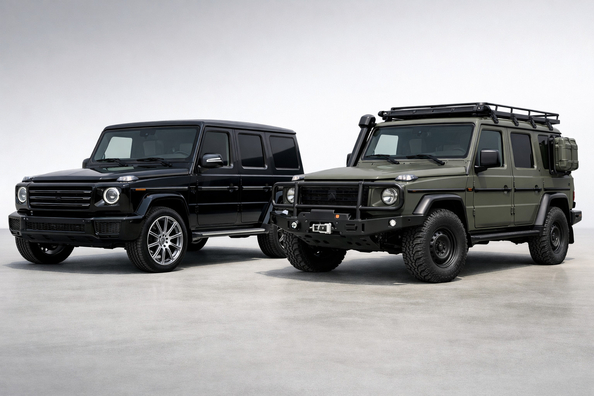
Mercedes G-Class W463A and W464 may look similar in silhouette, but this is not “the same G in different trims.” W463A is the civilian passenger branch, tuned for daily driving: 5 seats, a strong safety package, and better on-road manners. W464, which the professional line labels as BR464, is a working tool for services, special tasks, cargo, and body conversions.
To avoid mixing different markets and years, it’s best to compare specific versions: the civilian G 550 on W463A and the professional G 350 d on W464. This makes the key point obvious: one G-Class is built for an owner who drives every day, the other is built for a job that must be done in the field, under load, with no unnecessary compromises.
W463A sits in the segment of expensive body-on-frame SUVs, but unlike many status competitors it hasn’t lost its true off-road foundation: a ladder frame, low range, and three locking differentials. That’s why people buy it not only for the image, but also for the real ability to tow a trailer, drive off-road, and withstand hard use.
W464 plays in a different league. It’s not a city premium SUV, but a professional vehicle for agencies, rescue units, expedition tasks, and body upfits. In short, W463A competes with expensive SUVs, while W464 competes with utility platforms where what matters is not décor and multimedia, but payload, durability, and work suitability.
The G-Class family traces its history back to 1979, which is why there’s constant confusion with indices: the vehicles look very similar from the outside, but inside they are different generations with different roles. The classic W463 in the familiar shape lived for a very long time, while the modern civilian G-Class became much more expensive, quieter, and more road-oriented than its predecessors.
BR464 is the current professional branch of the G-Class, continuing the model’s service-oriented logic. It doesn’t try to be luxurious; instead it preserves utilitarian character, high payload capability, and compatibility with special equipment. That’s why W463A and W464 are better seen as two separate lines within one family, not simply “expensive” and “basic” versions.
On the civilian side, the reference version in this comparison is the 2021 G 550 on W463A. It’s a 4.0-liter V8 biturbo with 422 hp and 610 N·m, paired with a 9-speed automatic, permanent all-wheel drive, low range, and three locking differentials. So this isn’t just a heavy body-on-frame truck—it’s a very fast, torquey SUV that can also handle asphalt without the old “commercial” harshness.
In the professional branch, the key version is the G 350 d on W464. It uses a 3.0-liter inline 6-cylinder turbodiesel with 249 hp and 600 N·m, also with a 9-speed automatic. But the point is different: controlled traction, working under load, a crawl mode of 2–14 km/h in low range, and suitability for tough duty scenarios. If W463A is about performance and versatility, W464 is about pulling power, endurance, and predictability in harsh conditions.
| Parameter | W463A G 550 | W464 G 350 d |
|---|---|---|
| Engine | 4.0 L V8 biturbo | 3.0 L inline 6-cylinder turbodiesel |
| Power / torque | 422 hp / 610 N·m | 249 hp / 600 N·m |
| Transmission and drive | 9-speed automatic, all-wheel drive, low range, 3 locks | 9-speed automatic, all-wheel drive, low range, 3 locks |
| Seats | 5 | 4 in the enclosed body, 2 in the cab chassis |
| Wheelbase | 2890 mm | 3650 mm for the cab chassis; for the enclosed body not confirmed in public sources |
| Length | 4818 mm | 5397 mm for the cab chassis; for the enclosed body not confirmed in public sources |
| Ground clearance | 241 mm | 225 mm |
| Fording depth | 699 mm | 750 mm |
| Trunk / payload | 1079–1942 L | 1000 kg payload in the enclosed body; up to 2500 kg in the cab chassis |
| Towing | 3175 kg | 3500 kg |
This is where the main technical difference lies. W463A remains body-on-frame, but it gained independent front suspension, making it much calmer and more precise on asphalt. W464 has rigid axles front and rear, so it’s less refined on the move, but better suited to shock loads, rough terrain work, and field repairs.
According to confirmed data, the civilian W463A is 4818 mm long, 1969 mm tall, 2187 mm wide with mirrors, and has a curb weight of 2519 kg. The geometry is strong for such a heavy vehicle: 241 mm clearance, 699 mm fording depth, 31° approach angle, 30° departure angle, 26° breakover angle. In BR464 the emphasis shifts toward work: the enclosed body has a 3500 kg gross vehicle weight and 1000 kg payload, the roof is rated for up to 200 kg, and the cab chassis goes up to 4900 kg GVW and up to 2500 kg payload. On paper, W464 has less clearance—225 mm—but a greater fording depth—750 mm.
W463A is a full passenger G-Class with 5 seats. It has a more comfortable second row, a 60/40 folding backrest, a 1079 L trunk behind the second row and 1942 L with the seats folded, plus a broad set of safety systems: 10 airbags, automatic braking, blind-spot monitoring, surround-view, parking assistance, and other driver aids. That’s why it can realistically serve as a single expensive daily car.
W464 is far more utilitarian. The enclosed body has only 4 seats, the cab chassis has 2, and the priorities are different: protected electrics, preparation for service communications, an optional 24-volt system, special lighting, and simpler, more durable interior solutions. If you need a comfortable family cabin, the professional G-Class isn’t about that.
In daily life, W463A is clearly more user-friendly—but with no illusions. It’s a very wide and heavy vehicle that demands space, familiarity, and budget. For the 2021 G 550, official fuel consumption figures are very high: about 18.1 L/100 km in the city and 14.7 L/100 km on the highway, and real mixed driving easily lands around 16.8 L/100 km. So buying it as just a pretty city car is a questionable idea.
W464 is even tougher in everyday use, but it doesn’t try to be likable in the city. Its trump cards are different: towing up to 3500 kg, payload from 1000 to 2500 kg depending on the body, a big margin for roof load and equipment, and a driving range of over 600 km in the cab chassis. For municipal services, rescue teams, geology, expeditions, or technical support, that matters far more than ride softness. For early civilian vehicles, it’s also worth checking separately that all recall campaigns and service actions have been completed.
Both versions are strong where most large SUVs have already become crossovers with reduced practicality. But their compromises differ: W463A asks for more money for comfort and image, while W464 requires the owner to accept a rougher nature in exchange for true utilitarian capability.
| Version | Pros | Cons |
|---|---|---|
| W463A | Better on-road behavior, 5 seats, large trunk, strong safety package, powerful V8, good towing capacity | High fuel consumption, noise at speed, large dimensions, expensive ownership, doesn’t like tight city streets |
| W464 | Body-on-frame durability, rigid axles, large payload, 3.5 t towing, preparation for special equipment, off-asphalt capability | Less comfort, less passenger convenience, simpler interior, excessive utilitarianism for a private owner |
From an owner’s perspective, the conclusion is simple: W463A suits someone who truly drives every day but isn’t willing to give up a genuine off-road foundation. W464 suits someone who counts not cabin ambience, but payload, roof load, trailer, durability, and the vehicle’s fitness for a specific service.
For the G-Class, accessories make sense only when they strengthen the use case. For the civilian W463A, that’s usually protection, cabin cleanliness, and travel gear; for the professional W464, it’s everything that helps the vehicle work under load and off asphalt. An important nuance: parts compatibility must be checked by the exact body and year, because the old W463, the civilian W463A, and the professional BR464 are not interchangeable in many areas.
The worst-case scenario for a G-Class is piling on random decorative tuning without understanding the task. It’s better to equip the civilian G so you don’t lose daily convenience, and the professional one so you don’t overload it with unnecessary weight and don’t compromise access to factory service points.
W463A and W464 should be chosen not with your heart, but with your scenario. If you need one G-Class for every day, with a 5-seat cabin, a large trunk, a powerful engine, and genuinely decent on-road behavior, it makes more sense to look at W463A. If you need a vehicle for service work, upfits, heavy payload, a trailer, and hard work far from asphalt, then the right answer is BR464.
The main point is that these vehicles are honest about their purpose: the civilian G is no longer as rough as older generations, but it’s still a heavy body-on-frame SUV; the professional G doesn’t pretend to be luxurious, but it delivers what’s almost gone from the class—true utilitarian capability. The material is based on real selection experience, practice, and real use cases, so the final guideline is simple: W463A is for the owner, W464 is for the task.
| ✔ | W463A is better suited for everyday driving: it has 5 seats, a more comfortable second row, and a large trunk, so it can realistically be used as the only family car. |
| ✔ | The civilian G-Class has a strong safety package: the article mentions 10 airbags, automatic braking, blind-spot monitoring, a surround-view camera, and parking assistants. |
| ✔ | W463A retained the body-on-frame construction, low-range gearing, and three differential locks, but became calmer and more precise on asphalt thanks to the independent front suspension. |
| ✔ | W464 is better adapted for heavy-duty work: it has solid axles, a higher payload, preparation for special equipment, and better suitability for service and expeditions. |
| ✔ | The professional G-Class has stronger figures for practical tasks: towing capacity up to 3500 kg, a fording depth of 750 mm, and a large load reserve depending on the body. |
| ✘ | W463A is very thirsty: the article states about 18.1 l/100 km in the city and 14.7 l/100 km on the highway, so it is expensive to run in everyday use. |
| ✘ | Both versions remain large and heavy, but W463A is especially inconvenient in tight city conditions because of its dimensions and the space required for maneuvering. |
| ✘ | W464 is much less comfortable for a private owner: it has a simpler interior, less passenger comfort, and an utilitarian seating position that takes priority over comfort. |
| ✘ | In the professional version, some parameters either depend on the body type or are not always confirmed for the closed version, so before buying you need to carefully check the specific configuration. |
Shipping to EU
Wholesale and retail
Own warehouse
Опис продукту
Подарунки не надаються при оформленні покупки у кредит під 0,01% або при покупці частинами.