01.06.2026
231
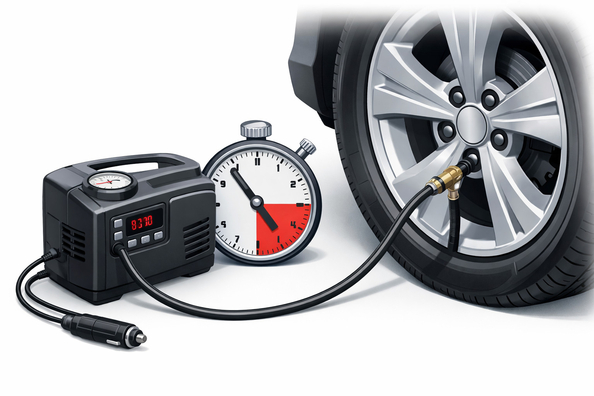
If a 12‑volt pump takes a long time to inflate a tire, it doesn’t always mean it’s faulty. For compact models, slow operation is often normal—especially on larger wheels or when the tire was noticeably deflated. But if you only need to add a bit of pressure and the compressor is loud, gets hot, and the gauge barely moves, the cause is usually quite specific.
Most often, the problem comes down to four things: the pump isn’t getting enough power, it has overheated, there’s an air leak, or the task is simply too big for that type of unit. You can tell these apart without complex diagnostics—by inflation time, heat, behavior on different power sources, and whether the pressure drops again.
A small car compressor is already working at its limit when it has to raise pressure not in a passenger-car tire, but in a crossover, minivan, or SUV wheel. The larger the tire volume and the lower the starting pressure, the longer it will take. So a few minutes on a heavily deflated tire for a compact model is not, by itself, a sign of a defect.
The problem starts when slow top‑up is combined with other symptoms: the housing gets very hot, the compressor noticeably loses pace after a few minutes, it works worse from the car socket than from a direct connection, or the tire goes soft again after a few days. In that case it’s not the pump’s “character,” but a specific cause that needs to be removed.
DD Tuning expert comment: the most common mistake is judging a pump based on one situation where the tire is already almost empty, while the compressor is connected through a weak socket or adapter. The second typical mistake is looking for the problem in the compressor when air is actually being lost through the valve or a poorly clamped chuck. Before replacing the pump, we always recommend ruling out power supply, overheating, and leaks—this takes less time than buying an unsuccessful replacement.
| Symptom | Likely cause | What to do |
|---|---|---|
| The pump hums, but pressure rises barely noticeably | Weak power supply or losses at contacts | Check the socket, fuse, vehicle power mode, remove adapters, and compare with another power source |
| Hissing near the valve during inflation | Incorrectly seated chuck | Re-seat and firmly lock the chuck, check the seal |
| Inflates normally at first, then suddenly weakens | Overheating | Stop, let the compressor cool down, and don’t exceed its duty cycle |
| After inflation the tire goes soft again after a few days | Leak at the valve, rim, or a puncture | Check the tire with soapy water and repair the leak point rather than just inflating again |
| On one large wheel the pump is very slow, on the others it’s tolerable | Not enough flow reserve for the tire volume | Either accept longer run time or switch to a higher-output compressor |
| A completely flat tire hardly builds pressure | Possible tire bead unseating | Don’t torture a small pump—check bead seating and, if needed, go to a tire shop |
If your pump is always slow and on all wheels, first look at the device class itself. In the selection of tire inflator pumps, it makes sense to choose a model not “just to have one,” but based on output and power method.
When you still don’t understand how a compact compressor for occasional top-ups differs from a model for a large wheel, it’s useful to start with which pump is best for a car. It helps you avoid overpaying for what you don’t need and avoid choosing another too-weak option.
If you have a crossover, minivan, or several cars in the family, a logical upgrade is a more powerful 85 L/min compressor. This switch makes sense specifically when the cause isn’t a leak or bad contacts, but a simple lack of output.
| Solution | When it works | When you shouldn’t spend money |
|---|---|---|
| Clean contacts, check the fuse and socket power | When the pump comes alive with a better connection or runs inconsistently | When even on reliable power it remains just as weak |
| Let the compressor cool and run in short cycles | When output drops after it heats up | When the problem is the same on a cold compressor |
| Check chuck seating on the valve | When you hear hissing or pressure rises in jerks | When the connection is airtight but the tire still quickly loses pressure after inflation |
| Find and repair the leak | When pressure drops again after days or weeks | When the only issue is slow pump operation and the tire holds pressure |
| Buy a higher-output compressor | When big wheels and frequent top-ups are objectively too much for a small pump | When the real cause is weak power or a leak, not output |
| Use sealant as a temporary measure | Only as an emergency option to reach service after a small tread puncture | When the leak is through the valve, rim, bead area, or you’re trying to “treat” a slow pump this way |
From a customer’s experience: a person complained that a compact compressor “barely inflates” the two front wheels of a crossover. After checking, it turned out that from the factory socket the pump lost a lot of performance, and on one wheel the valve was also whistling slightly. After replacing the valve and switching to a higher-output compressor, the problem disappeared: top-ups became normal in time, and pressure stopped dropping after a few days.
Long inflation doesn’t always mean the pump is unusable. For a small 12‑volt compressor, a few minutes of work can be normal, but a drawn-out process is almost always explained by weak power, overheating, a leak, or the pump simply being too small for your wheel.
The practical order of actions is simple: check pressure on a cold tire, rule out power and chuck issues, find any possible leak, and only then decide whether you need to replace the compressor. This material is based on real selection experience, diagnostic practice, and real-world use cases, so the main advice is one: don’t buy a new pump until you understand exactly what makes the old one slow.
| ✔ | For compact 12-volt pumps, slow operation on a large wheel or with a heavily deflated tire may be normal. This removes unnecessary expectations and helps avoid writing off the device as defective without checking the operating conditions. |
| ✔ | The article includes a simple way to tell normal slowness from a real problem: checking a cold tire, comparing inflation from different power sources, and monitoring heat buildup. These steps can be done without complicated diagnostics. |
| ✔ | The material clearly shows that the cause is often not the pump itself, but the power supply, poor contact, or an insecure connection to the valve. This allows you to first eliminate minor but practically important faults. |
| ✔ | There are specific recommendations on when to stop inflating and look for a leak with soapy water or go to a tire shop. This saves time and prevents endlessly topping up a wheel that keeps losing air anyway. |
| ✔ | The article helps understand the limits of a compact compressor and when a more powerful model is needed. This is useful for owners of crossovers, minivans, or multiple cars. |
| ✘ | If the problem is weak power, a factory socket, adapters, or a thin extension cord, the pump may perform much worse than expected. In that case, the device itself may seem "weak," although the cause is often the connection. |
| ✘ | Compact compressors do not handle long continuous operation well and can lose performance sharply due to overheating. For a large wheel or a nearly flat tire, this means a noticeably longer and less stable process. |
| ✘ | If there is a leak in the valve, near the rim, or a puncture, inflation only has a temporary effect. The wheel will start losing air again after a few days, and repeated pumping will not solve the problem. |
| ✘ | For large wheels or frequent top-ups, a small pump may simply be too low in output. Then even a working compressor will inflate slowly, and this is a limitation of the device class, not a breakdown. |
Shipping to EU
Wholesale and retail
Own warehouse
Опис продукту
Подарунки не надаються при оформленні покупки у кредит під 0,01% або при покупці частинами.