29.06.2026
546
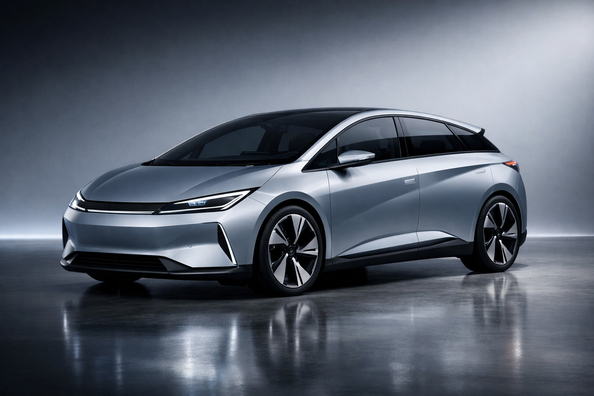
BYD Dolphin 2027 does not currently exist as a separately shown concept or a finished prototype. What has been officially confirmed is different: in April 2026, Dolphin SE was shown for the Brazilian market, and the manufacturer explicitly called it the new styling for the Dolphin family from 2027; in May 2026, Dolphin G DM-i was presented for Europe as a production hybrid branch of the lineup. So the correct status of the topic today is not “ready BYD Dolphin 2027”, but a set of official announcements and market signals that show the model’s development direction.
Rumors have already appeared around this about an all-new electric Dolphin with rear-wheel drive, a CTB layout, and a larger battery, but the manufacturer has not confirmed this yet. To avoid mixing facts with speculation, it makes sense to start from the current BYD Dolphin and separately look at what has already been officially stated and what is only expected.
There has not yet been a separate official reveal of a car specifically named BYD Dolphin 2027. Instead, there are two important confirmed steps: the updated Dolphin SE for Brazil as a visual preview of the 2027 styling direction, and Dolphin G DM-i for Europe as an already real production hybrid modification. In other words, the topic status is an official reveal of individual elements of the future family, not a full concept or a pre-production sample of one specific car.
| What is known | What is expected | What is unknown |
|---|---|---|
| BYD officially showed Dolphin SE with a new front-end design and directly linked this styling to the Dolphin family from 2027 | This design will become the basis for the next market versions of Dolphin | Whether there will be a separate global “Dolphin 2027” as a single car for all markets |
| Dolphin G DM-i officially launched as a plug-in hybrid option for Europe | The Dolphin range will split into electric and hybrid branches depending on the market | Which exact powertrains will be offered to Europe, China, and Latin America |
| The current Dolphin family base is officially linked to e-Platform 3.0 and the Blade battery | The next iteration will keep this logic, but with a deep modernization | Whether BYD will confirm CTB, rear-wheel drive, and a new rear suspension |
| Real dates exist only for SE and G DM-i in 2026 | The full transition to the new styling will happen throughout 2027 | The exact debut schedule for a separate new EV hatchback |
The officially confirmed technical base of the current Dolphin is e-Platform 3.0, the Blade battery, and an integrated electric drive unit. This is an important reference point, but not direct proof that “Dolphin 2027” will keep everything unchanged. Dolphin SE shows that BYD is already working on a new exterior for the family, but the very fact of a facelift does not automatically mean a new platform.
According to rumors, the next fully electric Dolphin may switch to a CTB layout, get a different rear suspension, and even rear-wheel drive. So far, this has not been confirmed by the manufacturer, so it should not be treated as fact. In the author’s view, a more realistic scenario is a deep evolution based on the current architecture—with better body rigidity, denser battery packaging, and targeted chassis changes—rather than a complete break from the present design.
Officially, there are already two directions within the Dolphin family. The first is fully electric, which the current Dolphin is built around. The second is the new Dolphin G DM-i, i.e., a plug-in hybrid with a claimed total range of over 1000 km. This means BYD is no longer keeping Dolphin only as an EV, but is expanding the range for different markets and usage scenarios.
As for a possible Dolphin 2027 EV, no drive type, exact batteries, or charging capabilities have been officially announced. Rumors mention a larger battery, a new generation of Blade, and rear-wheel drive. But for now, these are only expectations. If assessed pragmatically, BYD will most likely focus not on exotic solutions, but on better efficiency, faster DC charging, and a wider choice of trims—from basic city versions to more powerful ones.
DD Tuning expert comment: the most common mistake is to read rumors about a new body and immediately treat them as a finished specification for a production car. In the compact segment, manufacturers very often change styling and electronics before they change the platform or cabin geometry. So until the official start of sales, it’s better to verify not the model name, but the specific year, market, and body.
This is where official information is the most abundant. Dolphin SE has already shown the direction BYD is taking the family: the front end has become more mature, cleaner, and less “toy-like” than early versions. In short, 2027 for Dolphin will likely mean moving away from overly soft shapes toward a more composed, technical look.
For the interior, almost nothing has been officially announced for a separate Dolphin 2027. So everything below is only cautious expectation: a larger central screen, a fresher infotainment logic, more remote-access features, and an expanded driver-assistance package. Mentions of a new cabin electronics platform and a more powerful processor appear only in unofficial leaks.
The key here is not to mix numbers from different versions and different measurement methods. Dolphin already has WLTP, NEDC, PBEV, and unofficial reference points that are not directly comparable. So for the future 2027, it’s more useful to look not at one “magic” number, but at a corridor of possibilities.
| Parameter | Officially confirmed for 2026 versions | What can be expected for 2027 |
|---|---|---|
| Length | 4160 mm in Dolphin G DM-i; 4280 mm in Dolphin SE | Keeping the B-segment, but with targeted growth in dimensions depending on the market |
| Power | SE is rated at 177 hp and 290 N·m; the current European EV has versions up to 150 kW | A wider range from basic to more dynamic trims |
| Battery | SE officially lists a Blade 45,12 kWh | Likely capacity increase in higher EV trims, but without official confirmation |
| Charging | SE has DC 80 kW; the current European EV is up to 110 kW DC | Faster charging is expected, especially if BYD updates the electrical system |
| Range | SE lists different figures depending on the cycle; G DM-i claims over 1000 km total | For the new EV, an increase is likely, but not officially announced |
In terms of positioning, Dolphin remains a city and suburban B-segment hatchback, where not only kilowatts matter, but also entry price, second-row space, energy consumption, and charging speed. If BYD does update the model in 2027, it won’t be fighting “technology show cars”, but very down-to-earth mass-market rivals.
| Dolphin family version | Direct competitors | BYD’s position |
|---|---|---|
| Future electric Dolphin | Renault 5 E-Tech, Citroën ë-C3, Fiat Grande Panda, Peugeot e-208, Opel Corsa Electric | Focus on a roomy cabin, the Blade battery, and strong equipment for the money |
| Dolphin G DM-i | Toyota Yaris Hybrid, Renault Clio E-Tech, Honda Jazz e:HEV | An argument in the form of a large total range and lower dependence on charging infrastructure |
If the rear-wheel-drive rumors turn out to be true, it would be unusual for the class and would give the model a distinct technical highlight. But it’s too early to position the car around that feature.
Official dates exist only for specific versions: Dolphin SE already launched in Brazil in spring 2026, and Dolphin G DM-i was unveiled for Europe in late May 2026 with sales in June and deliveries in autumn. For a separate new electric Dolphin that could be called “2027”, there is still no official global launch date.
Rumors say the new EV could be shown before the end of 2026, and the price corridor in the home market is described as within the mass segment. But officially, neither the starting price nor the list of markets has been announced. If we follow BYD’s logic, the company will first cover China and selected large export markets, and only then adapt specifications for Europe and Latin America.
From customer experience: a typical situation is someone reads news about a “new Dolphin 2027” and looks for solutions already for the future car, while in reality they’ve ordered the current body or a very close version. After checking the market, year, and vehicle geometry, it usually turns out there’s no need to wait for an abstract “next generation”. The biggest satisfaction comes not from a loud headline name, but from a precise understanding of which exact car will actually arrive.
If you ignore the noise, the truth about BYD Dolphin 2027 is this: the new design direction for the family has been officially confirmed via Dolphin SE, and the range expansion has been confirmed via Dolphin G DM-i. Everything else—rear-wheel drive, CTB, a new battery, a radically different architecture—still sits in the rumor zone. In my opinion, BYD won’t break the model’s concept; it will deliver a more mature body, fresher electronics, better efficiency, and a clearer split between EV and hybrid versions.
So what’s worth waiting for is not a fantastically different car, but a very pragmatically refined mass-market hatchback that becomes stronger exactly where the buyer notices the difference every day: charging, interface, ride, space, and price. This material is based on real selection experience, practice, and real-world usage scenarios, so the main takeaway is simple: the direction for BYD Dolphin 2027 is already visible, but it’s still too early to consider the final hardware decided.
Shipping to EU
Wholesale and retail
Own warehouse
Опис продукту
Подарунки не надаються при оформленні покупки у кредит під 0,01% або при покупці частинами.