23.07.2026
166
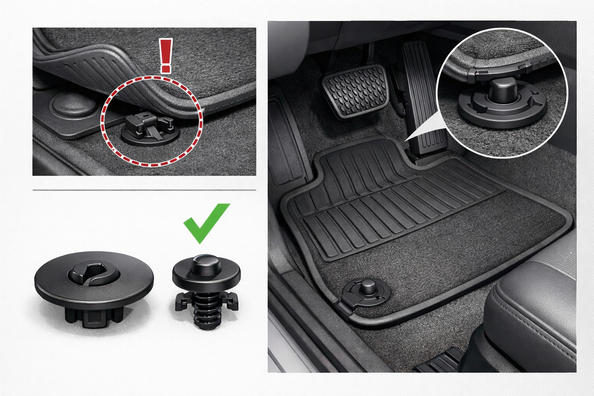
If the driver’s floor mat has started sliding, the issue is usually not that it’s simply “slippery”. Most often the cause is a broken or incompatible clip, a second mat underneath, dirt or moisture under the base, or a worn-out mounting hole near the fastener. If the mat doesn’t lock firmly onto the factory mounting points and even slightly creeps into the pedal area, you shouldn’t use it.
What matters here is not replacing everything at once. Replace only what’s actually worn: the clip, the retainer, or the mat itself. But a whole factory hook, pin, or floor fastener is better left alone without a reason—same as cutting holes at random.
The mat stays in place not only because of the material, but also because it fits correctly on the factory fixation points. When even one element in this chain stops working, the mat starts creeping forward under your heel, shifting sideways, or folding up.
The problem gets worse in winter and in rain: water, salt, sand, and ice under the base prevent the mat from sitting flat. Frequent removal for washing wears out the hole near the clip faster, and the floor retainer itself can loosen.
DD Tuning expert comment: The most common mistake is buying universal clips right away without checking whether there’s an old mat under the driver’s mat and whether the hole actually matches the factory point. Another typical story is yanking the mat upward in one jerk after washing, then ending up with a blown-out hole or a loosened floor fastener. First you need to check fitment and compatibility, and only then replace parts.
| Symptom | Likely cause | What to do |
|---|---|---|
| The mat moves forward after a few pedal presses | Not clipped onto the fastener, or dirt underneath | Remove it, clean the floor, reinstall, and check retention by pulling forward |
| The hole near the clip holds, but pops off again quickly | The hole edge is damaged or stretched | Assess the condition of the mat itself; often the mat needs replacement, not just the clip |
| The clip rotates or lifts together with the floor covering | Loose or broken factory retainer | Replace the retainer with a compatible one; don’t mask the issue with Velcro |
| One side of the mat doesn’t line up with the mounting point | Different fastener type or a non-vehicle-specific mat | Don’t modify the hole at random; choose a compatible mat or the correct fixation type |
| The edge of the mat comes close to the pedals | The mat sits on top of another one or is installed incorrectly | Immediately remove the extra mat, reinstall, and verify full pedal travel |
| The problem appears mostly in winter | Moisture, salt, ice, and frequent mat removal | Clean more often, dry the base, and monitor the condition of the hole and the fastener |
Accurate diagnostics before buying parts. In many cases it’s enough to remove dirt, take out the second mat, and properly latch the factory fixation. That’s simpler and cheaper than immediately looking for new clips.
Replacing the broken retainer or clip with a compatible part. If the floor fastener is loose or broken, it must be replaced—not propped up with DIY solutions. This is what restores a solid, rigid fit.
Replacing the mat itself if the hole is blown out or the shape has “warped”. When the material around the mounting point is torn, a new clip often won’t hold for long. In that case it’s more sensible to replace the driver’s mat.
Switching to a vehicle-specific mat with the correct geometry. If the current mat doesn’t align with the fixation points or reaches the pedals, the problem isn’t just one clip. Only the correct shape and the correct fixation type will help here.
If the problem is with the mat itself and the factory fastener is intact, it makes sense not to patch the old product but to look at a replacement. For everyday driving in dirt and moisture, rubber mats are practical, while for a calmer use case and a drier cabin, textile mats will do.
If you still haven’t decided what holds its shape better around the mountings and how different coverings behave in use, it’s worth separately checking materials for car mats. But if the floor retainer itself is broken, buying a new mat without fixing the mounting often doesn’t deliver results.
| Solution | When it works | When it’s not worth spending money |
|---|---|---|
| Cleaning the floor and reinstalling | When the cause is dirt, moisture, the wrong side up, or incomplete fixation | When the retainer is broken or the mat hole is already damaged |
| Replacing the factory clip or retainer with a compatible one | When the floor fixation point is loose or broken and the mat fits by shape | When the mat is non-vehicle-specific or doesn’t match the fastening |
| Replacing only the driver’s mat | When the shape is fine but the mounting hole has stretched or torn | When the floor fastener is broken and the new mat simply has nothing to hold onto |
| Switching to a vehicle-specific mat | When the current mat sits crooked, doesn’t align with the points, or reaches the pedals | When the issue is only contamination or incorrect installation of the old mat |
| Choosing a different material | When the old mat quickly deforms from moisture, salt, and frequent removal | When the main problem is not the material but a broken fastener |
| Universal clips, Velcro, DIY fasteners | Only as a very short-term temporary measure outside the pedal area | When it concerns the driver’s mat or an incompatible fixation system |
From a customer’s experience: the driver’s mat started sliding after winter, and the first thought was to just buy universal clips. During inspection it turned out the factory floor fastener had already loosened, and the hole in the mat had stretched. In the end we didn’t replace everything at random—we replaced the retainer and the driver’s mat specifically. After that, the mat stopped moving forward and didn’t interfere with the pedals.
When a mat doesn’t hold well because of the clips, the key is not to look for a “magic” universal fastener but to understand what exactly is worn: the floor retainer, the hole in the mat, or the mat’s shape. Start simple: remove all extra mats, clean the floor, reinstall the mat, and check that it doesn’t reach the pedals.
If the factory mounting is broken, replace it. If it’s intact but the mat itself is torn or doesn’t match, replace the mat and don’t touch a working fastener. This material is based on real selection experience, hands-on practice, and real-world use cases—so the takeaway is simple: first an accurate check, then a compatible replacement, not guesswork repairs.
Shipping to EU
Wholesale and retail
Own warehouse
Опис продукту
Подарунки не надаються при оформленні покупки у кредит під 0,01% або при покупці частинами.