20.06.2026
344
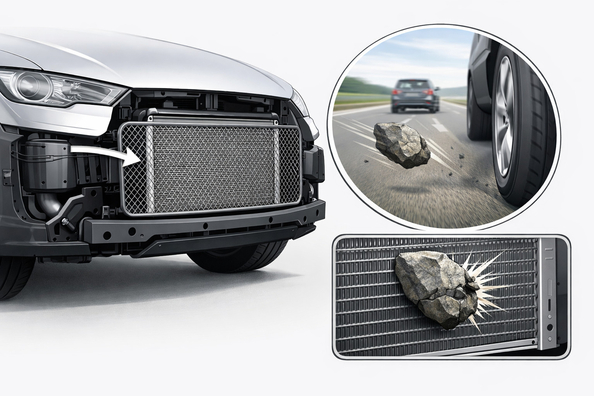

A radiator gets punctured on the highway not because it’s “weak”, but because there’s often a straight shot for a stone to reach it, and the whole cooling pack sits low and takes the hit at speed. The biggest mistake here is thinking any mesh will do. If it’s installed with no gap, poorly secured, or too dense, it may either not protect at all—or it can actually make cooling worse.
The practical approach is simple: first, distinguish a real radiator puncture from a leak at a hose, cap, or joint, and then install protection so it blocks stones without choking airflow. This matters especially on the highway: at speed even a small pebble hits much harder, and an overly dense front blockage noticeably affects heat transfer.
On many cars, the lower part of the front bumper opening is poorly protected or has large cells. Because of that, small stones, asphalt chips, insects, and debris fly straight into the condenser and radiator. If the car often drives on highways, follows closely, and the road surface isn’t perfect, the risk rises quickly.
The second reason is the front-end design itself. On some cars the radiator sits deeper; on others it’s almost right behind the grille. If there’s also an A/C condenser, intercooler, and a tightly packed stack of components, any additional screen must be chosen carefully: there’s less airflow margin there.
DD Tuning expert comment: most mistakes happen in two places—using too fine a mesh across the entire front end or mounting it right up against the radiator. In the first case you get worse airflow; in the second, a risk of abrasion from vibrations. For highway driving, not only the cell size and material matter, but also a proper gap and rigid yet careful fastening.
| Symptom | Likely cause | What to do |
|---|---|---|
| After a highway trip there’s a coolant smell and a wet spot on the radiator | Stone punctured the core or tank | Locate the leak, do a pressure test, don’t delay repair or replacement |
| Temperature rises, but there’s no obvious leak | Mesh or the radiator pack is clogged with insects, fluff, dirt | Clean carefully without high-pressure washing, check fin condition |
| There’s coolant under the car, but the radiator is dry | Hose, clamp, cap, or another system joint | Trace the source along the circuit; don’t replace the radiator blindly |
| After installing protection, the car runs hotter on the highway | Too dense or near-solid blockage of the front | Remove or redo the protection; switch to a more open solution |
| There are scuff marks on the radiator with no impact trace | The screen is installed with no gap and rubs the core | Reinstall with soft pads or abandon that mounting method |
The best option is a screen or mesh mounted in front of the radiator, with a proper fit, no contact with the core, and without sealing off the front end. Partial and more open protection is usually safer for cooling than a solid fine shield across the entire area.
The second thing that truly reduces risk is regular inspection and cleaning. If the protection has already caught insects, fluff, and road grime, it stops working as protection and starts working as an airflow restriction. It’s worth checking the front end at least once every six months, and more often with frequent highway driving.
Third is correct diagnosis after a suspected hit. A cold-engine pressure test quickly shows whether there’s an external leak. If pressure drops more than normal and the outside is dry, don’t automatically blame the radiator: the cause may be another part of the system.
A cheap universal mesh cinched with zip ties “just so it stays on” is a weak solution. It often sits crooked, doesn’t cover dangerous zones, and can start rubbing the radiator over bumps.
Washing the radiator with high pressure doesn’t help either. It easily bends the fins, and after that real cooling efficiency drops even more. Cleaning requires a gentle water flow or air—without overdoing it.
Winter covers are a narrow seasonal solution. In severe мороз they can be appropriate, but you can’t leave them on when temperatures rise: you reduce cooling headroom exactly when you already need it.
If the car часто runs the highway, drives behind trucks, encounters roadworks, or has a large lower bumper opening, a protective aluminum mesh makes sense. It’s stiffer, holds its shape better, and works well where a stable fit without sagging matters.
When you need a softer, simpler solution for a specific opening geometry, you can look at plastic meshes. But for highway use, it’s critical that the material doesn’t flap around and that the cell size isn’t too fine.
Replacing the radiator grille itself makes sense when the factory part has openings that are too large or damaged mounts. But if the issue is an already punctured radiator, the grille alone won’t fix it: first you must stop the leak, and only then build protection.
| Solution | When it works | When it’s not worth spending money |
|---|---|---|
| A tightly fitted screen with a gap from the core | For regular highway driving, an open lower opening, and correct installation | If it’s mounted flush to the radiator or blocks almost the entire front |
| A more open mesh instead of an ultra-fine one | When you need a balance between protection and airflow | If the car already has limited cooling margin in hot weather |
| Cleaning the radiator pack | When there’s overheating without an obvious leak and the front end is clogged with dirt | If there’s a real puncture and coolant is leaking out |
| Pressure-testing the system | To distinguish a punctured radiator from a hose, cap, or joint | If you rely only on a visual inspection and don’t check pressure |
| Winter cover | Only in severe мороз and with temperature monitored | For year-round use or at temperatures above freezing |
From a customer’s experience: after several highway trips, the owner noticed a coolant smell and decided the issue was an old hose. An inspection showed a fresh dent in the lower zone of the radiator, and after replacement he immediately installed a screen with a proper gap and отказался from a fine solid mesh across the entire area. As a result, he got stone protection without higher temperatures in summer heat.
Reducing the risk of a highway stone puncturing your radiator is realistic, but it’s not “any mesh”—only properly fitted protection with a gap, careful fastening, and регулярное cleaning works. If symptoms are already present, first you need to distinguish a radiator puncture from leaking hoses, joints, or the cap, and only then spend money on accessories or part replacement.
The smartest strategy is: protect the most vulnerable zones, don’t block the front end too densely, don’t wash fins with high pressure, and periodically pressure-check the system. This material is based on real selection experience, practical work, and real usage scenarios—not on the myth that any mesh automatically solves the problem.
| ✔ | A properly fitted screen or mesh with clearance from the core really reduces the risk of stone impact if it sits in front of the radiator and does not block the front end completely. It is more practical than universal solutions, because the protection works without direct contact with the radiator. |
| ✔ | Regular inspection and cleaning of the front end help you avoid missing a cooling pack clogged with dirt and notice signs of impact or leaks in time. This is useful for cars that often drive on highways, where the front end quickly collects insects, fluff, and road dirt. |
| ✔ | Pressure testing the system makes it possible to tell a radiator puncture from a hose, cap, or joint leak. This reduces the risk of replacing the wrong part and helps find the real source of the problem faster. |
| ✔ | Partial and more open protection is usually safer for cooling than a solid fine mesh over the entire area. This approach is better suited for highway driving, where it is important to maintain normal airflow. |
| ✘ | A universal cheap mesh, strapped on in a sloppy way, is often skewed and may not cover dangerous areas. It can also start rubbing against the radiator on bumps. |
| ✘ | An overly dense or solid mesh can worsen cooling, especially if the car already has little airflow reserve. On the highway, this may show up as a rise in temperature. |
| ✘ | Installing protection without a gap is dangerous because vibration gradually wears through the radiator fins. In other words, the screen itself can become the cause of damage. |
| ✘ | Washing the radiator with high pressure does not solve the problem and can bend the fins, after which cooling will become even worse. This is not suitable as a way to prevent stone damage. |
Shipping to EU
Wholesale and retail
Own warehouse
Опис продукту
Подарунки не надаються при оформленні покупки у кредит під 0,01% або при покупці частинами.