30.04.2026
543
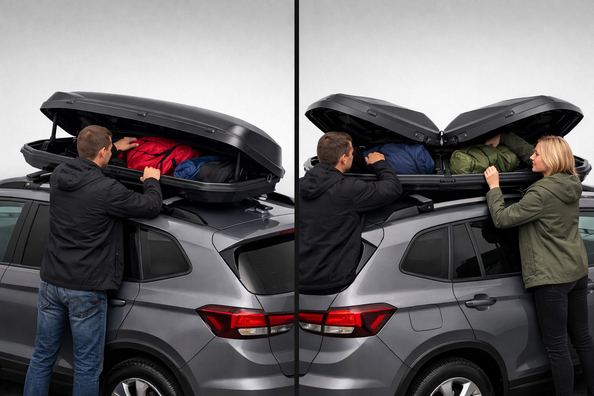

In short: paying extra for dual-side opening makes sense not by itself, but when you open the box often, the car is tall, or parking situations mean access is sometimes from the left and sometimes from the right. For occasional trips, a narrow box, and normal access from one side, a single-side option usually gets the job done for less.
The main mistake is thinking a dual-side box is automatically quieter, stronger, or simply “better”. Noise, fuel consumption, and highway behavior depend much more on the shell shape, crossbars, speed, and load. The opening type itself is primarily about how convenient it is to access your gear.
The choice boils down to one question: which side you’ll realistically need to take things out from. If the car is low, there’s plenty of space around it, and you open the box a few times per season, a single-side setup works fine. If it’s a crossover, minivan, or wagon with a tall roof, and you often load it in a courtyard, parking lot, or roadside, dual-side access saves time and stress.
The second point is the box width and roof layout. Narrow models are often installed closer to one side, so paying extra for opening from both sides brings less practical benefit. But a wide box shifted to make room for bike racks or other roof cargo can become inconvenient without dual-side access on the very first trip.
| Option | Strengths | Weaknesses | Who it’s for |
|---|---|---|---|
| Single-side opening | Lower price for similar volume, simpler construction, often sufficient for narrow boxes and occasional use | Less flexibility in tight parking, less convenient on tall vehicles, harder to reach items on the far side | For those who use a box a few times a year, have normal access from one side, and don’t plan to shift the box to fit other gear |
| Dual-side opening | Access from both sides, more convenient loading on crossovers and minivans, works better in tight spaces and when the box is shifted | Often more expensive, more moving parts, benefits are smaller with narrow models and occasional use | For those who use a box often, have a tall vehicle, park in varied conditions, or also carry other gear on the roof |
This is a sensible basic option when you simply need extra capacity without extra expense. If the box is narrow and mounted closer to the passenger side, access to most items is usually fine. For suitcases, soft bags, and seasonal trips, this is often enough.
The weak point of this setup shows up not on the highway, but in the parking lot. If there’s a wall, another car next to you, or you have to park with the “wrong” side to the curb, part of the loading becomes inconvenient. Another trap is that sellers may label left/right opening differently depending on the market—so check not the wording, but the actual access side on the vehicle.
The main advantage is that you don’t have to adapt to the parking situation. You can open the box from the safer, easier side to reach your gear. On tall vehicles, this genuinely reduces awkward movements, especially when you’re loading heavier bags or long items rather than light jackets.
The extra cost is more justified if the box stays on the roof often: in winter, during vacations, on sports trips, or family routes. But it’s important not to assign extra benefits to dual-side opening. It doesn’t automatically make the box quieter and doesn’t eliminate the impact on fuel consumption. And durability depends on the specific model: in cheaper versions, the more complex hardware can be annoying; in pricier ones, it can instead mean better stiffness and more reliable locks.
If you have a sedan or a low wagon and the box is mainly for summer or vacation trips, a single-side option is most often enough. In daily use, you simply won’t feel the difference strongly enough to justify the extra cost.
For crossovers, SUVs, family trips with frequent stops, winter outings, or combining a box with a bike rack, it’s better to look toward dual-side access. Here you’re not paying for a feature for the sake of it, but for real convenience every time you load up.
| Scenario | What to choose | Why |
|---|---|---|
| 1–3 trips a year, low vehicle, typical parking | Single-side opening | Lower cost, and in this usage pattern the practical difference is usually small |
| Crossover or minivan, frequent loading | Dual-side opening | Easier to access items from both sides and simpler to work on a tall roof |
| Tight courtyard, underground garage, roadside parking | Dual-side opening | You can choose the safer, freer side without compromising access |
| Narrow box for a few bags or skis, limited budget | Single-side opening | On narrow models, the extra opening side often adds little benefit |
| Box plus a bike rack or other roof cargo | Dual-side opening | When the box is shifted to one side, access from both sides saves you from an awkward layout |
A more expensive box is worth buying not when you simply want better trim, but when you’ll definitely use its advantages. That means frequent trips, a tall vehicle, regular loading in tight spaces, the need to shift the box to fit other gear, and a requirement for convenient mounts and a stiffer lid. In that case, it makes sense to look right away at mid- or higher-segment roof boxes, rather than trying to save on a feature that will annoy you on every trip.
If you need a box only occasionally and the scenario is simple, it’s better to invest the budget not in a second opening side, but in the right size, compatible mounts, and better crossbars. That more often delivers more value than a pricier access layout by itself.
Paying extra for dual-side opening is worth it when you’ll truly use it: a tall vehicle, tight parking, frequent loading, an offset box, or a combined roof setup. In other cases, a single-side box is a normal, practical, and often sufficient choice.
So the decision is simple: use it rarely and don’t want to overpay—go single-side. Want maximum convenience in real trips—look at dual-side, but assess it together with the mounts, stiffness, compatibility, and shell shape.
| ✔ | Double-sided opening is more convenient in tight spaces: you can access items from the side with more room and safer access. |
| ✔ | On taller vehicles, it makes loading noticeably easier, since you don’t have to reach over the roof or make extra awkward movements. |
| ✔ | When the box is offset by a bike rack or other roof gear, access from both sides really helps you use it without compromises. |
| ✔ | For frequent use, winter trips, and family travel, the double-sided setup saves time and hassle every time you open it. |
| ✔ | In more expensive models, double-sided access often comes together with better locks, mounts, and a stiffer construction. |
| ✘ | Double-sided models are usually more expensive, and the extra cost does not always bring any benefit if the box is opened rarely. |
| ✘ | There is more hardware in the design, so in cheaper versions the fittings may be less convenient to use. |
| ✘ | The opening type has almost no effect on noise or fuel consumption, so the extra cost is not justified for those parameters. |
| ✘ | For narrow boxes or a simple scenario with access from one side, the extra side often offers little practical gain. |
Shipping to EU
Wholesale and retail
Own warehouse
Опис продукту
Подарунки не надаються при оформленні покупки у кредит під 0,01% або при покупці частинами.