09.04.2026
560
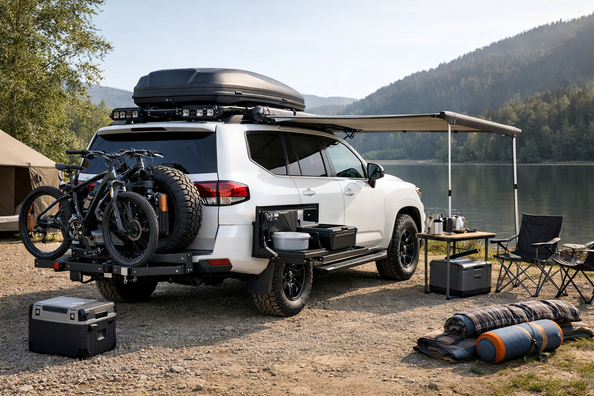
The upgrade package for a Toyota Land Cruiser 300 for family travel should cover five practical needs: safe power for a fridge/charging, control over securing children’s items in the cabin, organized luggage transport (without “chaos” and overload), a proper electrical installation solution for a dashcam and small electronics, and only then—comfort/visual upgrades.
The logic is simple: start with what affects safety and the travel scenario (power, child seat mounting, luggage), then what improves day-to-day convenience, and only after that exterior mods or “nice little extras.”
Family trips differ from “one-off” tuning tasks because you have a repeatable cycle: departure → hours in the cabin → frequent stops → loading/unloading → a night on the road or in a parking lot. So the upgrade should not be about “making the car look nicer,” but about specific risks: not enough energy for devices, discomfort for kids, unclear luggage packing, and electrical issues (especially with an inverter/dashcam).
The Land Cruiser 300 has a base advantage for this scenario: the specs highlight a large cargo area (depending on seat configuration) and existing in-cabin/cargo power solutions, plus overall readiness for family-oriented travel. But that doesn’t mean you can “just add a fridge” and “everything will somehow work out”—it’s the upgrades that make the system manageable.
First priority is a power system built for real consumers. If your trip includes a compressor fridge/cool box, charging for gadgets, and possibly a small inverter, you need: correct power routing, sufficient capacity/operating mode, and circuit protection. In practical discussions, people stress that the inverter must match the load: for sensitive equipment, it’s important that the “sine” is pure, not a compromise.
Second priority is child safety and convenience. Focus on mounting in the 2nd row: ISOFIX is noted on the outer 2nd-row seats, and top tether for 2nd-row positions. If your scenario involves three seats/holders, plan the layout so the mounting works exactly as the vehicle design and the CRS instructions allow.
Third priority is order in the cargo area and controllable loading. The Land Cruiser 300 has a large cargo volume (in the specs—hundreds/thousands of liters depending on configuration), but that doesn’t replace organization: you need nets, straps, containers, and if you travel with “everything,” a well-thought-out roof solution that accounts for weight and mounting limits.
| Upgrade | Why it’s needed | Who truly benefits |
|---|---|---|
| Power for a fridge/cool box (12V/through the right inverter, considering sine type) | So cooling works reliably during stops and while driving, without “voltage drops” and without risking the electrical system | Families who take fresh food/dairy for the whole day; those who sleep away from home |
| Power plan for charging and small electronics (organizing cables/access points) | So kids can charge gadgets, and cables don’t hang in walkways or obstruct evacuation | Families with multiple devices (tablets/power banks/radios/cameras) |
| Mounting and organization for kids’ small items in the 2nd row (shades/organizers/retention) | So items don’t fly around the cabin during braking and it’s easier to keep things tidy | Parents traveling with strollers/bags/toys, and those who often travel with 2–3 kids |
| Luggage organization (containers, nets, straps; volume solution depending on seating) | So “a trunk that sort of fits stuff” becomes a trunk that packs/unpacks predictably and doesn’t block access to the cabin | Those heading to the sea/mountains/cottage: lots of items, but fast access is needed |
| Hardwire for a dashcam (proper connected circuit + grounding) | So you don’t drain the battery “via the cigarette lighter” and you get stable power without random shutdowns | Families who drive a lot on highways/at night and want recordings saved reliably |
| Roof system for seasonal loads within the limits | So you can move suitcases/items out of the cabin without turning it into storage, and without creating overload risk | Those who regularly bring “extra” household items but travel in an organized way: box/carrier—within the rules |
The second stage is about reducing daily friction: easier access to items, more stable stop routines, and less “hassle” when loading. In a real family scenario, you often benefit from proper cabin prep for the road: well-planned places for kids’ items so they don’t constantly need “pass it to me” while moving, plus accessible charging across rows.
It’s also logical at this stage to add solutions for the dashcam and electronics if you still haven’t handled its wiring: connection discipline matters here (the right fuse/operating mode) and neat grounding. For drivers, this reduces the chance of surprises the day after a trip.
If you’re planning roof items—a box or seasonal cargo transport—the second stage is a good fit, because by then you understand what volume you need and how often you end up “not fitting” everything in the trunk. But do it only after calculating weight and mounting: the roof is not about “eyeballing,” it’s about limits.
Comfort upgrades and appearance have the lowest priority in a family scenario. They can be useful, but often “eat up” the budget needed for electrics or organizing the cabin/cargo area. Visual solutions don’t replace the basics: if the fridge doesn’t have enough power or kids’ items aren’t secured, you’ll suffer regardless of how the vehicle looks.
That said, some comfort elements really do reduce fatigue on the road: quality aisle organization, convenient packing of kids’ items, and thoughtful access to chargers and essentials during stops. The idea is simple: comfort should improve controllability, not be “decoration.”
The most common mistake is buying something that looks “right” but doesn’t fit your scenario. For example, an inverter: if it’s not compatible with the type of load, a compressor fridge may run inconsistently, or you’ll burn more energy than planned. Installation materials emphasize that modified sine wave inverters often aren’t suitable for these tasks, and a pure sine wave is needed (with 220 V / 50 Hz as the reference).
The second popular “wasted purchase” is roof solutions without considering weight and speed limits. For Thule Motion 3 class boxes, the specs list a maximum load of 75 kg and a maximum speed of 130 km/h. If you ignore that, you don’t increase comfort—you create risk.
The third mistake is overpaying for visual effect instead of practical function: sometimes it’s cheaper to invest in cargo organization (containers/straps/nets) than in expensive body kits or decorative elements that don’t solve real family problems.
| What to install first | What can be postponed | What isn’t required |
|---|---|---|
| Power supply for a fridge/charging (correct inverter/connection/protection) | Extra small “conveniences” for the cabin (cosmetic holders, non-critical organizers) | Decorative exterior elements without practical function |
| Child seat mounting and checking the row-by-row scenario (focus on the 2nd row and top tether/ISOFIX) | Comfort items that are “nice to have” on long trips but don’t affect safety | Exterior tuning “for looks” if the budget is limited |
| Cargo organization (containers/nets/straps according to how you’ll pack) | Expensive cabin solutions that don’t solve access/order issues | “Upgrades” without understanding where exactly you’ll put things |
| Dashcam hardwire and proper grounding | Additional electronic devices if they don’t affect safety/record retention | Extra USB splitters/adapters if interfaces are already covered |
| Roof load planning (volume/weight/mounting)—only after you understand the trunk isn’t enough | Details of exterior “bling” for the roof (accessories that don’t affect usable volume) | Things that only “fill space” in commercial descriptions but aren’t actually needed |
More expensive solutions make sense where you’re paying for risk control: stable power, proper wiring, and matching inverter/cables to the load. If you’re planning an inverter for a fridge or an expanded electrical zone in the cabin/cargo area, it’s better not to cheap out on compatibility and installation quality: “cheap” often means unstable operation or higher energy consumption.
More expensive approaches are also justified for a dashcam when hardwire installation quality matters: correct connections, a clear power mode, and reliable grounding. If you’re just starting to think about reworking the electrics at all, it makes sense to cross-check your approach with basic upgrade concepts using Land Cruiser 300 tuning as an example: Toyota Land Cruiser 300 tuning.
Separately about roof boxes/solutions: a pricier kit is often a better deal not because of the brand, but because of transparent limits and documentation. For boxes with clearly stated maximum loads/speeds, it’s easier to follow operating rules than to “guess” them from alternatives.
For family travel with a Land Cruiser 300, the optimal upgrade order looks like this: first power for the fridge/charging and basic electrics for electronics (including dashcam hardwire), then child seats and 2nd-row organization, then a systematic cargo setup, and only after that—roof solutions. Comfort and looks are a nice bonus, but only after safety, controllability, and the energy scenario are covered.
Practical verdict: if your list is “fridge + kids + lots of small stuff,” start with electrics and mountings, not decor. These upgrades are what most quickly turn trips into a predictable process rather than a constant fight with cables, luggage, and lack of time at stops.
| ✔ | The package first covers the energy needs for a refrigerator/cool box, chargers, and small electronics, so there are no drops or risks to the electrical system while parked or on the move. |
| ✔ | It provides mounting for children’s items/organization for the 2nd row (with support for ISOFIX on the outer seats and top tether for the 2nd-row positions), so there is less clutter in the cabin during braking. |
| ✔ | It organizes luggage with containers, nets, and straps so that the setup becomes manageable and does not interfere with cabin access or unloading. |
| ✔ | It adds a proper electrical installation solution for a hardwire dash cam, with emphasis on correct connection and grounding, so you don’t have to rely on the cigarette lighter and can maintain stable power supply. |
| ✔ | The staged approach (electrical/safety → child scenario and cabin → luggage → roof) helps avoid spending the budget on "nice-to-have" extras before the practical risks are covered. |
| ✘ | Careful inverter compatibility with the load type is required: if an unsuitable one is chosen, the compressor refrigerator may work unstably or energy consumption may turn out higher than expected. |
| ✘ | Roof solutions can create risks if the maximum weight and speed are not taken into account (for example, Thule Motion 3 specifies 75 kg and 130 km/h), so calculations will be needed rather than choosing "by eye." |
| ✘ | For the system to work predictably, you will have to invest not only in the purchase itself, but also in installation discipline (connection, fuse control, grounding), otherwise there will be "surprises" on the next trip. |
Shipping to EU
Wholesale and retail
Own warehouse
Опис продукту
Подарунки не надаються при оформленні покупки у кредит під 0,01% або при покупці частинами.