20.05.2026
210
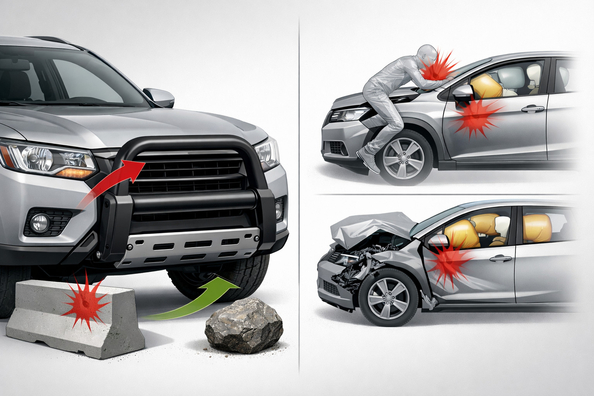
Front protection is often bought with the expectation that it will “save the front end.” In reality, it only takes on part of low-speed contacts: a light bump while parking, brushing against bushes, or occasional hits to the lower area. It won’t protect you from a serious frontal crash, sensor errors, or issues with safety systems.
The main mistake isn’t the accessory itself, but inflated expectations and the wrong choice. On a modern car, a poorly chosen or universal kit can cause more trouble than benefit: false parking sensor alerts, a blocked camera view, radar conflicts, or unnecessary load on the front end.
Front protection is perceived as a structural, load-bearing element, although a car’s OEM front end works very differently: the bumper, brackets, crumple zones, and sensors are designed as one system. Any rigid part added up front changes the impact geometry, meaning it can both shield something and simultaneously create a new risk.
A telling point is that even the requirements for such structures are aimed at controlled scenarios at relatively low speeds and strictly limit weight, shape, protrusion, and clearances. This means one simple thing: front protection is meant to reduce local damage within its intended scenario, not to “armor” the vehicle.
DD Tuning expert comment: the most common mistake is buying a universal bar “so it fits.” On a car with parking sensors and a camera, even a slight misalignment or extra forward protrusion already changes how the front systems work. If the problem appeared immediately after installation, you shouldn’t blame “fussy sensors”—you need to look at kit compatibility and the installation method.
| Symptom | Likely cause | What to do |
|---|---|---|
| Parking sensors beep immediately after installation even in dry weather | The bar sits in the sensor’s detection zone or the sensor is shifted | Check compatibility, sensor seating, and brackets; remove the kit if needed |
| Errors appear only in rain, snow, or frost | Dirt, water, or ice on the sensors or in the gaps | Clean the sensor area, check sealing, and repeat the test in dry conditions |
| The camera shows a cropped image or a foreign object | Incorrect shape or height of the protection | You need a different vehicle-specific kit or отказаться from the accessory |
| There is a message about a malfunction of front assist systems | Conflict with radar, wiring, or connectors | Don’t mask the error—check installation and trim-level compatibility |
| The protection vibrates, knocks, or rubs against the body | Wrong mounting points or bracket misalignment | Reinstall according to the instructions; if the geometry doesn’t line up, the kit is a bad fit |
| After a light contact, both the protection and the bumper were damaged | Wrong type of protection chosen or the risk zone isn’t covered | Revisit the goal: sometimes it makes more sense to repair the OEM assembly than to add a bar |
An accessory makes sense when the task is specific: reduce the risk of minor contacts, cover the lower bumper area, or install compatible protection on a car that actually drives on poor roads. In that case, you don’t look at an “aggressive look,” but at whether the front protection fits your front end specifically.
If the most vulnerable point is the lower part of the bumper, sometimes it’s more logical to look at front bumper protection rather than a high bar. And the bull bars and side steps section should be considered only when, for your trim level, there is no conflict with sensors, the camera, and body protrusions.
Replacing OEM components is often smarter than adding an accessory if the bumper is already cracked, sensor mounts are broken, or the car has a tightly packaged front end with multiple driver-assistance systems. In that situation, restoring the factory geometry is safer than complicating it with an additional metal structure.
| Solution | When it works | When it’s not worth the money |
|---|---|---|
| Vehicle-specific front protection | There is clear compatibility by body, year, and trim level | If the kit “almost fits” or requires on-the-spot modifications |
| Lower bumper protection | The main risk is curbs, low obstacles, light contacts from below | If you expect protection from a serious frontal crash |
| Relocating or correcting sensor mounts | The issue is seating, not the concept of the kit itself | If the tube physically sits in the sensor’s or camera’s field of view |
| Cleaning sensors and connectors and checking after winter | Glitches appear only with moisture, snow, or ice | If errors are consistent in dry weather after installation |
| Repairing the OEM bumper and brackets | You need to restore correct front-end geometry | If the problem isn’t damage but the real-world scenario of minor road contacts |
| Skipping front protection | On a car with a pedestrian airbag, complex assists, or without confirmed compatibility | If there is a proven vehicle-specific solution for your trim level and it solves a specific task |
From a customer’s experience: a crossover owner wanted a heavy-duty bar after a few minor parking-lot contacts. After checking, it turned out the car had a front camera and parking sensors, so they отказались from a high design and chose a more restrained compatible option for the lower bumper zone. As a result, he got protection for his scenario without constant warnings on the dashboard.
Front protection is useful not by itself, but only when it’s matched to a specific car and a specific task. It can take a minor low-speed contact, but it doesn’t replace the OEM front-end structure, doesn’t fix installation errors, and must not conflict with sensors, the camera, or safety systems.
The practical rule is simple: first define what exactly you want to protect against, then verify front-end compatibility, and only then choose an accessory or repair OEM components. This material is based on real selection experience, hands-on practice, and real use cases—not on the myth that one bar can solve everything.
| ✔ | Front protection can really reduce minor damage at low speeds: during parking, light scrapes against obstacles, or contact with the lower front end. In such scenarios, it takes part of the impact instead of the bumper. |
| ✔ | A vehicle-specific kit integrates into the front end much better than a universal bar. If it is matched to the body, year, and trim level, the risk of conflict with sensors and the camera is much lower. |
| ✔ | The protection can be useful for a specific task, for example, to cover the lower part of the bumper from curbs and light contact. This is more practical than expecting it to provide universal protection from all impacts. |
| ✔ | With proper fitment and installation, it does not necessarily interfere with the factory systems if the design and compatibility have been verified. The material directly states that separate brackets, a clear field of view, and no misalignment are important. |
| ✘ | Front protection does not save you from a serious frontal impact and does not replace the factory bumper structure. Its capabilities are limited to minor contacts and controlled scenarios at low speed. |
| ✘ | Universal or poorly chosen kits can create more problems than benefits. Typical consequences include false parking sensor signals, camera blockage, or conflict with the radar. |
| ✘ | Incorrect geometry, crooked brackets, or too large a forward overhang make the accessory problematic. In such a case, it may vibrate, rub against the body, or impair the operation of the front systems. |
| ✘ | On cars with a pedestrian airbag, active sensors, or a front radar, installing such protection without direct compatibility is risky. If the kit “almost fits,” the author advises rather to give it up. |
Shipping to EU
Wholesale and retail
Own warehouse
Опис продукту
Подарунки не надаються при оформленні покупки у кредит під 0,01% або при покупці частинами.