29.05.2026
410


If an odor keeps reminding you of itself on every trip, the problem usually isn’t that your car lacks an air freshener. Most often you don’t need “another scent,” but the right diagnosis and one basic purchase: a cabin filter with activated carbon. But it will only help when the source of the smell isn’t coolant, fuel, exhaust, or a wet floor.
The practical approach is simple: first understand where and when the smell appears, then remove the cause, and only after that add accessories for everyday comfort. Otherwise, on every drive you’ll have to open the windows again, air out the cabin, and wonder why the “new product” didn’t help.
A car interior is a closed space where moisture, dust, organic matter, and vapors build up quickly, and the blower spreads them throughout the cabin. Most often a smell doesn’t appear on its own, but because of a combination of two factors: there is a contamination source and there is moisture that allows it to linger for weeks.
That’s why the same car can smell different depending on the season and driving pattern. In summer, the issue is more often related to the A/C evaporator and drain; in autumn and winter—to wet mats, snow, and a damp floor; while a constant sweet or fuel-like smell points not to maintenance, but to a repair.
DD Tuning expert comment: The most common mistake is buying a strong air freshener instead of checking the cause. If the smell comes specifically with the airflow, you should start with the filter, the evaporator, and checking for moisture under the mats. The second typical mistake is assuming a “once every two years” filter schedule fits everyone, even though city driving, dust, and a wet cabin significantly reduce its service life.
| Symptom | Likely cause | What to do |
|---|---|---|
| Musty smell at A/C start-up | Moisture and dirt on the evaporator, clogged drain, old cabin filter | Check the filter, clean the evaporator, clear the drain |
| Damp smell after rain or snow | Wet mats, floor, moisture in the trunk | Dry the interior completely, remove the water source, don’t leave moisture for longer than 1–2 days |
| Sweet smell and fogging windows | Coolant leak, often through the heater core | Don’t mask the smell—check the cooling system and fix the leak |
| Strong gasoline smell | Issue with the fuel system or fuel vapors | Stop experimenting with air fresheners and go for diagnostics |
| Exhaust smell in the cabin | Exhaust system leak | Inspect the exhaust and seals, don’t delay the repair |
| Smell persists constantly, even without A/C | Trash, organic residue, pets, dirty cabin or trunk | Deep-clean the interior, check hard-to-reach areas, replace the filter if needed |
A cabin filter with activated carbon is the smartest purchase if the source of the smell is already understood and isn’t related to a failure. Its advantage is that it works not only on dust but also partly on unpleasant gases and vapors, so the difference compared to a regular filter is noticeable sooner.
Cleaning the evaporator and drain helps when the stench comes specifically from the ventilation. In practice, this is more important than replacing an air freshener and often more important than the filter change itself—if the filter is new but the evaporator remains dirty.
Fully drying the interior is necessary after any flooding, wet mats, or spilled liquids. If you leave moisture for too long, it will quickly bring the smell back even after cleaning. If the smell is sweet, fuel-like, or exhaust-like, only repairing the cause truly helps.
An air freshener without removing the source only masks it. At best, you’ll smell a “new scent” for a few days, then it mixes with mustiness and the cabin becomes even worse.
Ozone as a universal answer is a bad bet. It doesn’t replace cleaning, drying, and repairs, and when used safely it doesn’t solve many odor sources the way ads promise.
Simply replacing the filter without checking the evaporator also doesn’t always work. If there’s already moisture, dirt, or a clogged drain inside the system, a new filter will only slightly delay the smell’s return.
Accessories make sense when they either prevent the cabin from becoming damp again, or add comfort after the cause has been eliminated. If you want to put together a practical kit without unnecessary purchases, look at car accessories from the standpoint of usefulness on the road—not just visual effect.
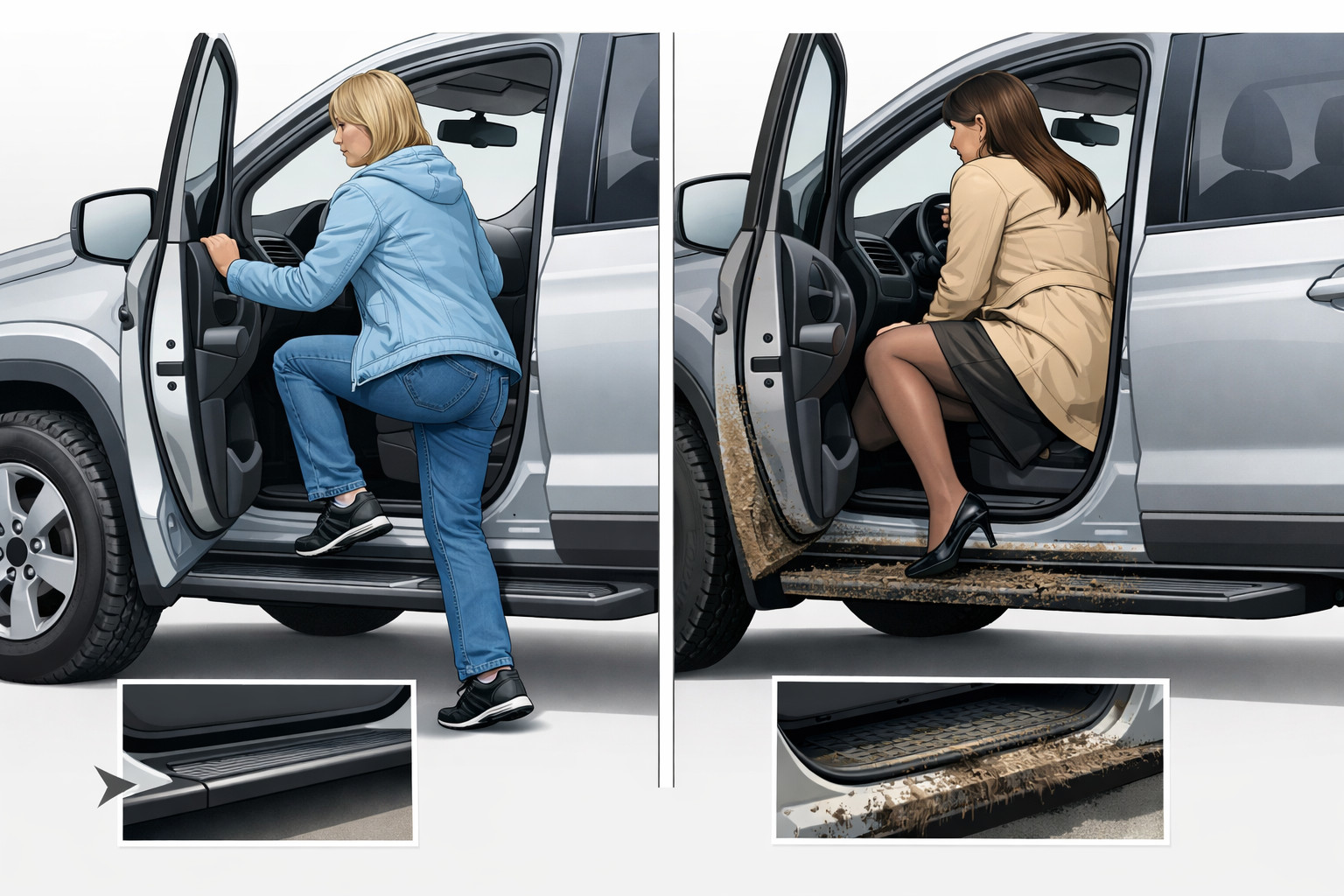
After cleaning the ventilation system, you can add a light background scent with car air fresheners, but only as an add-on. If the moisture source is snow, rain, wet shoes, or items, it’s more logical to start with things that make cleaning easier and don’t hold water in the cabin—for example EVA mats.
Replacing the cabin filter shouldn’t be done “by the calendar for everyone,” but according to operating conditions. If the car is driven in the city, parked in dust, carries pets, or someone smokes inside, you’ll need to change it more often than in a calm suburban routine.
| Solution | When it works | When it’s not worth spending money |
|---|---|---|
| Cabin filter with activated carbon | When the cause is a dirty filter, city dust, mild smells from the ventilation | When there’s a coolant or fuel leak, or severe dampness in the cabin |
| Cleaning the evaporator and drain | When the smell appears at A/C start-up or from the air ducts | When the smell isn’t from the ventilation but from a wet floor or a technical fault |
| Drying the interior and cleaning under the mats | After rain, snow, spilled liquids, transporting wet items | If the smell is sweet, fuel-like, or exhaust-like |
| Air freshener | Only after the cause is eliminated, to maintain a neutral cabin smell | When it’s used to replace cleaning, drying, or repairs |
| Repeated “random” filter replacement | Only if the previous one has truly reached the end of its service life | When the first new filter didn’t help and the A/C system hasn’t been checked yet |
| Repairing the cooling, fuel, or exhaust system | When the smell clearly indicates a technical fault | It should never be postponed by replacing the repair with any accessory |
From a customer’s experience: a driver wanted a simple fix for daily trips and first planned to limit it to an air freshener. After inspection, it turned out moisture was trapped under the mat and the cabin filter hadn’t been changed for a long time; after drying the interior, cleaning the system, and installing a carbon filter, the unpleasant smell disappeared. The air freshener was kept only as a light background—not as a way to fight the cause.
If you want to buy something truly useful for driving and stop thinking about an unpleasant odor every time you’re on the road, start not with a freshener but with the cause. In most everyday cases, a combination of proper diagnostics, drying the cabin, cleaning the evaporator, and replacing the cabin filter with an activated-carbon version works. An air freshener is appropriate only after that, while the smell of coolant, fuel, or exhaust requires a repair—not an accessory.
This material is based on real experience with selection, hands-on practice, and real usage scenarios: what helps in daily operation and what isn’t worth spending money on twice.
| ✔ | A cabin air filter with activated carbon really helps if the smell is coming from the ventilation system or the filter has not been changed for a long time. It not only traps dust, but also partially reduces unpleasant gases and vapors, so the effect is more noticeable than with a regular filter. |
| ✔ | Cleaning the evaporator and drain removes the source of the musty smell that often appears when the air conditioner is first turned on. This is more practical than trying to mask the problem with an air freshener. |
| ✔ | Thoroughly drying the cabin after rain, snow, or spilled liquid helps prevent the smell from coming back. If the moisture is removed in time, the smell does not return so quickly after cleaning. |
| ✔ | After the cause has been eliminated, an air freshener can be used as a light background scent rather than the main way to fight the smell. This allows you to maintain a neutral smell in the cabin without expecting too much from it. |
| ✘ | An air freshener without eliminating the source of the smell works only as a mask. In the cabin, it quickly mixes with mustiness, and the problem becomes even more noticeable. |
| ✘ | Ozone is not a universal solution and does not replace cleaning, drying, or repair. The article directly states that it does not solve many causes of smell the way it is often promised. |
| ✘ | Simply replacing the cabin air filter without checking the evaporator and drain does not always produce results. If moisture or dirt remains inside the system, the smell returns quite quickly. |
| ✘ | If the smell is sweet, fuel-like, or exhaust-like, there is no point spending money on accessories — repair is needed. In such cases, it is already a sign of a technical fault, not a comfort issue. |
Shipping to EU
Wholesale and retail
Own warehouse
Опис продукту
Подарунки не надаються при оформленні покупки у кредит під 0,01% або при покупці частинами.