04.07.2026
216
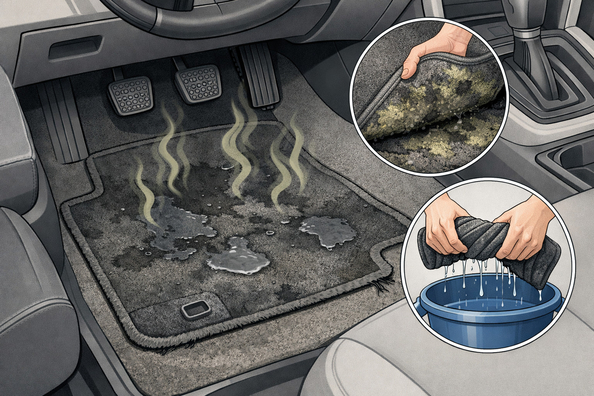
If textile floor mats have started to smell musty and take two days to dry, the problem is almost never the textile as a material. Most often, moisture gets trapped in the pile, the backing, or underneath the mat, and the smell means water has been sitting there for too long. If the smell comes back quickly after washing, you need to look for the source of moisture rather than just soaking it in chemicals again.
In dry weather, textile mats are perfectly fine, but in winter, slush, rain, and with frequent wet entries they become demanding to maintain. The practical threshold is simple: if the mat or its bottom layer stays damp for more than 24–48 hours, if you see delamination, cracks, holes, or slipping, it’s no longer worth saving at any cost—you should consider replacement.
Textile collects dirt and water not only on the surface, but also inside its structure. When moisture passes through the pile into the backing, the top of the mat may feel almost dry while the underside is still wet. Air circulation under it in the cabin is weak, so it takes longer to dry than it seems.
The second reason is geometry. If the mat is short, universal, or has gaps along the edges, water from shoes goes not only into it but also under it. There, it lingers longer than on an open surface. That’s why the smell often returns even after a proper cleaning of the mat itself.
Start not with the smell, but with moisture. Remove the mat and check the underside with your hand and the floor underneath it. If it’s dry on top but wet underneath, the issue is trapped moisture, not “bad-smelling fabric.”
Next, dry two areas separately: the mat itself and the cabin floor. If the mat dries completely outside the car and no longer smells, but after putting it back the smell returns, the source isn’t just the mat. You need to check the carpet underneath, the underlay, drains, and the cabin filter.
Another simple test is localization. If it’s wet only near the driver’s feet in winter, the cause is often straightforward: daily water from shoes. If moisture appears after rain even without driving, look for leaks. If the edges are wet while the center is relatively dry, the problem is the mat’s shape and coverage.
DD Tuning expert comment: the most common mistake is to clean the top of the pile, smell the mat an hour later, and decide everything is fine. In reality, the odor often sits in the bottom layer or in the carpet underneath. The second typical mistake is covering an old wet textile mat with another mat so “the dirt isn’t visible”: that keeps the moisture trapped inside even longer.
| Symptom | Likely cause | What to do |
|---|---|---|
| Musty smell is stronger in the morning or after rain | Hidden moisture in the backing or under the mat | Remove the mat, dry it and the floor separately, check drains and the carpet |
| Top seems dry, but the bottom is wet | Water gets trapped underneath due to poor ventilation | Dry both sides; don’t put it back until fully dry |
| After washing, the smell disappears for a day or two and returns | The mat or the floor wasn’t dried completely | Repeat cleaning only with full airflow drying for at least a day |
| Mostly wet in the driver area in winter | Daily water from shoes | For the cold season, switch to a different type of mats or keep a separate winter set |
| There’s a smell, but the mat itself is almost dry | The source isn’t the mat, but the floor, filter, or a leak | Check the cabin carpet, filter, A/C drain, seals |
| The mat slips, edges are raised, delamination is visible | Material is worn out | Don’t do cosmetic fixes—replace it |
Only an approach that removes the source works—not one that masks the result. Start with dry cleaning, then proper washing, and after that—long drying with airflow. A towel for blotting moisture, an open space, a fan, or steady airflow works better than just an hour in the sun.
The second step is checking the floor under the mat. If it’s wet, cleaning the textile alone is pointless. You need to dry both the mat and the base beneath it. If after that the smell doesn’t go away, you should look not at the accessory, but at the reason the cabin is getting wet.
A seasonal approach also helps: keep textile for the dry period, and for winter or frequent wet trips switch to solutions that don’t absorb water as deeply. If the mat doesn’t dry within 24–48 hours, the smell returns after proper drying, or the bottom layer is already damaged, replacement is more practical than yet another round of chemicals.
Fresheners, fragrances, and dry powders don’t remove the source of the odor. They only cover it for a few days, after which the mustiness returns. The same applies to “light refreshing cleaning” without full drying.
It’s a bad idea to put a new or rubber mat on top of an old damp textile one. You won’t solve the problem—you’ll preserve moisture underneath. Repeated shampooing with lots of water also barely works if you have no way to properly extract and dry the residual moisture.
If the car is driven mostly in a dry city and the smell appeared after one heavy soak, it makes sense to stick with textile mats, but only after complete drying and checking the floor. If wet shoes, snow, and slush are routine for you, it’s more practical to switch to rubber cabin mats, which are easier to shake out and dry.
It’s also worth looking at the trunk. If moisture often comes into the cabin from wet items, jerry cans, tools, or a stroller, rubber trunk mats are useful. This won’t cure odor under your feet directly, but it removes another steady source of dampness in the car.
You should replace a mat when it no longer holds its shape, slips, delaminates, or continues to stink after proper cleaning and drying. Don’t buy new textile if the carpet underneath is wet: first eliminate the cause, otherwise the new set will share the old one’s fate.
| Solution | When it works | When it’s not worth spending money |
|---|---|---|
| Deep cleaning and complete separate drying | The mat is intact, the smell appeared recently, the floor isn’t damaged | If after complete drying the smell quickly returns |
| Finding and eliminating the moisture source | The carpet is wet, moisture appears after rain or without obvious wet shoes | Don’t buy a new set without fixing a leak or drainage issue |
| New textile set | The car is used mostly in dry conditions; you want comfort and a quieter cabin | If there’s daily snow, slush, frequent spills, or prolonged dampness |
| Switching to rubber or all-season mats | For winter, rain, frequent wet entries, and heavy textile maintenance | If the car is almost always dry and the issue was a one-off rather than systemic |
| Extra trunk protection | You often carry wet items, tools, containers, or gear | If dampness occurs only in the front and the trunk has nothing to do with it |
From a customer’s experience: a typical situation—textile mats were washed several times, but the smell returned within a week. After removing them, it turned out the underlayer under the driver’s area was constantly wet, even though the top looked decent. In the end, they kept textile for the warm season and switched to a separate set for winter, and the problem of constant dampness disappeared.
Textile mats smell and take a long time to dry not because they’re “bad,” but because moisture is getting trapped somewhere. If the mat doesn’t dry within 24–48 hours, the smell returns after proper cleaning, and the bottom layer or shape is already damaged, replacement is justified. If the issue is one-off and the material is intact, proper cleaning, full drying, and checking the floor underneath are often enough.
The most important thing is not to confuse cosmetic masking with a real solution. This material is based on real selection experience, practice, and real usage scenarios: first we look for the source of moisture, then we decide whether it’s worth saving the textile or switching to a format that better fits your conditions.
| ✔ | The text clearly explains that odor and long drying time are usually not caused by the textile itself, but by moisture in the backing or under the mat. This helps avoid wasting time on repeated chemicals and look for the real cause. |
| ✔ | There is a clear practical threshold for when the mat should already be replaced: if it or the lower layer stays wet for more than 24–48 hours, delamination, cracks, holes, or slipping appear. |
| ✔ | The material gives a clear inspection algorithm: separately assess the mat itself, the floor under it, and the source of moisture in the cabin. This makes it possible to distinguish a mat problem from leaks, drains, or wet carpeting. |
| ✔ | It also shows what works in practice: thorough drying with an airflow, checking the floor under the mat, and a seasonal switch to a different type of mats in slush or winter. This is useful for those who regularly drive in wet conditions. |
| ✔ | The article clearly separates when it makes sense to save the textile and when it is more practical to switch to rubber or all-season mats. This helps make a decision without unnecessary spending on a new set. |
| ✘ | The article does not offer a universal solution for cases when moisture comes not from the mat, but from the cabin — then you will have to separately look for leaks, drains, or seal issues. This can take more time than simply replacing the mat. |
| ✘ | Textile mats require disciplined care: they need not only to be washed, but also completely dried, otherwise the smell returns. For daily slush or wet shoes, this is inconvenient. |
| ✘ | If the mat has already delaminated, slips, or is damaged underneath, cosmetic cleaning will not help. In this state, you will have to spend money on replacement rather than on an inexpensive repair. |
Shipping to EU
Wholesale and retail
Own warehouse
Опис продукту
Подарунки не надаються при оформленні покупки у кредит під 0,01% або при покупці частинами.