02.07.2026
311
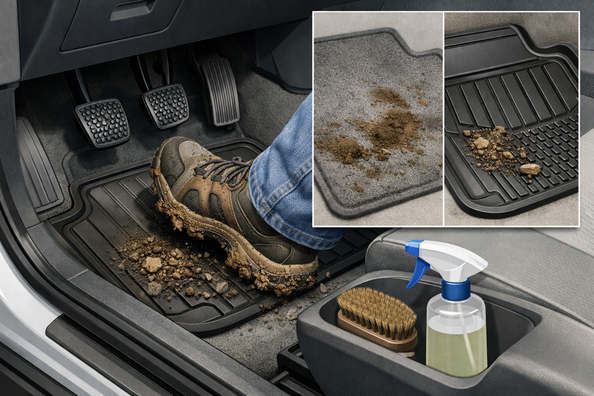
Dirt on the floor doesn’t appear because your shoes are “super dirty,” but because sand, water, snow, and road salt slip past the edge of the mat every day, build up underneath it, and get ground into the carpet. That’s where stains, dampness, odors, and a worn area near the pedals come from.
In most cases, the problem isn’t fixed by a single cleaning—it’s the wrong type of mat, weak floor coverage, or missing retention. If you understand exactly where the dirt gets through—along the edges, under your heel, in the pedal area, or under the mat itself—the solution becomes obvious.
Shoe soles bring not only dry dust into the cabin, but a mix of fine sand, water, snow, and salt. When a mat doesn’t cover the entire footwell or has a low rim, that mix goes into the carpet—then you don’t notice it until salt marks appear, moisture shows up under the mat, or an odor develops.
In dry weather, the main enemy is abrasive sand that wears down the pile and turns the floor a dirty gray. In slush, it’s different: moisture lingers longer than you think, especially if you rarely remove and dry the mat. That’s why the same set can be fine in summer and weak in winter.
The best check takes just a few minutes after one rainy or snowy day. Don’t wash the interior right away—this makes it easier to see where the protection setup isn’t working.
DD Tuning expert comment: The most common mistake is looking only at the material and not at the floor shape. A universal mat may look fine in a photo, but in the car it leaves the area by the left foot or the pedals exposed. The second typical mistake is placing one mat on top of another in winter, after which it starts shifting and no longer keeps dirt where it should.
| Symptom | Likely cause | What to do |
|---|---|---|
| Sand collects along the edges of the mat | The mat doesn’t match the footwell shape or is too small | Switch to a vehicle-specific mat with fuller coverage |
| Moisture or salt under the mat | Weak retention, low rim, or the mat is rarely removed | Check the fasteners, regularly remove, wash, and dry the mat and the floor |
| Carpet worn under the heel | Worn driver’s mat or an exposed high-load area | Replace the driver’s mat or add heel-area protection if the overall fit is correct |
| The mat slides toward the pedals | No retainers, they’re broken, or mats are stacked one on top of another | Keep only one mat, restore proper fastening, do not use the car with a loose, moving mat |
| Dampness and odor appear in the cabin | Moisture accumulates in the carpet and stays unnoticed on top for a long time | Dry the floor, wash the mats, switch the protection type to all-weather |
| Dirt returns quickly after cleaning | You removed the symptom, not the cause: weak coverage or unsuitable material | Change the protection setup instead of just repeating carpet cleaning |
If the car is used daily in the city and the main issue is sand, crumbs, and moisture from shoes, it makes sense to look at EVA cabin mats: the cells keep fine dirt localized, and the mat itself is easy to shake out. If your driving includes more meltwater, snow, and salt, rubber mats with a solid working surface and a pronounced rim are more often justified.
It also makes sense to protect the trunk if you regularly carry wet items, a stroller, tools, or spare shoes: then a trunk mat removes another source of dirt. But if the retainers are broken or the driver’s mat is worn down to nothing, you should start not with “better material,” but with restoring proper fit and replacing the worn element.
| Solution | When it works | When it’s not worth spending money |
|---|---|---|
| Vehicle-specific EVA mat | Daily city use, lots of sand, mixed dry and wet weather, fast cleaning needed | If the owner isn’t ready to regularly shake water and dirt out of the cells |
| Vehicle-specific rubber mat | Winter, slush, snow, salt, frequent short trips with wet shoes | If the problem isn’t moisture but that the mat simply doesn’t stay fixed or doesn’t fit the shape |
| Textile mat | Dry season, little moisture, interior is cleaned often | For fall and winter, when the main enemy is wet sand and salt |
| Replacing the driver’s mat or adding heel-area protection | When the main wear is localized and the rest of the coverage fits correctly | If the mat is generally too small, slippery, or leaves edges exposed |
| Carpet deep cleaning | After the cause has already been fixed and you need to remove the consequences | If you don’t change the mat type, retention, and care routine |
| Universal mat as a temporary option | Only for a short time and only where it truly doesn’t leave gaps | For ongoing use in the wet season or in a car with a complex floor shape |
From a customer’s experience: a person came in with a simple complaint—after every slushy day the driver’s carpet was wet again, even though there were mats. During the check, it turned out the carpet mat left the area near the gas pedal exposed, and there was always salt underneath. After switching to a vehicle-specific mat with retention and getting into the habit of shaking it out every few days, the dirt stopped spreading through the cabin and the floor no longer stayed damp.
To keep everyday dirt from shoes from ruining the interior, you need to cover not only the center of the floor but the entire working zone: edges, heel area, the section near the pedals, and places where water accumulates. Most often, a simple combination works: a vehicle-specific mat for the season, proper retention, and regular washing without letting moisture build up underneath.
If you limit yourself to a universal mat or a one-time carpet cleaning, the effect will be short-lived. This material is based on real selection experience, hands-on practice, and real-world usage scenarios, so the main advice is simple: first find the point where dirt slips past the protection, and only then spend money on accessories.
Shipping to EU
Wholesale and retail
Own warehouse
Опис продукту
Подарунки не надаються при оформленні покупки у кредит під 0,01% або при покупці частинами.