01.06.2026
1000
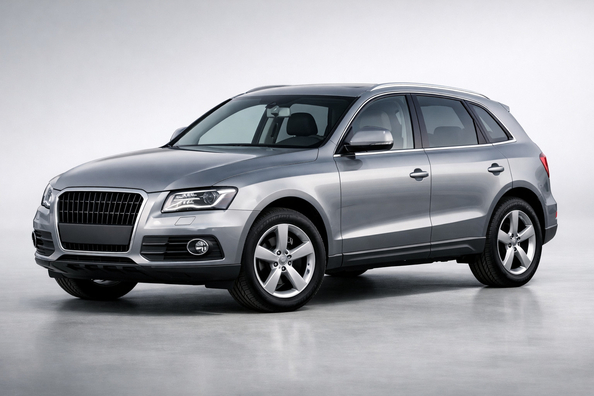

The first-generation Audi Q5 is one of the few used premium crossovers that still feels like a sensible buy rather than just a pretty badge with future bills attached. It strikes a strong balance: the cabin feels above its class, the handling isn’t vague, quattro all-wheel drive adds confidence, and the boot and second row don’t force everyday compromises.
But this isn’t a car for those who want premium at mass-market running costs. A Q5 is worth buying only with a transparent service history, because the condition of the specific car matters more here than a nice options list or fresh polishing shine.
On the used market, the Audi Q5 2008-2017 holds its value for a simple reason: it doesn’t feel outdated in the basics. The driving position is comfortable, the interior is solidly assembled, city noise insulation is decent, and its road manners sit somewhere between the firmer BMW X3 and the softer Lexus RX. That’s why the Q5 suits a family, a city driver, and those who do a lot of motorway miles.
It won’t suit buyers looking for minimal service costs, the simplest possible electronics, or the newest safety assistants with no compromises. This is old-school premium: pleasant in daily life, but sensitive to skipped maintenance.
The first-generation Q5 debuted in 2008, and in many markets is listed as model years 2009-2017. The second generation started from 2018, so in listings it’s important to check not only the year on the registration, but also the VIN and the car’s market of origin.
There’s another important detail: specifications vary heavily by country. In some markets petrol versions and the hybrid dominate, while in others diesels are more common. Because of this, comparing “all first-generation Q5s” without specifying the version isn’t entirely correct.
Among confirmed versions for different years and markets, it makes sense to ориент yourself around these engines: the 2,0 TFSI with 211 or 220 hp, the 3,0 TFSI with 272 hp, the hybrid based on the 2,0 TFSI with a combined 245 hp, and the 3,0 TDI with 240 hp. Early years had other options depending on the market, so the exact engine lineup should be verified by VIN.
There are differences in transmissions by year as well. The early 3,2 V6 had a 6-speed Tiptronic automatic, while petrol versions in 2013-2017 used an 8-speed automatic with manual mode. quattro all-wheel drive was standard on the Q5, and that’s one reason the model is still valued in regions with harsh weather.
In practical terms, the 2,0 TFSI is a compromise between performance and running costs, the 3,0 TFSI suits those who often drive on the motorway or tow a trailer, and the 3,0 TDI is attractive for its torque and efficiency on long distances. But it’s the early 2,0 TFSI that needs the most careful inspection due to well-known stories about oil consumption, carbon buildup, and cooling-system components.
By size, the Q5 doesn’t turn into a bulky crossover, but it delivers noticeably more everyday usefulness than a hatchback or saloon. For later versions of the generation, the benchmarks are: length 4637 mm, width 1898 mm, height 1655 mm, wheelbase 2807 mm, ground clearance 201 mm. Boot volume is 824 L behind the second row and up to 1622 L with the backs folded.
| Parameter | Value | What it means in practice |
|---|---|---|
| Generation | First, model years 2009-2017 | The market has many cars from different countries with different drivetrain combinations |
| Body and interior | 5-seat compact crossover | Works for a family without feeling oversized |
| Dimensions | 4637 × 1898 × 1655 mm | Easier to live with in the city than larger premium crossovers |
| Wheelbase | 2807 mm | A solid amount of space for the second row |
| Ground clearance | 201 mm | Enough for kerbs, snow, and gravel roads, but it’s not an off-roader |
| Boot | 824/1622 L | One of the model’s strongest arguments for everyday use |
| Fuel tank | 74,9 L | On the motorway, the range is convenient even in petrol versions |
| Towing | Up to 1996 kg | The Q5 is suitable not only for the city, but also for a trailer or active leisure |
| Confirmed engines | 2,0 TFSI 211-220 hp; 3,0 TFSI 272 hp; hybrid 245 hp; 3,0 TDI 240 hp | The choice is wide, but condition matters more than the quoted power output |
| Drivetrain and gearboxes | quattro; 6- or 8-speed automatic depending on year | A strong base for daily driving, motorway use, and winter |
The Q5’s suspension is tuned not for sporty showmanship, but for a sensible balance. The car doesn’t feel boaty, yet it doesn’t punish you with harshness over every patch. That’s exactly what keeps it relevant: even with age, it doesn’t feel like a random purchase.
The cabin is one of the main reasons to look specifically at the Q5. Materials, driving position, build quality, and the overall feel of the interior are strong even by today’s standards. On later versions, the second row offers 40/20/40 seatbacks, recline adjustment, and fore-aft sliding, so the car adapts well to family scenarios.
Equipment isn’t sparse either: panoramic roof, leather interior, three-zone climate control, power tailgate, a decent audio system, xenon or LED lighting. Safety includes standard stability control, traction control, and front, side, and curtain airbags. But it may lack the modern active electronic assistants people are used to in newer models.
In daily driving the Q5 is convenient: a high seating position, adequate visibility, a roomy boot, and a large tank make it a solid all-rounder for every day. For fuel consumption, the rough benchmarks are: the petrol 2,0 TFSI, depending on year and measurement method, usually lands around 8,7-11,8 L/100 km; the 3,0 TFSI needs noticeably more; the diesel and hybrid look more economical.
But ownership won’t be cheap. Premium fuel, pricier parts, sensitivity to missed fluid changes, and typical age-related risks mean you should focus not on the entry price, but on the total budget. Before buying, it’s advisable to separately check service history, recall campaigns related to the fuel system and gearbox units, as well as the condition of the cooling system.
In real-life use, the Q5 appeals not by one standout figure, but by a collection of many small, smart choices. The problem is that these advantages fully show only on a well-maintained car.
| Pros | Cons | What it means for the owner |
|---|---|---|
| A very well-executed interior and a great driving position | Infotainment and control logic already feel noticeably outdated | The car is pleasant to live with, but you’ll need to get used to the electronics |
| Roomy boot and a convenient second row | Road noise can be noticeable on the motorway | Strong for family use and trips, but not perfectly quiet |
| Balanced handling and standard quattro | Servicing and repairs aren’t cheap | It drives with confidence, but you can’t really save on maintenance |
| Good torque, ground clearance, and towing potential | Early 2,0 TFSI can have issues with oil, carbon buildup, and cooling | Better to pay extra for a transparent history than to pay for a major repair later |
In short, the Q5’s strength is the feel of a cohesive, expensive car without an obvious bias in one direction. Its weakness is the high cost of a mistake when buying a bad example.
For the first Q5, the most sensible approach isn’t aggressive tuning but practical upgrades. If the car is bought for a family, trips out of town, or motorway driving, it’s worth first checking the full catalogue for Audi Q5 and covering the everyday basics: interior and boot protection, roof carrying solutions, and body protection from dirt.
Performance tuning for the 2,0 TFSI and 3,0 TFSI can make sense in theory, but only after a complete diagnostic. With older premium cars, you should first get the engine, cooling, gearbox, and suspension into proper shape—and only then think about extra loads.
The first-generation Audi Q5 is still worth considering if you need a used premium crossover with a strong interior, good practicality, and sensible on-road behaviour. It’s a good buy for those who are willing to pay for condition and servicing; it’s not for those who just want “cheaper premium” without a maintenance buffer. This piece is based on real selection experience, practical know-how, and real usage scenarios rather than a dry options list, and that’s why the main advice is simple: with a Q5, you’re not buying the model—you’re buying a specific well-kept example.
| ✔ | The Q5’s interior looks and feels more expensive than its age suggests: the quality materials, comfortable seating position, and solid build quality are all clearly noticeable in everyday driving. |
| ✔ | The car is well suited to family use: it has a spacious trunk, a decent second row, and enough room without the body feeling bulky. |
| ✔ | Its on-road behavior is well balanced, and the standard quattro adds confidence on wet roads, in winter, and on the highway. |
| ✔ | It offers a practical level of versatility: the ground clearance is enough for the city, snow, and dirt roads, while the towing capacity and torquey engines make the Q5 useful for more than just asphalt driving. |
| ✔ | For everyday use, the Q5 is convenient: the high seating position, decent visibility, and large fuel tank make both city driving and long trips easier. |
| ✘ | Maintenance and repairs are not cheap, so the Q5 is not for those expecting mass-market running costs. |
| ✘ | The multimedia system and control logic are already outdated, and many versions may lack modern active electronic assistants. |
| ✘ | Road noise can be noticeable on the highway, so this is not the best choice for those who expect perfect quiet from an older premium car. |
| ✘ | Early 2,0 TFSI engines require especially careful inspection due to known issues with oil consumption, carbon buildup, and cooling components. |
Shipping to EU
Wholesale and retail
Own warehouse
Опис продукту
Подарунки не надаються при оформленні покупки у кредит під 0,01% або при покупці частинами.