31.08.2026
64
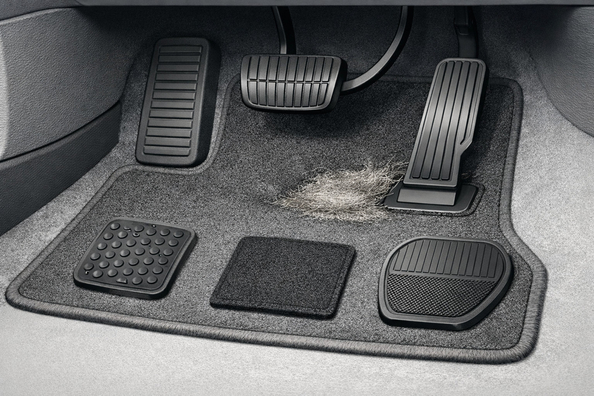
When your heel quickly rubs through the mat near the pedals, it’s usually not a “weird defect” but constant point friction in the same spot. If you simply tape over the hole or put another mat on top, the cause doesn’t go away: the load stays in the same place, and sometimes you also add the risk of the mat shifting toward the pedals.
A different approach works in practice: first remove everything that makes the mat move or deform, then protect the heel area. If the mat is already thin, creased, or damaged underneath, a local patch rarely lasts long — in that case you need either a new compatible mat, or a separate heel pad, or both together.
The driver’s heel almost always acts as a pivot point: the foot doesn’t just rest there, it constantly rotates and slides between the pedals. That’s why wear doesn’t spread across the whole surface, but concentrates in a very small area. That’s where a shiny worn spot appears first, then the top layer is cut through, and after that the mat’s base starts to suffer.
The wear rate strongly depends on the mat’s construction and your driving pattern. In the city, where your foot often moves from the gas to the brake, and in cars with more active pedal work, the load is higher. In winter and in the rain, sand, salt, and moisture speed things up: they act like an abrasive and finish off the heel area faster.
Start simple: leave only one set of mats in the car and check whether the driver’s mat is installed on the factory retainers. Next, with the engine off, fully press each pedal and see whether the mat catches on an edge, a fold, or an overlay. If it does, the issue is no longer just wear — it’s also a safety concern.
Look at the damaged area itself. If there’s a clearly worn spot almost in one place and the mat lies flat, the cause is your heel pivoting. If the wear is stretched diagonally, an edge curls up, or the mark shifts, the mat is moving. If the hole on top is small but the base underneath is already soft, cracked, or crumbling, glueing it won’t give you decent service life.
Also assess how the car is used. If the biggest wear progress happens in fall and winter, and it’s often wet and dirty under your foot, one overlay may not be enough: you need a material that handles water better, plus protection specifically in the heel zone.
DD Tuning expert comment: the most common mistake is installing a heel pad on a mat that already shifts or has a worn-out base. The second typical mistake is putting another universal mat on top “so it won’t wear through.” First you need to achieve proper fitment and secure retention, and only then reinforce the heel area. After any installation, always check full pedal travel.
| Symptom | Likely cause | What to do |
|---|---|---|
| A bald spot or hole clearly in one point | Constant heel friction with normal mat fitment | Install a heel pad or replace the mat with a new one that has reinforced heel area |
| Wear runs in a strip, the mat bunches into a fold | The mat shifts or doesn’t match the shape | Remove the extra layer, restore retention, or replace with a compatible mat |
| A patch doesn’t last long and peels off | The base is already weakened, the load stayed the same | Don’t waste time on new glue patches — replace the mat or install a heel pad on a solid base |
| Wear increases sharply in rain and winter | Moisture, sand, and salt act as an abrasive | Switch to a more practical all-weather material and protect the heel zone separately |
| The mat edge moves closer to the pedals | Double-layer mats or a poor shape | Remove the second layer immediately and check full pedal travel |
The best result comes not from one trick, but from the right sequence of actions. First, you keep one compatible mat with proper retention. Then you assess its condition: if the problem is only localized abrasion, a separate heel pad takes the impact and noticeably slows down wear. But if the mat shifts or is already tearing not only on the surface, it needs to be replaced, not patched.
For a dry interior and normal textile mats, it’s often enough to reinforce the heel pivot point. For the wet season, more practical are materials that don’t hold water and dirt for so long — but even they don’t eliminate point loading. In other words, in wet weather the best setup is a combination: a moisture-resistant mat plus heel-zone protection, not just one or the other.
Another practical criterion is simple: if after installation the mat lies flat, doesn’t shift, and the pedals move freely, the solution is chosen correctly. If you have to bend edges, put something underneath, or live with a fold — that’s not a solution.
If the mat is still intact, well secured, and only one point suffers, it makes sense to install the V2 heel pad. It’s cheaper and more practical than waiting for a hole to go all the way through.
If you need a different shape or type of protection for a specific mat, check out heel pads for car mats. And when the car constantly drives through wet mud, snow, and sand, EVA mats make more sense: they’re more practical in the wet season, but they also must be installed with no compromises on retention.
You should plan to replace the mat itself when not only the surface but also the base is damaged, or when the shape near the pedals is poor from the start. In that situation, even a good heel pad won’t fix a weak foundation.
| Solution | When it works | When it’s not worth spending money |
|---|---|---|
| Separate heel pad | The mat is intact, lies flat, and only the heel area wears | The mat shifts, has cracks, or a weak base |
| New compatible mat with retention | The old mat won’t hold its shape, creeps toward the pedals, or is already worn through in the base | The problem is only one localized point and the rest of the mat is in good condition |
| All-weather material for the wet season | The car often drives through water, snow, sand, salt | You expect the material alone to fully remove point wear without heel-zone protection |
| Glue patch | As a very short-term temporary measure until replacement | You need long service life or the spot is already heavily worn |
| Second mat on top | Almost never | Always, when it comes to the driver’s area near the pedals |
From a customer’s experience: a driver came in with a typical complaint — after a year, a new mat wore through under the heel again. During inspection it turned out there was another thin universal mat on top, and the lower mat had already lost stiffness. After they left one set, corrected the fitment, and added protection in the heel zone, the problem stopped coming back, and pedal operation remained free.
The real cause of wear-through is almost always one of three: point heel friction, mat shifting, or an already weakened base. That’s why the solution should be chosen not “by eye,” but by symptoms: first compatibility and retention, then heel-zone protection, and if the base is worn out — a full mat replacement.
Most often, what works is the combination of one properly installed mat and a separate heel pad. What doesn’t last are patches on a worn spot and double-layer mats. This material is based on real selection experience, hands-on practice, and real usage scenarios — not universal advice without checking in the car.
Shipping to EU
Wholesale and retail
Own warehouse
Опис продукту
Подарунки не надаються при оформленні покупки у кредит під 0,01% або при покупці частинами.