31.03.2026
287
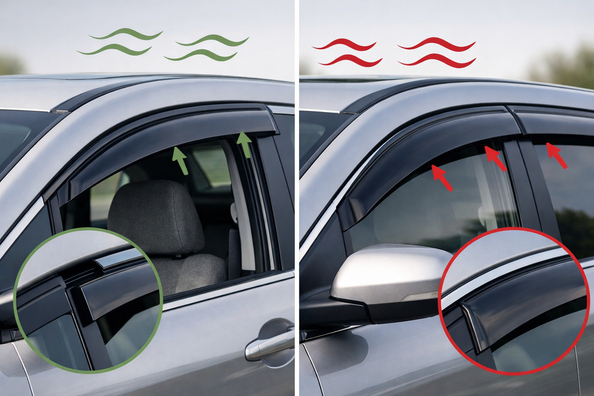
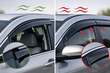
If you need a short answer, then for most cars the best choice starts not with “in-channel or stick-on”, but with “is there an exact kit for my model”. In-channel window deflectors often look cleaner and give a more integrated fit because they sit in the window channel. Stick-on ones are more often easier to install and less stressful in daily use if the glass is sensitive to any additional pressure at the top of the frame.
When it comes to quietness, there’s no clear winner. Both types can slightly reduce air turbulence with the window cracked open, but real noise depends much more on the deflector’s geometry, the mirrors, the seals, and how evenly the part sits on the car.
The main difference between these two types is the mounting method—and everything that follows from it. In-channel deflectors go into the window channel, so they don’t have external adhesive tape and usually look closer to an OEM solution. But for that same reason they can be sensitive to shape accuracy, window regulator operation, and the condition of the seals.
Stick-on deflectors are taped to the door frame or upper edge. Their strong side is easier installation, less dependence on the window mechanism, and often a larger usable gap for ventilation. The downside is that the result directly depends on tape quality, installation temperature, degreasing, and getting the placement right on the first try.
Installation. For in-channel, correct seating in the channel matters, along with careful window up/down cycles after installation and the period when you shouldn’t open the windows. For stick-on, a clean surface, proper temperature, and curing time after bonding are critical.
Noise. Don’t look only at the mounting type. A low profile and accurate curvature are often more important than whether the deflector is in-channel or adhesive.
Service life. With in-channel, lifespan depends on whether the glass pinches them and whether the element gets pushed out of the channel. With stick-on, it depends on the quality of the acrylic tape, washing, sun exposure, and correct initial installation.
Practicality. Both types let you open the window slightly in rain, snow, or heat. But if the car often carries passengers, does courier stops, or needs frequent cabin ventilation, day-to-day usability becomes the priority.
Price. More expensive kits are usually justified not by the word “premium”, but by model-specific accuracy, stable geometry, UV resistance, and a lower risk of having to redo the job after installation.
| Option | Strengths | Weaknesses | Who it suits |
|---|---|---|---|
| In-channel | Clean look, no external tape, often precise model-specific fit | May conflict with the window regulator, sometimes scratch the edge of the glass or tint film, sensitive to fitment | Those who want the neatest possible look and have an exact kit for their model |
| Stick-on | Easier installation, less impact on window movement, often more convenient for active ventilation | Depend on tape quality and surface prep; cheap options more often whistle or peel off | Those who value easy installation, fast results, and fewer risks for the glass |
DD Tuning expert comment: the most common mistake is buying the cheapest kit without a clear body-specific match and expecting it to be quiet. The second typical issue is incorrect installation: people immediately run the power window with in-channel deflectors, while stick-on ones get applied in the cold or on a poorly degreased surface. Because of this, customers blame the deflector type, even though the cause is often the fitment itself.
This is the choice for those who care about appearance and the feeling that the accessory isn’t stuck on top, but integrated into the door frame. With good model-specific kits, it works really well. But an in-channel deflector must precisely follow the window channel, otherwise you’ll get misalignment, extra pressure on the upper edge, or shifting during use.
In terms of noise, in-channel doesn’t automatically guarantee silence. If the shape is right, the result will be good. If the geometry is questionable, you may get whistling or additional contact with the glass. For cars with sensitive auto-up functions and tight seals, this type should be chosen more carefully.
Stick-on deflectors make sense when you want predictable installation without interfering with the window channel. If the kit is high quality and installed on a clean, dry, warm surface, they can hold for a long time. The plus is that the glass moves freely, without an extra element inside the channel.
Their main risk isn’t the format itself, but cutting corners on materials and installation. Weak tape, rushing the bonding, washing the car right after installation, or a positioning mistake leads to lifting edges, extra noise, and difficult removal with adhesive residue.
For daily city driving, where you sometimes want to crack a window in the rain and avoid extra hassle, stick-on is often more practical. They’re less demanding on door mechanics and deliver a finished result faster.
For an owner who wants a clean look without external tape and is ready to buy an exact body-specific kit, in-channel is usually more appealing—especially if the car has no issues with window travel and you want a restrained, low-profile look.
For cars with tint, a finicky window regulator, or seals that are no longer perfect, I’d be more cautious with in-channel. In such cases, stick-on often turns out to be less problematic.
| Scenario | What to choose | Why |
|---|---|---|
| I want a neat, OEM-like look | In-channel | Less visible mounting, cleaner outline, if the kit is exactly for the model |
| I need simple installation without interfering with the window channel | Stick-on | Easier to install, less chance of affecting window operation |
| The car often sits in the sun, goes to the car wash, lots of daily driving | A quality model-specific kit of either type | Here it’s not the format but material quality, shape accuracy, and correct installation that matter |
| There is tint or there have been window regulator issues | Stick-on | Lower risk of contact with the top edge of the glass and the film |
| I often need active ventilation in the rain | Stick-on or deeper-profile models | They often provide a larger usable gap with the window slightly open |
Paying extra makes sense when you need not just a visor over the window, but stable fitment without rework. That requires precise model geometry, decent material that doesn’t haze or become brittle, and predictable installation. In these cases it’s worth looking not only at general window deflectors, but also at specific model solutions.
If the car is used daily, spends a lot of time on the highway, or regularly goes to the car wash, it’s better to immediately look for a kit with proper body-specific fitment. For example, individual model options such as wind deflectors for Honda Jazz or wind deflectors for Skoda Superb make more sense than no-name universal sets, because there’s less chance of misalignment, whistling, or issues after a few weeks of use.
From a customer’s experience: the driver was looking for wind deflectors for a daily city car, because in the rain they constantly cracked the window open and didn’t want whistling at speed. At first they considered a cheap universal kit, but in the end chose model-specific stick-on ones, because on their car the window already moved tightly. The result was normal ventilation without conflict with the regulator and without the need to adjust anything after installation.
In short, in-channel more often wins on looks, while stick-on wins on installation simplicity and predictability. As for what holds better and rides quieter, you can’t honestly name one winner for all cars: shape, kit accuracy, glass condition, and installation quality decide.
So the choice is simple: want the cleanest possible look and have an exact kit for your model—look at in-channel. Need a stress-free installation, fewer risks for the glass, and everyday practicality—stick-on more often wins. This material is based on real selection experience, hands-on practice, and real usage scenarios, not an abstract split into a “better” and “worse” type.
| ✔ | In-channel wind deflectors look neater and closer to the factory solution, because they sit in the window channel without external tape. |
| ✔ | Stick-on ones are usually easier to install: they do not interfere with the window channel and depend less on the power window mechanism. |
| ✔ | Both types can slightly reduce air turbulence with the window partly open, so they are actually usable for ventilation in rain or heat. |
| ✔ | For daily city driving, stick-on ones are often more practical, as they provide a faster and less risky result without complicated fitting. |
| ✔ | It makes sense to pay extra if you need a precise model-specific fit and stable performance without modifications after installation. |
| ✘ | In-channel ones may conflict with the power window mechanism, and sometimes even scratch the glass edge or tint if the fit is not exact. |
| ✘ | Stick-on ones depend heavily on the quality of the tape, surface preparation, and mounting temperature; otherwise, they may come loose or make noise. |
| ✘ | No type guarantees silence on its own: noise depends more on the deflector shape, mirrors, seals, and installation accuracy. |
| ✘ | Cheap or universal kits more often end up misaligned, whistle, or develop problems after a few weeks of use. |
Shipping to EU
Wholesale and retail
Own warehouse
Опис продукту
Подарунки не надаються при оформленні покупки у кредит під 0,01% або при покупці частинами.