13.05.2026
1012
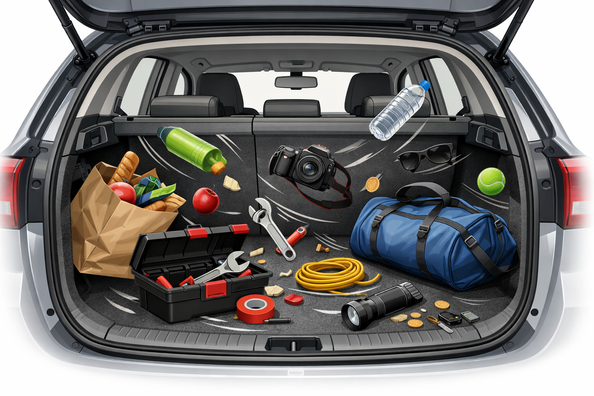
Bags, tools, and small items start “living their own life” in the trunk not because of one random incident, but because of the wrong combination of placement and securing. If the floor is slippery, the load sits far from the seatback, and small items aren’t separated into sections, then during braking or cornering everything shifts, bangs against the trim, and in an open luggage area can fly forward.
The good news is that the problem can almost always be solved without complicated modifications. It’s not one “magic” accessory that works, but a combo of three actions: place the heavy stuff correctly, collect small items separately, and secure anything that can move.
Simple physics applies in the trunk: the car slows down or turns, and the load, by inertia, wants to keep moving. If an item is lying on smooth plastic, a rubber liner with low friction, or simply on a flat floor without a stop, it will slide even during a normal city maneuver.
The worst-case scenario is when heavy items are placed high up or closer to the trunk lid rather than the rear seatback. Then they have more distance to pick up speed. In hatchbacks, wagons, and crossovers this is even more critical, because the luggage compartment is essentially open to the cabin.
Start by checking the floor. Put an empty box or bag in the trunk and push it by hand: if it slides easily without noticeable effort, the problem is partly in the surface. If it slides together with the mat itself, you don’t need to change the box—you need to change the base.
Next, look at where the heaviest item sits. If it’s closer to the trunk lid than to the seatback, or raised by other items, the cause is already obvious. Also check whether there are factory loops or tie-down points and whether the straps (if you use them) are worn out.
Another simple test is not aggressive driving, but your normal route. If bags fall over in a gentle turn, lateral movement and lack of separation are to blame. If, during braking, one heavy item slides forward, you don’t need an organizer—you need more rigid securing.
DD Tuning expert comment: the most common mistake is trying to hold a heavy box with a regular net or a grocery hook. The second typical mistake is buying an organizer for small items but leaving a jerry can, pump, or tool kit separate—so they keep flying around the trunk. First separate the load by weight, and only then choose the securing method.
| Symptom | Likely cause | What to do |
|---|---|---|
| Bags fall over in every turn | Slippery floor and no lateral support | Place bags into a section, an organizer, or behind a net; press heavier bags against the seatback |
| The toolbox slides forward under braking | A heavy item is separate and not secured | Move it lower and closer to the seatback, cinch it down with a strap to factory points |
| The mat shifts together with the load | The liner itself is slippery or poorly secured | Clean the floor, check the mat fit, and if needed switch to a grippier surface |
| The net is stretched, but items still wobble around | The net only restrains light cargo or is too elastic | Keep the net for small/light items, and secure heavy items separately with a strap |
| Small items constantly scatter into the corners | No rigid container or sectioning | Gather everything into a rigid organizer or separate boxes |
The best basic approach is to place heavy items as low as possible and brace them against the rear seatback. This gives the item less room to move, and a strap or stop works noticeably better.
For small items, you need more than just a “spot”—you need a rigid shape. Bottles, wipes, small tools, a compressor, a first-aid kit, and car chemicals stop rolling around when they sit in a bin or organizer rather than spread across the floor.
The third effective step is to separate light and heavy items. A net, elastic holder, or blocks work well for grocery bags, small boxes, and balls. For a heavy toolbox, jerry can, or suitcase, you need a strap to factory points or a rigid barrier—ideally both together.
One elastic cord across everything is a temporary measure. It stretches, doesn’t clamp the load rigidly, and doesn’t allow proper load distribution. The same goes for trying to hang a heavy bag on a hook designed only for a light grocery bag.
It’s also not worth relying on a net as a universal solution. It’s great for light contents, but it shouldn’t be catching a toolbox or a metal jerry can. There’s also little benefit in “soft” hacks like an old blanket under the load: sometimes it even reduces stability because the fabric bunches up and slides.
If the main issue is scattered small items, it makes sense to start with a trunk organizer. It won’t hold a heavy box during emergency braking, but it will remove the chaos of bags, car chemicals, tools, and small purchases.
When the load slides—or the surface moves along with it—it’s worth looking at a rubber trunk mat. This is appropriate if the current liner is too smooth, worn out, or doesn’t sit properly on the floor.
For light bags and items you simply need to keep within one zone, a trunk net will do. But if you regularly carry heavy tools, jerry cans, or suitcases, treat it only as an addition to straps and proper placement—not a replacement.
| Solution | When it works | When it’s not worth spending money |
|---|---|---|
| Rigid organizer | For small items, car chemicals, lightweight tools, bags | When the main problem is one heavy item with no securing |
| Grippier mat or liner replacement | When the load shifts because the floor is slippery | When it’s not the floor that’s sliding, but a poorly placed heavy load |
| Trunk net | For light bags, clothing, small boxes | For jerry cans, suitcases, toolboxes, metal objects |
| Strap to factory points | For heavy, dense items that need to be firmly clamped down | If there are no reliable tie-down points or the strap is worn |
| Divider or bracing bar | In large trunks where you need to separate a cargo zone | If items are heavy and still aren’t cinched down separately with a strap |
From a customer’s experience: in a crossover, grocery bags, car chemicals, and a small toolbox were carried weekly, which caused constant noise in the trunk when cornering. After replacing the slippery surface with a grippier one and switching to a rigid organizer, small items stopped rolling around, and the box was secured separately to a factory loop. As a result, the mess disappeared and it became clear that a net alone wouldn’t have solved the task.
If things are flying around the trunk, the cause is almost always a combination of three factors: a slippery base, lack of separation, and incorrect placement of heavy cargo. Start by changing the layout: heavy items down and against the seatback, small items into separate sections, and anything potentially dangerous onto proper restraints. Only after that should you choose accessories for a specific task, not “just in case.” This material is based on real selection experience, practice, and real-world use scenarios, so the main advice is simple: don’t look for one universal accessory—build a working system for your specific trunk.
| ✔ | Explains the cause of the problem through specific factors: a slippery floor, improper placement of heavy items, and lack of separation. This helps avoid guessing and identify the weak point in your trunk. |
| ✔ | Offers simple ways to check what exactly is causing the mess: test the mat’s grip separately, the placement of the heaviest item, and how the load behaves on a regular route. This lets you quickly understand what to fix first. |
| ✔ | Suggests a practical action plan without complicated modifications: place heavy items lower and closer to the seat back, keep small items in a rigid organizer, and secure anything that can shift with a strap or barrier. This solution is suitable for everyday use. |
| ✔ | Clearly separates what works for light items and what works for heavy cargo. This reduces the chance of spending money on an accessory that won’t solve your specific problem. |
| ✔ | Includes specific examples of when it makes sense to change the trunk lining or install an organizer, net, or strap. This is useful because it helps choose cargo securing that matches the type of load rather than a universal one. |
| ✘ | There is no single simple solution in the article that covers all scenarios, so you’ll have to combine several tools. For some drivers, this means extra purchases and time spent choosing. |
| ✘ | The net, hooks, and elastic holders are of limited use: they are only suitable for light cargo. If you often carry a tool box, a canister, or a suitcase, you can’t do without straps and rigid fastening. |
| ✘ | The effectiveness of some solutions depends heavily on the condition of the trunk: dirt, moisture, or an overly slippery liner reduce their performance. In other words, sometimes you first need to clean or replace the covering before moving on to organizers. |
| ✘ | If the trunk is often overloaded with mixed items, even basic tidying may require a complete rethink of how things are packed. For those used to throwing everything in together, this is not a quick fix but a change of habit. |
Shipping to EU
Wholesale and retail
Own warehouse
Опис продукту
Подарунки не надаються при оформленні покупки у кредит під 0,01% або при покупці частинами.