01.05.2026
518
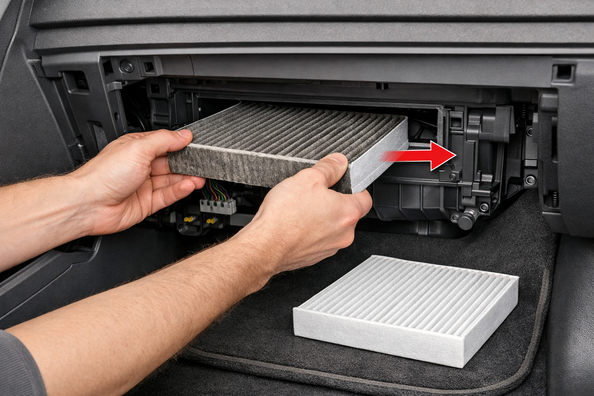

On the Renault Megane III, replacing the cabin filter often seems like a minor task, but in practice the issue isn’t the element itself—it’s the access to it. If the airflow has become weak, the windows take longer to defog, and a musty smell comes from the vents, in most cases a clogged or damp filter is to blame.
On most versions, access is under the glovebox; on some right-hand-drive cars it’s in the clutch pedal area. That’s why the same job takes about half an hour for some people, while for others the first replacement drags on much longer due to the tight space and mistakes with the access layout.
The cabin filter on the Megane III sits in the HVAC housing and gradually collects dust, pollen, soot, small leaves, and moisture. As airflow resistance increases, the fan gets louder, but the actual flow through the vents drops. In the cold and damp season it’s more noticeable: air passes worse, the windows fog up faster, and the smell in the cabin becomes sharper.
The second part of the problem is packaging. Because access is tight, owners often postpone service, and during installation they crumple the new element or fit it against the airflow direction. Then even a new filter won’t deliver a normal result.
Start not by dismantling half the interior, but with the logic of the symptoms. If there’s fan noise at all speeds but the airflow is weak, the most likely issue is the filter’s flow capacity rather than the fan itself.
For the check itself, basic tools are enough: usually a Phillips screwdriver, a flathead screwdriver, and Torx T20. On left-hand-drive versions you often have to remove the glovebox, and the filter housing cover has its own fasteners as well. If you have a right-hand-drive car, don’t guess the procedure: access may be on a completely different side.
DD Tuning expert comment: On the Megane III, users most often make two mistakes: they follow the access procedure for the wrong steering side and try to fit a new filter without proper access to the housing. As a result, they crumple the element, install it against the airflow direction, and get the same weak airflow. If access is tight, it’s better to spend a little more time on careful removal than to dismantle the interior twice.
| Symptom | Likely cause | What to do |
|---|---|---|
| Weak airflow at all speeds | Clogged, damp, or deformed filter | Remove the element, assess its condition, replace it, and clean the cavity of debris |
| Windows take a long time to defog | Airflow drops due to a dirty filter | Install a new filter and check whether airflow through the vents has recovered |
| Musty or sour smell from the air ducts | Damp filter or dirty evaporator | Start by replacing the filter; if the smell remains, move on to cleaning the evaporator and checking the drain |
| The fan is louder than before | Air struggles to pass through a clogged element | Inspect the filter, the cover, and correct seating |
| After replacement, the smell barely changed | The issue isn’t only the filter | Don’t buy a second filter in a row—check the evaporator and condensate drainage |
When everything is done correctly, the result is felt quickly: airflow is stronger, the windows defog better, and the smell from the vents becomes weaker or disappears entirely.
Accessories don’t replace HVAC service, but sometimes help with secondary causes of moisture and dirt in the cabin. If there’s constantly water underfoot in autumn and winter, rubber floor mats are appropriate: they won’t remove odor from the ventilation, but they prevent excess moisture from spreading across the floor.
For ventilation during rain, window deflectors can be useful, and if you want to browse compatible options for this model right away, it’s convenient to start from the Renault Megane III page. As for replacing parts, the most common worthwhile change is switching to a charcoal filter when city odors are annoying, but it won’t fix a dirty evaporator.
| Solution | When it works | When it’s not worth spending money |
|---|---|---|
| Correct filter replacement with cavity cleaning | When there’s weak airflow, fogging, and the element is visibly dirty or wet | When a new filter is already installed correctly, but the smell didn’t change at all |
| Charcoal filter instead of a standard one | When you often drive in the city and are bothered by outside odors and exhaust fumes | When the main issue isn’t odor but incorrect installation or a dirty evaporator |
| Evaporator cleaning and drain check | When a persistent musty smell remains after replacing the filter | When the old filter is clearly clogged and you haven’t even done the basic replacement yet |
| Shortening the service interval | When the car is driven in dust, in the city, in traffic jams, or often used in wet seasons | When the car has light operating conditions and the yearly interval isn’t exceeded |
From a customer’s experience: a Megane III owner complained about weak airflow and a damp smell, though he was sure only A/C cleaning was needed. After inspection, it turned out the filter hadn’t been changed for a long time, and its cavity was clogged with leaves; after replacement and cleaning, airflow returned to normal. The smell decreased immediately, and later the owner switched to a charcoal element because he drives a lot in the city.
For the Renault Megane III, replacing the cabin filter solves most cases of weak airflow, fogging, and unpleasant odor—but only when the element is truly clogged and installed correctly. If the smell remains after a new part, there’s no point endlessly changing filters—you need to look at the evaporator and the drain. The main difficulty of this model isn’t the part itself, but access, the correct procedure for the specific version, and careful installation.
Shipping to EU
Wholesale and retail
Own warehouse
Опис продукту
Подарунки не надаються при оформленні покупки у кредит під 0,01% або при покупці частинами.