29.04.2026
585
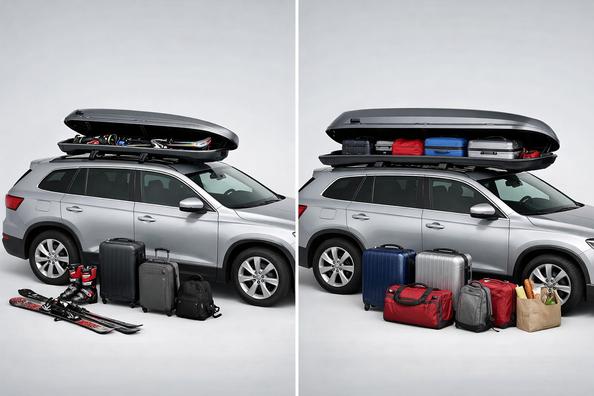
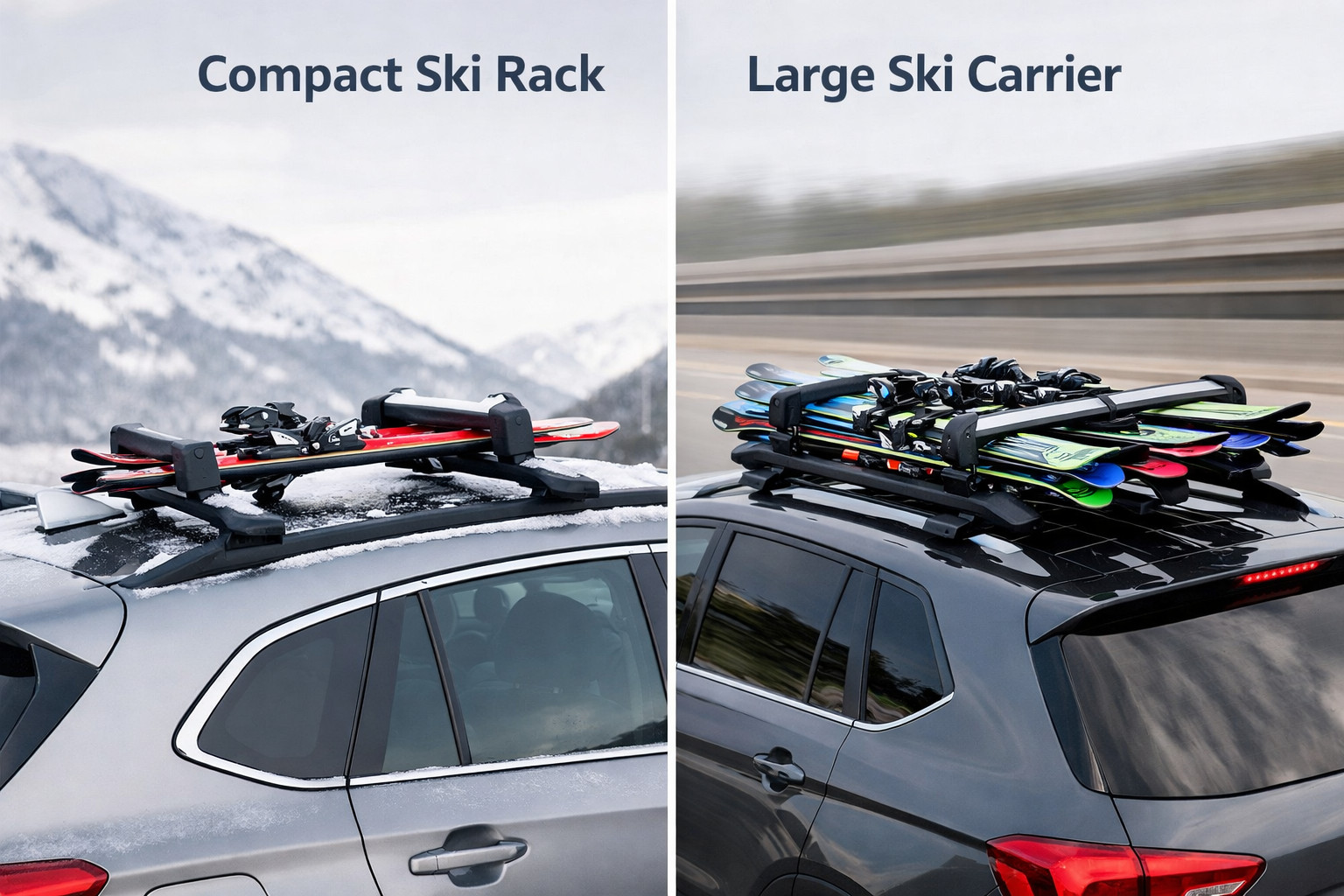
If the main task is skis, a couple of bags, and you want to keep space on the roof for a bike or kayak, a narrow roof box usually wins. But if you regularly carry suitcases, children’s items, soft travel bags, and other bulky luggage, a wide format is more practical and less likely to force you to pack things “tight.”
The typical mistake here is looking only at liters. In reality, what matters is the box geometry, weight, ease of installation, noise at speed, how much space is left on the crossbars, and whether the tailgate will open after installation. So a narrow vs. wide box is not just “smaller or bigger,” but two different usage scenarios.
A narrow box is strong where the load is long and not too wide: skis, snowboards, light camping gear, seasonal items. Its advantage is not only its shape, but also that it leaves part of the crossbars free for another mount. For compact cars, this is often critical.
A wide box takes the lead on family trips. It handles suitcases, large bags, kids’ luggage, and oddly shaped items better. But you pay for it with higher box weight, stricter roof-geometry requirements, and a bigger impact on aerodynamics, noise, and fuel consumption—especially on the highway.
| Option | Strengths | Weaknesses | Who it’s for |
|---|---|---|---|
| Narrow roof box | Better for skis and long gear; takes up less space on the crossbars; usually lighter; often more convenient for compact cars | Less space for suitcases; worse with wide bags; long models may conflict with the tailgate on a short roof | Those who carry skis, drive daily, and want to keep room for a bike or kayak |
| Wide roof box | Better fits suitcases, soft bags, and family luggage; larger usable volume; fewer packing constraints | Heavier; usually noisier on the highway; affects fuel consumption more; can take all the roof space | Families, travelers, owners of lots of luggage, and those who value volume more than spare rail space |
A typical sporty narrow format offers around 300 L, about 190 cm in length, about 63 cm in width, and about 15 kg in weight. It’s a convenient size for 3–5 pairs of skis or a few boards when you need to keep side space on the crossbars. For city driving and seasonal use, this type of box often makes more sense because it burdens the car less and is easier to handle.
Its weak point is not the liters by themselves, but the shape. It accepts two or three large suitcases worse than a wide format, even if the volume numbers on paper seem acceptable. Another nuance: if your skis are longer than about 175 cm, look not at the format name but at the real usable length of the specific model. In terms of longevity, a narrow box has no automatic advantage: if the lid is flexible and the mounts are weak, width won’t save it.
For reference, a large wide format can be around 490 L, about 215 cm long, about 89 cm wide, and about 23 kg in weight. This geometry works well with suitcases, travel bags, kids’ items, and mixed luggage. In a big box, it’s easier to pack without constantly reshuffling items, and longer models also accept long skis better.
The downsides are practical too. First, a heavier box leaves less margin for roof load capacity. Second, it usually requires more front clearance: on some cars, the tailgate may not open well after installation. Third, the wide shell affects noise and fuel consumption at speed more. If you install the box for a few long trips per year, it’s tolerable. If you drive with it all the time, the difference is noticeable.
If 80% of your tasks are skis, snowboards, light camping cargo, and the occasional need to mount something else next to it, go with a narrow format. It fits the sporty scenario better and interferes less in everyday use.
If 80% of your tasks are family trips, suitcases, kids’ items, winter clothing, and the need to simply fit more without complicated packing, a wide box is more convenient. Here, extra centimeters of width are often more important than the difference in liters.
There are mixed cases too. For example, with very long skis, the decisive factor is not width but the length of the specific box. And with a short-roof hatchback, the decisive factor becomes tailgate clearance. That’s why the final choice should be made after measuring your car, not just based on the product description.
| Scenario | What to choose | Why |
|---|---|---|
| 2–4 pairs of skis and a desire to keep space for a bike mount | Narrow roof box | Gives the length needed for sports gear and doesn’t take up the full width of the crossbars |
| Daily city driving, box not installed for the whole season | Narrow roof box | Usually lighter and less bulky for installation and storage |
| Family vacation with suitcases, soft bags, and kids’ items | Wide roof box | More useful width and larger volume mean fewer packing issues |
| Long skis or gear around 180–200 cm | Wide roof box | Among larger models, sufficient usable length is more common—but you must verify the specific model |
| Compact hatchback or wagon with a short roof | Narrow roof box | Often easier to fit geometrically, but front clearance still needs to be measured |
| Trips to the sea or mountains with a large group | Wide roof box | Works better with mixed-size luggage and reduces compromises when loading |
A more expensive box is justified not when you want it “just in case,” but when you actually use it often. If the box is installed for the season, opened regularly, driven in rain, snow, and on long distances, the difference comes from quick mounts, dual-side opening, a proper-close indicator, and a stiffer lid. Before paying extra, it’s worth going through the box size selection, because even the most expensive model won’t fix choosing the wrong format.
Premium solutions especially make sense for those who install the box themselves, take it off often, don’t want to fight a misaligned lock, and value predictable installation. In these conditions, everyday usability matters more than an extra 30–50 L, which in practice may change nothing.
If you only need a box twice a year for a simple trip with suitcases, it’s better to invest in the right geometry and vehicle compatibility rather than overpay for features that won’t be used weekly. For a quick sanity check of your choice, the article how to choose a roof box is a good fit.
A narrow roof box is better for skis, sports gear, daily tasks, and scenarios where keeping roof space matters. A wide roof box is more logical for suitcases, family trips, and bulky luggage when the priority is capacity without complicated packing.
The final rule is simple: buy a box for the tasks you face most often, not for one hypothetical trip. Before paying, verify your gear length, tailgate clearance, crossbar compatibility, and allowable roof load. These details most often determine whether the box will be convenient—or just big.
| ✔ | A narrow cargo box is better suited for skis, snowboards, and long gear. It also leaves part of the crossbars free for a bike mount or other cargo. |
| ✔ | A wide cargo box is more convenient for suitcases, soft bags, and children’s items. It’s easier to pack luggage in it without constantly rearranging things. |
| ✔ | The lighter narrow box is easier to install yourself and is less bulky in everyday use. For compact cars, it is often a more practical option. |
| ✔ | The wide format works better for family trips and mixed cargo. In larger models, it also more often has enough usable length for long skis. |
| ✘ | A narrow box handles large suitcases and wide bags worse. Even with a normal capacity, the shape can limit loading. |
| ✘ | A wide box is heavier and has a greater impact on noise and fuel consumption on the highway. Because of this, regular driving with it is less comfortable. |
| ✘ | For a wide box, you often need to separately check the clearance to the trunk lid. On some cars, it can interfere with opening. |
| ✘ | With the narrow format, long items should be matched not by the model name, but by the actual internal length. Otherwise, you can make a mistake when choosing it for skis or other gear. |
Shipping to EU
Wholesale and retail
Own warehouse
Опис продукту
Подарунки не надаються при оформленні покупки у кредит під 0,01% або при покупці частинами.