28.04.2026
524
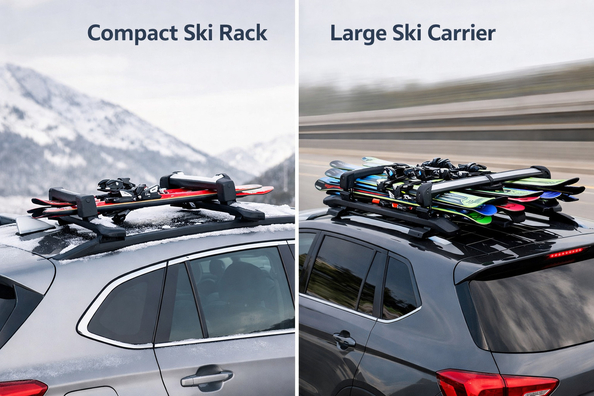
If you go skiing a few times per season and don’t want to carry your gear in the cabin, the most practical choice is usually an open 4-pair rack: simple, or more expensive but more compact in shape. If you travel often, far, and in any weather, the choice shifts toward a larger open 6-pair rack or straight to an enclosed roof box.
In this topic, “simple,” “compact,” and “for frequent trips” shouldn’t be taken as official classes, but as usage scenarios. So you should compare not the loud names, but the real things: installation, noise, service life, practicality on the road, and the price difference.
The main trade-off is straightforward: the more basic the rack, the easier it is to get into the topic and the fewer extra costs. But open holders react more strongly to oncoming airflow, pick up salt and grime faster, and on long highway runs that shows up both in noise and in maintenance.
A compact low-profile solution is interesting not because it carries more, but because it’s less annoying in everyday use: better aerodynamics, more convenient locks, easier access with gloves on. The “for frequent trips” option starts where not only capacity matters, but also highway comfort, gear protection, and fewer compromises for a family or group.
Also pay attention to the rated limits: for some open systems the upper speed limit is up to 130 km/h, and they are not designed for off-road use.
| Option | Strengths | Weaknesses | Who it suits |
|---|---|---|---|
| Simple open 4-pair rack | Lightweight, quick to install, doesn’t take up cabin space, most affordable | Noisier at speed, gear is exposed to dirt and salt, often simpler locks | Those who travel rarely, alone or as a pair, and don’t want to overpay |
| Compact low-profile 4-pair rack | Better aerodynamics, easier access, neater lock operation, quick installation | Capacity is almost like the basic option, but the price is higher; gear is still exposed | Those who value quiet, often install/remove the rack, and drive on highways |
| Large open 6-pair rack | More room for a family or group, fewer compromises on gear quantity, sometimes better clearance for bindings | Heavier, wider, catches airflow more, more expensive than basic models, weather protection is still open | Those who often travel as a group but aren’t ready to switch to a box yet |
| Enclosed roof box | Better protection from rain, snow, dirt, and salt, usually quieter, suitable for long skis and frequent trips | Most expensive, heavier, takes storage space, installation/removal is less convenient | Those who travel regularly, far, and want maximum practicality |
DD Tuning expert comment: most often people don’t choose the wrong brand—they choose the wrong format. They buy a 4-pair rack “with room to spare” without checking ski tip width and binding height, or they leave an open holder on the roof all winter and then complain about noise and seized locks. If trips are regular, the question should be: do you just need to secure the skis, or do you also need protection from the road.
This is the most logical starter format. Typical models in this class weigh about 3.6 kg, install tool-free in roughly 10 minutes, and cover the basic need: getting skis out of the cabin and onto the roof. For short or infrequent trips, that’s enough. The downsides are also standard: more noise, more contact with snow, dirt, and road chemicals, and simpler hardware.
Here the point isn’t more capacity, but better behavior at speed and better convenience. These models usually weigh around 4.5 kg, also install quickly, and often have integrated locks. If the car spends a lot of time on the highway, the difference between a basic and a low-profile housing is noticeable: less droning, easier to open with gloves, and less small day-to-day annoyance. But the gear still remains exposed.
This is no longer an “once a month” option, but for regular trips with a family or group. Typical capacity is up to 6 pairs of skis or up to 4 snowboards, with a weight around 6.4 kg. The advantage is that you don’t have to juggle placement and decide whose pair has to go into the cabin. The downside is that it’s still an open system: noise, dirt, and the need to remove it off-season don’t go away.
If you look not only at the fact of transport, but at the comfort of the whole winter routine, a box is the most practical solution. A typical volume of about 450 L lets you take 5–7 pairs of skis; load capacity can reach 50 kg, but the box itself weighs about 22 kg. That means it’s not a small accessory, but a separate system. That’s why it’s justified where there are regular long trips, wet roads, night drives, and the desire not to clean gear after every run.
If you have 2–4 trips per season, one or two people in the car, and no need to carry a lot of gear, a simple open rack offers the best balance between cost and benefit. It gets the job done without unnecessary complications.
A compact rack is worth choosing when the basic capacity is fine, but the user experience isn’t. It’s relevant for those who travel more often, like well-finished products, and don’t want extra droning at speed.
A large open 6-pair rack works well as a middle-ground solution. It solves the quantity issue when a family or group is traveling, but it doesn’t provide the cleanliness and quiet that a box does.
A box makes sense when you already know you travel a lot. On long highway runs it’s usually more comfortable, protects gear better, and makes you think less about the weather. For frequent trips, it’s not a luxury anymore, but a way to remove several recurring small problems with one solution.
| Scenario | What to choose | Why |
|---|---|---|
| 1–3 trips per season, one or two people | Simple open 4-pair rack | Minimal cost, quick installation, basic capacity is enough |
| Short trips, but noise is annoying and you want better ergonomics | Compact low-profile | Better at speed and more convenient in everyday use |
| Family or group, lots of gear for one trip | Large open 6-pair rack | Provides extra capacity without switching to a heavy and expensive box |
| Weekly highway trips, long distance | Enclosed box | Quieter, cleaner, protects skis better from weather and road grime |
| Long skis, wet snow, the car often sits in a parking lot | Enclosed box | Fewer compromises on gear protection and real-world convenience |
It’s worth paying extra not for “status,” but for less hassle. If you already have crossbars and just need to move gear out of the cabin, you can start with ski racks. If trips are long, regular, and protection from wet snow and road grime matters, it’s more logical to look straight at roof boxes. And if the roof isn’t prepared yet, the first step is a compatible roof rack, because the base determines both the format choice and installation convenience.
A more expensive compact rack is justified when you genuinely care about noise, locks, and day-to-day convenience. A box is justified when you want not just to transport skis, but to stop thinking about salt, water, long skis, night highways, and cabin clutter. If these problems repeat every weekend, the pricier solution quickly stops feeling unnecessary.
From a customer’s experience: at first, for a crossover we chose a simple open 4-pair rack because we traveled rarely as a pair and didn’t want extra expense. When trips became weekly, kids’ skis were added, and the route got longer, the main downsides were noise and dirt on the gear. In the end we switched to an enclosed box and got not a “more expensive toy,” but noticeably calmer winter logistics.
For occasional trips and city use, a simple or compact 4-pair rack looks the most rational. If you travel often, as a family, or on long mountain routes, it’s better not to save on the format: a large open rack solves capacity, and a box solves comfort, cleanliness, and protection.
This material is based on real selection experience, practice, and real usage scenarios. That’s why the takeaway is simple: don’t look for the “best” option in general—choose the one that matches your trip frequency, the amount of gear, and your willingness to live with noise and maintenance.
| ✔ | A simple open mount for 4 pairs installs quickly without tools and usually doesn’t take up space in the cabin. For occasional trips, it means minimal hassle for little money. |
| ✔ | A compact low-profile mount handles speed better: it makes less noise and is more convenient for daily use. It’s also easier to open with gloves on, which is useful in winter. |
| ✔ | A large open mount for 6 pairs comes in handy when traveling with family or a group and you need to take more gear. It solves the problem of who has to put skis in the cabin because of lack of space. |
| ✔ | A closed roof box protects skis better from rain, snow, dirt, and salt. On long highway drives, it is usually quieter and less tiring on the road. |
| ✔ | For frequent trips, a box or a large mount offers a more practical setup than the basic option. You have to think less about the weather, cleaning the gear, and where to put things. |
| ✘ | Open mounts are noisy at speed and catch more oncoming air. On long highway drives, this is noticeable both in the hum and in overall comfort. |
| ✘ | In open versions, the gear remains unprotected from dirt, salt, and snow. If you leave such a mount on the roof all season, the rubber elements, locks, and moving parts wear out faster. |
| ✘ | A compact mount costs more than a simple one, but its capacity is almost the same. So the extra payment is not for more volume, but mainly for quietness and convenience. |
| ✘ | A closed box is the most expensive and heaviest of the options, and it also takes up more storage space. Mounting and removal are less convenient than with open solutions. |
Shipping to EU
Wholesale and retail
Own warehouse
Опис продукту
Подарунки не надаються при оформленні покупки у кредит під 0,01% або при покупці частинами.