Electric cars are often called the transport of the future thanks to the absence of exhaust gases. But are they really that eco-friendly? While EVs significantly reduce pollution while driving, their impact depends on the electricity source and battery manufacturing technologies. And if you want to personalize your car or enhance its appearance, take a look at the tuning accessories available in our catalog in a wide range.
Environmental benefits of electric cars
- No tailpipe emissions (although non-exhaust particles still remain: tire and road wear, and partly brake wear) — while driving, an electric car does not produce CO₂ or NOx. This is especially beneficial for large cities, where air quality improves and noise pollution decreases.
- Lower lifecycle emissions — According to recent studies, even when considering the average projected EU energy mix for 2025–2044, electric cars have significantly lower lifecycle emissions than gasoline vehicles.
- Resource savings — the absence of an internal combustion engine means less oil, fewer filters, and fewer parts, reducing industrial impact.
Drawbacks and myths
- Battery production — manufacturing batteries (mining lithium, cobalt, nickel) requires a lot of energy and water, increasing the initial carbon footprint. In the first 1–2 years of use, an electric car may «catch up» to a gasoline car in emissions.
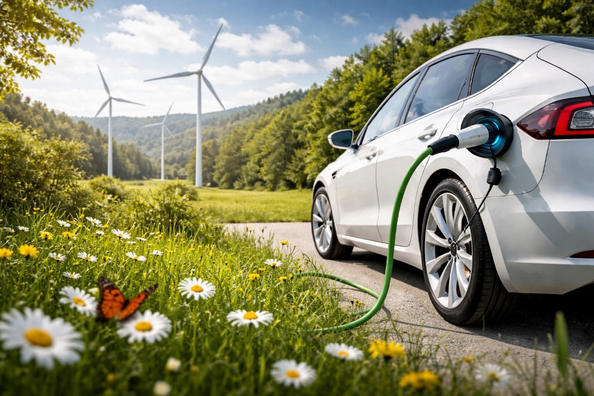
- Dependence on the power grid — if electricity is generated from coal, the environmental effect is reduced. In countries with «dirty» generation, the advantage is smaller.
- Disposal — battery recycling is not yet perfect, although technologies are developing rapidly.
Conclusion: the balance favors electric cars
The full lifecycle advantage usually appears relatively early in operation and then only grows. As the transition to renewable energy accelerates and battery recycling improves, the positive impact of electric vehicles will increase. The key is to develop «green» energy in parallel with e-mobility.