23.05.2026
509
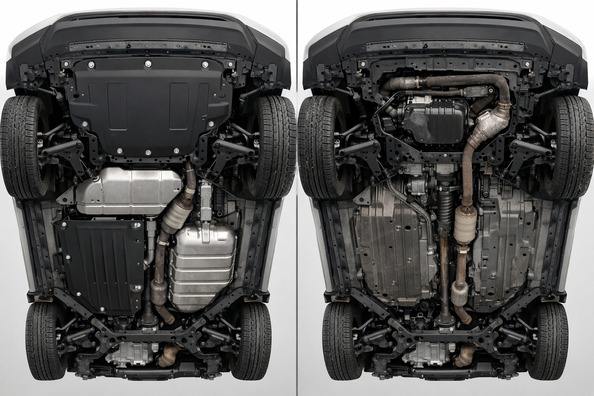
You should start underbody protection not with the biggest kit, but with the components whose failure can actually stop the car: the engine oil pan and the gearbox or transfer case area. These deliver the biggest effect for the first money spent. Fuel tank protection usually comes as the second stage, while differentials, control arms and other point components only make sense for a specific route.
For city driving, highways and most trips, modular 6 mm aluminum is more practical: it’s lighter, handles moisture and road salt better, and adds less weight. 3 mm steel makes sense where the underside regularly hits rocks, ruts or stumps, but it’s heavier and more often makes servicing less convenient.
The right question is: which impact will be the most expensive for your car in terms of consequences. If you punch the engine oil pan, the trip can end immediately. If you hit the gearbox or transfer case, the risk is even more serious, because it’s no longer just noise or a scratch—it’s downtime and a tow truck.
That’s why the first stage is almost never about making the underside look nice or buying a full kit—it’s about covering the critical components. The logic is simple: engine and transmission first, then the tank, and only after that everything that suffers only in harsh off-road use. This staged approach reduces costs, doesn’t overload the vehicle, and doesn’t force you to buy extra right away.
If you want to double-check component priorities in a more practical format, it’s useful to look at underbody protection and separately gearbox protection, because these sections usually provide the biggest benefit at the start.
Another important point: thickness without context doesn’t decide anything. 3 mm steel and 6 mm aluminum can both be equally appropriate, but in different conditions and on different components.
| Option | Strengths | Weaknesses | Who it’s for |
|---|---|---|---|
| Front skid plate for the sump or engine only | The fastest and cheapest start; protects the oil pan from curbs, ice, gravel and accidental hits | The gearbox and further underbody areas remain exposed; protection is incomplete | Mainly city and highway driving, occasional trips onto bad roads |
| Engine plus gearbox or transfer case | Covers the components whose damage most often stops a trip; the best balance of benefit and price | More expensive than one shield; you need to check access for maintenance | Crossovers, SUVs, vehicles for travel and mixed routes |
| Engine plus transmission plus fuel tank, mostly in aluminum | Practically covers the main risks on dirt roads and trips; without excessive weight | Often excessive for a purely city car; higher price | Those who regularly drive on gravel, forest roads, with a loaded vehicle |
| Full kit with additional protection for differentials and control arms, often with steel on the lowest components | Maximum durability with frequent harsh contacts; works well where the underside truly hits the terrain | Highest weight, higher price, more chances to complicate service and get resonance from poor installation | Regular rocky or harsh off-road driving |
DD Tuning expert comment: the most common mistake is buying a big full underbody kit without checking access to the oil drain and the clearance to the exhaust. As a result, people overpay, and at every service they remove extra sections or get droning after installation. If routes aren’t clear yet, it’s better to start with the engine and transmission, and add the tank based on real trips.
This is the most obvious first purchase, because the front area is the first to catch ice, a pothole edge, a rock, or deep snow. For a passenger car or crossover that lives on asphalt, such a plate often covers 80% of everyday risks. But its limitation is that after it comes another vulnerable area: the gearbox.
The factory plastic under-engine cover is often needed for aerodynamics and quietness, but it doesn’t replace a metal protection against a hard hit. This is where many people go wrong, assuming the factory plastic is enough.
This is no longer cosmetic—it’s basic downtime protection. If the car goes out of town, drives on broken roads, or has a low-mounted transmission, this kit should be considered the first real level of protection. For most scenarios, it’s the smartest start.
This is exactly where a modular layout works best: a separate front section and a separate gearbox area. If one part gets damaged, you don’t have to replace the entire kit. For a daily driver, 6 mm aluminum is most often the logical choice, because it provides a good safety margin without extra weight.
You don’t always need to install the tank protection together with the first sections. If the car hardly ever sees ruts, stumps, and rocks, you can safely postpone it. But as soon as gravel routes, forest roads, expedition-style load, or the habit of driving where the underside sits on the terrain appear, the tank becomes a logical second stage.
The point here is not to cover everything underneath at any cost, but to protect a component whose damage is critical far from service. For a travel vehicle, this is often much more important than additional shields for small elements.
If your routes already include long trips or frequent gravel, it makes sense to evaluate fuel tank protection right away, because it often becomes the second step after the engine and transmission.
This is no longer a universal choice, but a scenario-driven one. If the vehicle regularly crawls over rocky terrain, sits in ruts, or works in harsh off-road conditions, then protecting these components is justified. This is where 3 mm steel often makes more sense, because the hits are repeated and severe.
For a typical crossover that goes fishing once a season, these elements are often unnecessary. They add weight, can complicate service, and don’t deliver the return you get from a basic engine-and-transmission kit.
| Material | What it delivers in practice | When it’s appropriate | What to pay attention to |
|---|---|---|---|
| 6 mm aluminum | Lighter, handles moisture and salt better, puts less load on the suspension | City, highway, travel, mixed routes | Check section shape, compatibility, and service access |
| 3 mm steel | Higher strength reserve with frequent impacts against rocks and terrain | Harsh off-road, differentials, control arms, low-mounted components | Weight, possible droning, corrosion care, installation clearances |
| Plastic or HDPE | Better for aerodynamics and noise than for impact resistance | Light city conditions where serious impacts are rare | Don’t confuse it with full-fledged metal protection |
For city driving, highway trips, and winter, the key factors are weight, corrosion resistance, and normal access for maintenance. Here a light staged approach wins: the front skid plate, and if needed, also a gearbox section. A full kit usually doesn’t pay off.
For a crossover or SUV that often drives on dirt roads, the right minimum is already broader: engine plus gearbox or transfer case. If you travel far from service and often with gear, the next step is the fuel tank.
For harsh off-road use, it’s not the principle of “thicker everywhere is better,” but a mixed approach. Large areas under the engine and transmission can be made lighter, while the lowest components that regularly take direct hits can be covered with stronger steel elements.
| Scenario | Best choice | Why |
|---|---|---|
| City, curbs, ice, snow, potholes | Front skid plate for the sump or engine; if the gearbox hangs low, add the second section right away | Protects against the most typical everyday hits without extra weight and costs |
| Highway, winter, broken asphalt | Modular engine + gearbox kit, preferably lighter in weight | Combines protection for critical components, good durability, and puts less load on the vehicle |
| Crossover for gravel, field and forest roads | Engine + transmission as the first stage, tank as the second | These components are the ones that most often suffer and can realistically derail a trip |
| Long trips with full load | Staged aluminum kit: engine, gearbox, tank | Lower weight matters when the vehicle is already loaded, and protection must be sufficient on mixed routes |
| Frequent rocky off-road | A more complete kit with steel on the lowest impact-prone components and a modular design for the rest | Repeated harsh contacts require a bigger strength reserve exactly where impacts are strongest |
A more expensive option is justified when vehicle downtime costs more than the kit itself: long trips, repeated routes off asphalt, a loaded vehicle, low-mounted assemblies. In that case, it makes sense not to buy a random single shield, but to build a staged underbody protection setup with precise coverage of critical zones.
After the front section, the next upgrade that usually makes the most sense is gearbox protection, because it covers the second critical zone after the engine. If your routes include ruts, rocks, stumps, or frequent trips far from service, the next logical investment is fuel tank protection. The most expensive full kit is only sensible when the underside regularly works against the terrain—not just once a season.
From a customer’s experience: a crossover owner initially wanted a full steel kit because he was afraid of damaging everything at once. After reviewing the routes, it turned out the car is driven on highways, winter roads, and goes onto gravel a few times a year. In the end, he started with engine and gearbox protection, and added the tank before a long trip on dirt roads—and it proved sufficient without extra weight or overpaying.
In short, the first thing truly worth installing is protection for the engine oil pan and the gearbox or transfer case area. These are what most often save you from downtime. Fuel tank protection is a logical second stage, while differentials, control arms, and other lower components make sense when the route is genuinely harsh and regular.
For most daily and travel scenarios, the most rational choice is a lighter modular kit with proper installation and service access—not the maximum amount of metal. This review is based on real selection experience, practical use, and real-world scenarios, not the abstract idea of covering everything at once.
| ✔ | It is generally recommended to start with protection for the engine oil pan and the gearbox or transfer case area. These cover the components whose damage most often stops the car right away, so the effect of the first money invested is the greatest. |
| ✔ | For city driving, highways, and most trips, a modular 6 mm aluminum option is considered more practical. It is lighter, handles moisture and salt better, and puts less load on the vehicle. |
| ✔ | A modular design with separate sections for the engine and gearbox is more convenient to service. If one part gets damaged, there is no need to replace the entire set. |
| ✔ | A phased approach makes it possible not to overload the vehicle and not to overpay for unnecessary elements. First, the critical components are covered, and the fuel tank and smaller components are added only when needed. |
| ✔ | For hard off-road use, a mixed approach is suggested: lighter panels under the engine and transmission, and stronger steel elements on the lower impact points. This provides extra strength where impacts are strongest. |
| ✘ | A full set right away often turns out to be unnecessary for the city, highways, or rare trips on bad roads. It adds weight and cost without any noticeable benefit in such scenarios. |
| ✘ | 3 mm steel is suitable for rocks, ruts, and stumps, but it is heavier than aluminum. It can also make servicing more difficult and more often requires attention to the coating after winter and contact with dirt. |
| ✘ | Even the right shield can cause problems if the installation is done incorrectly. Incorrect clearances to the exhaust, driveshaft, or subframe can cause humming or vibration. |
| ✘ | A single large sheet is not always convenient in daily use. For access to the filter or oil drain, the section sometimes still has to be removed, which makes maintenance more difficult. |
Shipping to EU
Wholesale and retail
Own warehouse
Опис продукту
Подарунки не надаються при оформленні покупки у кредит під 0,01% або при покупці частинами.