29.06.2026
277
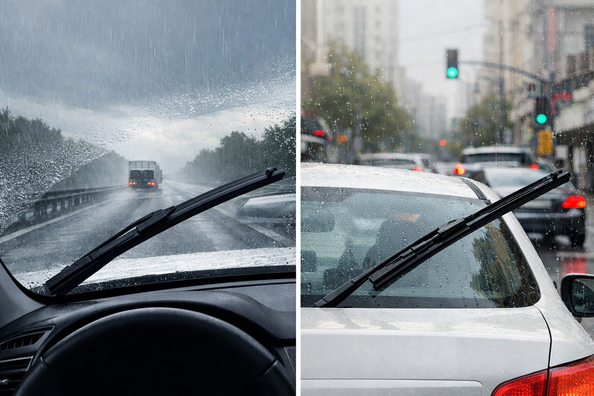
If your car spends most of its time driving in the city, quality conventional (frame) wiper blades are usually enough: they’re cheaper, simpler, and deliver a solid result at lower speeds. But if you regularly drive on the highway, face heavy rain, open windy areas, or winter trips, it’s worth looking at beam (frameless) or hybrid options: they hold better at speed, make less noise, and suffer from ice less often.
The main mistake here is simple: choosing only by blade type. In reality, the result also depends on length, mounting type, windshield curvature, the condition of the windshield itself, and how often you drive in rain or мороз. So below it’s not about “the best wipers overall”, but about which option makes sense for your specific use case.
The choice comes down to balancing price, high-speed behavior, and winter practicality. For city driving, there’s usually no big reason to overpay for a more complex design if the car rarely leaves town and doesn’t operate in severe мороз. In that kind of use, the difference between good frame blades and more expensive types is often smaller than it seems at the time of purchase.
For highway driving it’s different: at speed you need consistent pressure against the glass, less chatter, and less aerodynamic noise. That’s where beam and hybrid blades typically show their stronger side. And if winters are harsh in your region, it’s worth thinking specifically about anti-icing protection—not just brand or price.
So you should compare not “what’s more expensive”, but “what will work better on my car in my driving conditions”. Sometimes the correct length and mounting give more than moving to a higher-priced segment.
| Option | Strengths | Weaknesses | Who it’s for |
|---|---|---|---|
| Frame | Lower price, simple design, sufficient for city use | More often noisy, handles ice worse, weaker pressure at speed | For those who mostly drive in the city and don’t want to overpay |
| Beam (frameless) | Better aerodynamics, quieter operation, more even pressure | More expensive, sensitive to correct length and mounting selection | For those who often drive on the highway or have a curved windshield |
| Hybrid | Good pressure, better protection of the mechanism, stable year-round performance | Usually more expensive than frame blades, not always necessary for calm city driving | For those who want a compromise between highway, city, and winter |
| Winter | Works better in snow and мороз, less ice in joints | Wears faster in warm weather | For those who regularly drive in winter in a cold region |
| Premium silicone | Potentially longer service life, stability across a wide temperature range | Higher price, material alone doesn’t fix selection mistakes | For those who drive a lot and want to replace blades less often |
DD Tuning expert comment: Most often, the buyer looks only at the blade type and misses the exact length and connector. The second common mistake is expecting an expensive blade to remove streaks on a worn or dirty windshield. If the fitment is wrong or the glass itself is already problematic, even a good set won’t show its level.
This is the logical option for city use when you need a working set without extra expense. Frame blades are easy to select, often noticeably cheaper, and at a calm urban pace they really can meet the need. Their weak points show up in wind, at speed, and in winter, when exposed joints collect ice more easily.
The strong side of these blades is more even pressure and better aerodynamics. On the highway they’re usually quieter, chatter less, and work more consistently on curved glass. But they’re more demanding when it comes to correct fitment: a mistake in length or connector quickly cancels the advantages.
A hybrid design combines the rigidity of a frame with an aerodynamic cover. In practice, it’s often a successful compromise for those who drive both in the city and on the highway, don’t want separate summer and winter sets, but want more stable performance at speed. The extra cost isn’t always justified, but in mixed use it’s felt more than in purely urban driving.
Winter blades are worth considering separately if you regularly deal with мороз, wet snow, and overnight outdoor parking. Softer rubber stays elastic in the cold, and a closed design protects better against ice. The downside is simple: in warm weather they wear faster, so they’re not the best all-season option.
It’s important not to get confused here: a silicone blade isn’t a separate frame type—it’s a more expensive material for the wiping edge. Its value is in service life and stability in both cold and heat, but only with proper blade geometry, correct mounting, and clean glass. If the car is driven мало and in a mild climate, the real-world difference may not be as big as the price difference.
For a typical city car that runs short routes, parks in the yard, and rarely goes on high-speed roads, quality frame blades are enough. They provide normal cleaning for less money, and the saved budget is often smarter to spend on timely replacement and proper washer fluid.
If you regularly drive on the highway, especially in rain, then beam or hybrid blades already make practical sense. For winter, it’s best to look either at dedicated winter blades or at designs that are less prone to icing up. And if the car has a noticeably curved windshield, a more expensive option may not give a “premium feel” but simply more even wiping without missed edges.
| Scenario | Best choice | Why |
|---|---|---|
| Daily city driving, low speeds | Frame | Cheaper and usually sufficient if there’s no harsh winter and no frequent highway trips |
| City plus occasional highway | Beam (frameless) | Quieter and more stable at speed, without clearly overloading the budget |
| Frequent highway trips in rain | Beam or hybrid | Holds pressure better, lifts less in airflow, chatters less |
| Freezing winter, snow, ice | Winter or hybrid with better protection | Less chance the joints will clog with ice and the blade will start streaking |
| High annual mileage, don’t want frequent replacements | Premium silicone | The extra cost can pay back in service life, but only with correct fitment |
Another common mistake is choosing based on a review from the owner of a different car. The same model can work differently due to different windshield curvature, different arm geometry, and different surface condition.
Paying extra for more expensive blades is justified when you actually use their strengths: you often drive on the highway, regularly get caught in heavy rain, have a cold winter, or want more service life with high mileage. If you’re choosing a new set right now, take a look at wiper blades; if you’re torn between designs, the article on beam (frameless) blades will help; and for the cold season it’s useful to separately understand why wipers freeze up in winter.
If the car is almost always in the city, the climate is mild, and speeds are moderate, an expensive set won’t always deliver a proportional difference. In that case, it’s more выгодно to buy solid frame blades, not miss the size, and replace them on time than to overpay once for features you barely use.
From a customer’s experience: A driver was looking for quieter blades after a few rainy highway trips, even though in the city his old frame blades were still doing an okay job. After switching to a correctly selected beam set, the main difference showed up at speed: less chatter, a more even sweep, and calmer operation. For the second family car, which is driven almost only in the city, he kept frame blades because the extra cost simply didn’t bring noticeable benefit there.
In short: for the city, quality frame blades are most often enough; for the highway it’s more logical to look at beam or hybrid; and for harsh winters—winter blades or designs that are better protected from ice. Premium silicone options make sense where there’s high mileage, a wide temperature range, and a desire to replace the set less often.
There’s no universally best option: the right choice is made based on your driving scenario, mounting, length, windshield curvature, and the condition of the windshield itself. This material is based on real fitment experience, hands-on practice, and real-use scenarios, so the main advice is simple: don’t overpay for a type you don’t need, but don’t save where wipers directly affect visibility at speed and in bad weather.
| ✔ | For city driving, quality framed wiper blades are usually enough: they are cheaper, simpler, and work well at low speeds. |
| ✔ | Frameless wiper blades are better suited for highway driving, because at speed they provide more consistent pressure, vibrate less, and are usually quieter. |
| ✔ | Hybrid models look like a practical compromise for mixed use: city, highway, and occasional winter without a separate set for each season. |
| ✔ | Winter wiper blades hold up better in freezing temperatures, and snow and ice clog their design less, so they are useful for cold climates. |
| ✔ | Premium silicone wiper blades can make sense with high mileage, because they are chosen for their durability and stability across a wide temperature range. |
| ✘ | More expensive wiper blades do not always provide a noticeable advantage in the city, so the extra cost may be unnecessary if the car rarely goes on the highway. |
| ✘ | Frameless and hybrid wiper blades are more demanding in terms of selection: a mistake in length or mounting quickly reduces their effectiveness. |
| ✘ | Winter wiper blades are not universal for the whole year — in warm weather they wear out faster. |
| ✘ | The condition of the glass greatly affects the result: even good wipers can leave streaks if the windshield has deposits, an oily film, or micro-scratches. |
Shipping to EU
Wholesale and retail
Own warehouse
Опис продукту
Подарунки не надаються при оформленні покупки у кредит під 0,01% або при покупці частинами.