12.06.2026
156
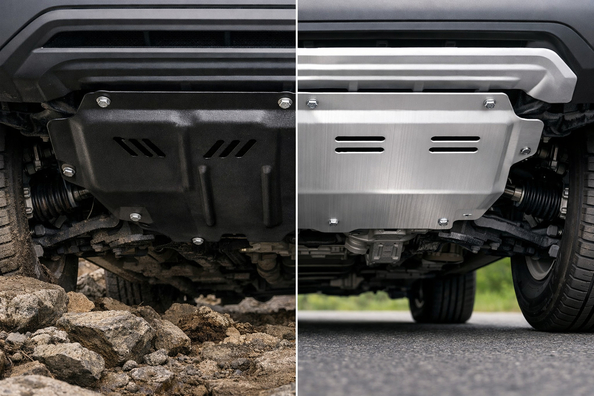
If we’re talking about real roads rather than hard, rocky off-road, then in most cases an aluminum skid plate is the more practical choice. The reason is simple: on large panels it delivers noticeably less weight, puts less load on the front of the car, and usually makes installation less complicated. Steel makes sense where a component sits low and takes strong, concentrated hits.
The main mistake when choosing is reducing everything to the phrase “steel is stronger.” For engine underbody protection, not only the material matters, but also thickness, stiffening ribs, brackets, clearances to the exhaust and subframe, and whether you need to re-torque the fasteners after the first few hundred kilometers. In practice, a poorly installed good skid plate causes more problems than a correctly selected “wrong” metal.
Aluminum is almost 2.9 times lighter than ordinary structural steel by density, so on large sheets the weight difference isn’t symbolic—it’s very noticeable. In real kits, this can be tens of kilograms. For a crossover or passenger car that drives daily in the city, on highways, broken asphalt, and dirt roads, this is a stronger argument than the abstract “greater strength” of steel.
But steel is stiffer and handles direct localized impacts at the lowest points better. That’s why for protecting the engine, transmission, and large areas of the underbody, aluminum often looks more logical, while for certain very vulnerable components—like low-slung suspension elements or differential/gearbox zones—steel is more often justified. Hence the conclusion: in real life, it’s often not one metal that wins, but a mixed setup.
| Option | Strengths | Weaknesses | Who it suits |
|---|---|---|---|
| Steel | High stiffness, better behavior under strong point impacts, appropriate for the highest-risk components | High weight, more difficult installation, corrosion risk if the coating is damaged | For those who often drive over very harsh terrain or want maximum durability at the lowest points |
| Aluminum | Lower weight, better practicality for large panels, handles moisture and salt more calmly | More prone to denting from a strong localized hit, more sensitive to fitment and fastening errors | For city, highway, travel, bad roads, and most crossovers and all-round daily cars |
| Mixed kit | Balance between weight and durability: steel where it hits, aluminum where area and weight matter | Usually more expensive; you need to closely inspect the design of each section | For those who want a compromise without leaning into “heavy armor” or unnecessary delicacy |
DD Tuning expert comment: most often the mistake isn’t the metal, but the selection logic. People choose the thickest sheet possible but don’t look at clearances to the exhaust, mounting points, or service access, and then end up with noise or inconvenient maintenance. If the car doesn’t live on rocks, extra weight under the floor is rarely justified.
Steel protection works well where the impact is short, harsh, and concentrated in one point. By modulus of elasticity, steel is significantly stiffer than aluminum, so it “flexes” less under load. That’s exactly why it’s often chosen for the lowest, most impact-prone zones.
The downside is weight. In a large set, the difference versus an alloy can be very noticeable, and it affects not only installation convenience but also suspension load, handling over small bumps, and simply how pleasant it is to service the car. The second downside is corrosion: if the coating gets knocked off, steel requires attention.
Aluminum protection wins where you need to cover a large area without a sharp increase in weight. That’s why it’s well suited for the engine, transmission, central underbody panels, touring vehicles, and daily drivers. In real kits, aluminum is often made thicker than steel to compensate for lower stiffness, and that’s a normal approach when the design is calculated for this material from the start.
Its weak point is a strong localized impact. Such a panel can dent more easily, and with imperfect fitment it can sometimes start to resonate. So aluminum shouldn’t be bought on the principle of “install anything and forget.” Correct brackets, clearances, and a follow-up fastener check after break-in are especially important here.
For most real-world roads, this is the healthiest option. The idea is simple: large areas are covered by a lighter material, while at points where hard contact is possible, steel—or steel brackets—does the work. This setup matches real use better than trying to make the whole kit from one metal just “for reliability.”
For city driving, highways, winter trips, cottage routes, and broken asphalt, aluminum wins more often. It’s lighter, more convenient in everyday use, and less stressful in daily operation when the car isn’t hopping over boulders but regularly catches potholes, ice edges, ruts, and gravel.
Steel pulls ahead when the vehicle actually hits hard obstacles with the underbody, rather than just needing insurance against accidental contact. If the vehicle is driven in mixed conditions, the most reasonable choice is usually a combined kit: it provides protection where it’s truly needed and doesn’t turn the car into a heavy projectile without clear benefit.
| Scenario | Best choice | Why |
|---|---|---|
| City, curbs, potholes, winter slush | Aluminum engine skid plate | Sufficient protection without extra weight, better resistance to moisture and salt |
| Highway and long trips with luggage | Aluminum or a mixed kit | Less load on the vehicle, more practical over long distances, easier to work with large panels |
| Poor rural roads and dirt tracks | Mixed setup | Gives a good balance between weight and durability, especially when contact risk isn’t constant |
| Low car, frequent hard underbody touches | Steel at the lowest points | Handles localized impacts better where the panel truly works like a shield |
| Regular hard rocky off-road | Steel or a heavy mixed kit | Priority is not weight but structural durability and stiffness in impact zones |
A more expensive skid plate is justified when you’re buying not just a sheet under the engine, but an entire usage concept. If the car spends a lot of time on the highway, is loaded for travel, often sees bad roads, and at the same time doesn’t need “tank-like” mass, an aluminum or mixed kit usually brings more benefit. If the task is to survive hard contacts at the lowest points, then paying extra for the right steel in specific zones also makes sense.
It’s best to start with basic engine skid plate protection. If the impact risk shifts further along the underbody, it’s logical to look at transmission protection as well. And before buying, it’s useful to check what exactly to look for in design and installation in the article how to choose an engine skid plate.
From a customer’s experience: a crossover owner wasn’t looking for maximum armor, but protection for highway trips, winter driving, and broken access roads to a cottage. In the end, they chose an aluminum engine guard with proper geometry and service access, and declined a heavy steel kit. After a season, they were satisfied specifically because the car didn’t become heavier in everyday use, while the protection covered the typical risks of their routes.
For real roads, aluminum wins more often: it’s lighter, more practical over large areas, and better suited to daily use. Steel is stronger where there’s a hard localized impact and where the component sits low. If you need a sensible compromise, most often you should look toward a mixed setup and careful installation with correct clearances and re-torquing.
This material is based on real selection experience, practice, and real usage scenarios—not an abstract argument about “what’s stronger on paper.” That’s why the right answer here is: for most regular cars and normal roads—aluminum or a combined kit; for harsh impact zones—steel.
| ✔ | Aluminum protection is much lighter than steel, so it puts less load on the front of the car and is easier to install. For everyday driving in the city, on the highway, and on rough pavement, this gives a noticeable practical advantage. |
| ✔ | On large panels, aluminum is more convenient for covering the engine, transmission, and central underbody areas without a sharp increase in weight. The article states directly that in real kits, this can amount to a difference of dozens of kilograms. |
| ✔ | Steel handles strong localized impacts at the lowest points better. This is useful where the car really hits the underbody against hard obstacles or there is a risk of point impact. |
| ✔ | Aluminum handles moisture and winter salt better and is not as vulnerable to corrosion as steel with damaged coating. For winter use, this is a noticeable plus. |
| ✔ | A mixed setup looks like the most sensible compromise for most real roads: the lighter material works on large areas, while steel is used in zones where rigidity is needed. This approach makes it possible not to overpay for unnecessary weight everywhere. |
| ✘ | Steel protection is heavier, and this mass not only makes installation more difficult, but also adds load to the suspension and worsens the feel in everyday driving. For a regular car, this may be unnecessary. |
| ✘ | Steel needs proper coating and chip control, otherwise corrosion appears quickly. After damage, the protection already requires attention instead of simply continuing to work. |
| ✘ | Aluminum dents more easily from a strong point impact, so it is not suitable as a universal solution for areas that regularly take hard hits. In such places, the author recommends steel or a combined option. |
| ✘ | If an aluminum panel is installed with poor fitment or incorrect brackets, it can start to resonate or rattle. In other words, the material itself does not help without proper installation and clearance checks. |
Shipping to EU
Wholesale and retail
Own warehouse
Опис продукту
Подарунки не надаються при оформленні покупки у кредит під 0,01% або при покупці частинами.