05.06.2026
342
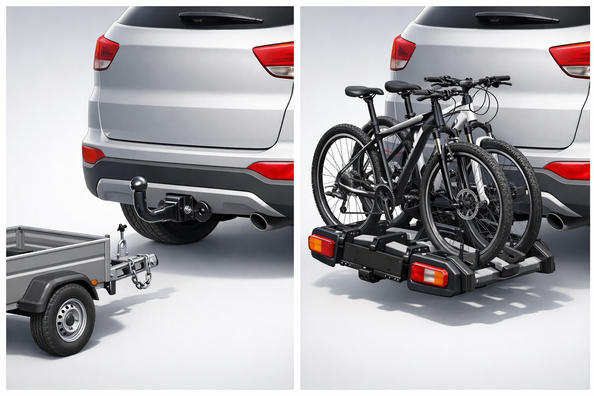
The confusion is simple: from the outside, it looks like a towbar is the same unit both for a trailer and for bicycles. But the loads, required equipment, and limitations are different. If you need to tow a trailer, you need a towing kit. If you need to carry bikes, you need a bike rack that fits the towbar square receiver, and for heavy bikes a 50.8 mm receiver is most often the more practical choice.
The main mistake is looking only at the towbar itself and not calculating the whole system. The real limit is set not by the biggest part but by the weakest one: the vehicle rating, the specific towbar, an adapter, an extension, or the rack itself. That’s why the choice doesn’t start with the “bigger is better” class, but with the answer to the questions: what exactly are you carrying, how much does it weigh, and how often will you use it.
Car owners often follow one line of thinking: “I’ll install a towbar, and then I’ll somehow do both a trailer and bikes.” In practice, it doesn’t work that way. For a trailer, the key factors are permissible towing mass, the tow ball, wiring, safety chains, and sometimes a brake controller. For bikes, what matters more is the receiver size, vertical load rating, rack overhang, and the total mass of the bikes together with the platform.
The second reason is similar class and size markings. A 31.75 mm square receiver is usually associated with lighter solutions, while 50.8 mm offers a wider selection of racks and is better suited for 3–4 bikes and heavier platforms. That’s why the same vehicle can work fine with a light two-bike rack, but be a poor base for a heavy platform setup or for towing a trailer.
Start with the simplest test: do you need to tow a trailer or carry bikes. If it’s a trailer, check the vehicle’s permissible towing mass and a complete towing kit. If it’s bikes, look not at towing capacity but at the towbar’s vertical load rating and the square receiver size.
If after these checks it turns out the limit is specifically the vertical load, the problem isn’t that the towbar is “weak” — it’s that the configuration is too heavy or too long. If you need a trailer but your shopping list doesn’t include wiring and safety components, you’re looking at the wrong type of solution.
DD Tuning expert comment: most mistakes happen where people try to use a single adapter to turn a light 31.75 mm square receiver into a universal solution for a heavy platform. The second common miss is counting only the bike weight and forgetting the weight of the rack itself. Before buying, always cross-check three numbers: the vehicle limit, the towbar limit, and the rack limit.
| Symptom | Likely cause | What to do |
|---|---|---|
| You need to tow a trailer but you’re only considering a bike rack | Tasks are mixed up | Choose a towing towbar with a ball, wiring, and safety components |
| You want 3–4 bikes or e-bikes, but you have a 31.75 mm square receiver | Receiver and vertical-load limitations | Check the limits; if the vehicle allows it, focus on 50.8 mm solutions |
| The rack noticeably wobbles | Adapter, extension, small receiver, or an overly heavy setup | Remove unnecessary adapters, check the pin and lock, switch to a compatible rack without extra overhang |
| The trunk is hard to open | A rack without a tilt mechanism was chosen | For frequent trips, choose a platform with tilt or swing-away function |
| You think a bigger towbar will automatically raise the vehicle limit | Misunderstanding of towbar class | Go by the smallest allowed limit across the entire system |
Accessories make sense when they address a specific shortcoming, not when they mask a poor base configuration. If you already have the right towbar but lack a bike-carrying solution, it’s logical to select a rack. But if the receiver itself or the permissible load doesn’t match the task, you don’t need a small tweak — you need a different setup.
| Solution | When it works | When it’s not worth spending money |
|---|---|---|
| Towing towbar with a full kit | When you need to tow a trailer and the vehicle has a permitted towing mass | When the task is only transporting bicycles |
| Platform bike rack for 50.8 mm | For 2–4 bikes, heavy frames, e-bikes, frequent trips | If the vehicle doesn’t allow the required vertical load or your use case is light and occasional |
| Hanging rack for 31.75 mm | For lighter bikes and a moderate budget | For heavy bikes, larger quantities, or if you already have wobble issues |
| Adapter or extension | Only when you can’t do without it and there is load margin | As a permanent way to hang a heavier system at the limit |
| Switching the configuration to 50.8 mm | When heavier bike racks are planned and the vehicle allows it | When the limit is set by the vehicle itself, not the receiver size |
From a customer’s experience: a person wanted one solution for both a small trailer and two heavy bicycles, initially hoping to get by with a light receiver and an adapter. After calculating the combined weight of the rack and bikes, it became clear there was almost no margin, so for bike trips they chose a 50.8 mm platform rack, and for the trailer they assembled a separate towing kit. As a result, the wobble feeling disappeared, while trunk access remained normal.
The choice here depends not on trends and not on the “bigger is better” class, but on the task. For a trailer, you need a towing towbar with full equipment. For bikes, you need a compatible rack for the towbar square receiver, and for heavier scenarios the 50.8 mm receiver usually wins. If you have to “save” the configuration with adapters, that’s already a signal to re-check the entire system from scratch. This material is based on real selection experience, practice, and real usage scenarios — not abstract “eyeballed” advice.
| ✔ | For a trailer, you can put together a separate towing kit with a ball, wiring, and safety components, so the solution will match the towing task itself. This is more practical than trying to adapt a bike rack for another function. |
| ✔ | For bicycles, the article clearly recommends choosing the type of mount for a specific scenario: platform-style for heavy frames, e-bikes, and frequent trips. This helps avoid buying a universal solution that won’t withstand the actual load later on. |
| ✔ | The 50.8 mm square offers a wider choice of mounts and is better suited for 3-4 bicycles and heavier platforms. If the car allows it, this option is less limited in future accessory choices. |
| ✔ | The article suggests checking three limits at once: the vehicle limit, the towbar limit, and the mount limit. This reduces the risk of buying a system that technically fits but in practice works at the edge. |
| ✔ | There is a clear pre-purchase checklist: the type of task, permissible vertical load, receiver size, total system weight, and the need for an adapter. This approach helps identify the issue before the trip. |
| ✘ | An adapter or extension does not solve the problem indefinitely: it adds leverage and can reduce the allowable load. For a heavy platform, this is an unreliable setup rather than a complete solution. |
| ✘ | The 31.75 mm square rather limits your choice and is not well suited for heavy bikes or 3-4 bicycles. If the scenario is more complex, you either have to change the setup or accept major limitations. |
| ✘ | The towbar itself does not cover the trailer task if there is no wiring, ball, and safety components. In other words, buying only one unit may turn out to be incomplete and bring extra costs. |
| ✘ | Buying a “towbar with a reserve” will not help if the car itself does not have the required permitted limit. In that case, the real restriction is still set by the car, not by a stronger unit. |
Shipping to EU
Wholesale and retail
Own warehouse
Опис продукту
Подарунки не надаються при оформленні покупки у кредит під 0,01% або при покупці частинами.