
13.04.2026
245
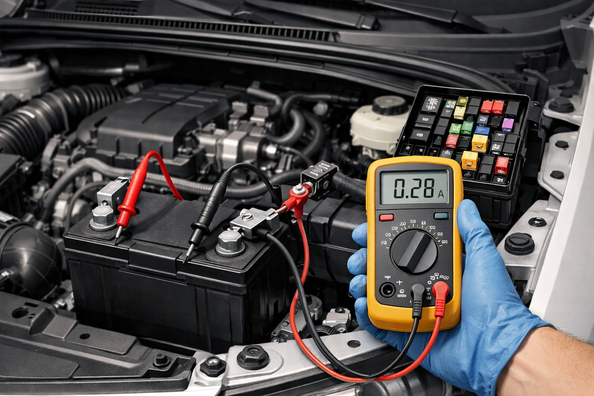

If the car started fine in the evening but in the morning the battery is already “dead”, the cause is most often not the battery itself, but a current draw that doesn’t disappear after you switch the ignition off. The correct algorithm is simple: wait until the electronics go to sleep, measure the resting current, and only then look for the guilty circuit.
For most cars, a normal resting current is considered to be about 20–50 mA; on some newer models it may be slightly higher. If after the modules have gone to sleep you see more than 50 mA, that’s already a reason to check, and over 100 mA is a clear problem. A very large drain—especially from 1 A and up—can flatten the battery literally overnight.
Overnight discharge appears in two typical scenarios. The first is that the car truly has a parasitic draw: some consumer remains active after the ignition is turned off. The second is that the resting current is normal, but the battery is already weak, undercharged from short trips, or not receiving a proper charge from the alternator.
Confusion arises because a modern car doesn’t fully “switch off” immediately. Comfort modules, keyless entry, security systems, and other units can take 20–75 minutes to fall asleep. If you measure earlier, or with a door, trunk, or hood open, you’ll see an elevated current and draw the wrong conclusion.
DD Tuning expert comment: The most common mistake is measuring current right after switching the car off or with the doors open. At that moment the network is still active, so people suspect the battery for nothing. The second typical mistake is not checking aftermarket equipment, even though it often causes a steady overnight draw.
| Symptom | Likely cause | What to do |
|---|---|---|
| Battery is discharged in the morning, the problem repeats every day | Parasitic draw above normal, module doesn’t sleep | Measure resting current after modules sleep, then check fuses |
| The battery goes flat literally overnight | Very large drain: dome light, relay, constant-power circuit | First look for lights, relays, hot components, and high-current circuits |
| The problem appeared after installing a dash cam or alarm | Incorrect connection to constant power | Check the power wiring and whether there is a low-voltage cutoff |
| In cold weather and after short trips the start is weak, but no drain is found | Undercharge or a worn battery | Recharge the battery, check its condition and alternator operation |
| Dim lights, charging indicator, unusual smell | Alternator or diode-bridge problem | Check the alternator separately; don’t reduce everything to replacing the battery |
| Discharge happens only when doors or the trunk are left open | Switch or lighting prevents the car from sleeping | Inspect dome lights, locks, switches, and the light shutoff logic |
Only a step-by-step check works—not replacing parts at random. The best basic test is measuring resting current after the electronics have fully gone to sleep. It immediately separates a real drain from a weak battery. If you need a practical start, also look at how to measure parasitic draw with a multimeter.
The second step that truly saves time is localization by fuses and relays. This way you don’t guess—you narrow the search down to a specific circuit: infotainment, security, interior lighting, charging sockets, or the comfort module. It’s also useful to go through basic tips for checking the car’s electrical equipment.
Separately, check everything installed after the factory: dash cam, amplifier, alarm, tracker. If the issue is in the alternator, it’s usually visible not only during parking, but also through undercharging, dim lights, or warnings on the cluster.
For long-term parking, a maintenance charger is useful—but only when there is no actual drain. A healthy battery with normal resting current usually withstands several weeks of downtime without surprises.
| Check | What it tells you | When to do it |
|---|---|---|
| Resting current measurement | Shows whether there is a real drain | After modules sleep and doors are closed |
| Pulling fuses one by one | Finds the exact circuit | When current is above normal |
| Alternator check | Detects reverse current and undercharging | When there are signs of weak charging or dim lights |
| Inspection of aftermarket accessories | Looks for the source of overnight load | After vehicle upgrades |
If the car sits for a long time and the resting current is within normal limits, the point isn’t hunting a “mystical” drain, but maintaining charge. In that scenario, an intelligent charger is justified: it’s useful for a seasonal car, a second car in the family, or during extended diagnostics.
If the discharge started after upgrades, first check the power wiring of whatever was installed. Most often questions arise because of a dash cam in parking mode or an old alarm system that’s connected without proper shutoff logic. Replacing the battery makes sense only when the resting current is normal but the battery itself no longer holds a charge.
| Solution | When it works | When it’s not worth spending money |
|---|---|---|
| Resting current measurement and fuse-based search | When you need to find the exact circuit without guessing | Don’t skip this step and immediately replace the battery or alternator |
| Disconnecting or rewiring aftermarket accessories | When the issue appeared after upgrades | Won’t help if a factory module, relay, or alternator is at fault |
| Relay replacement or alternator repair | When there’s sticking or reverse current through diodes | Pointless if high current comes from another circuit and it isn’t confirmed by measurement |
| New battery | When resting current is normal but the battery doesn’t hold a charge | Doesn’t solve parasitic drain |
| Maintenance charger | When the car sits for a long time and there is no drain | Doesn’t fix a circuit that is actually draining the battery while parked |
| Regular longer drive | When the problem is undercharge after short routes | Almost useless with a consumer that draws current all night |
From a customer’s experience: A person was looking for a new battery because the car couldn’t survive an overnight stay. After a proper current measurement, it turned out that after installing a dash cam the circuit kept about 0.3 A even at rest. After correct rewiring with a low-voltage cutoff, the battery stopped going flat—and there was no need to replace it.
If the battery goes flat overnight, don’t start by buying a new one. First wait for the modules to sleep, measure the resting current, and localize the guilty circuit by fuses. That’s how you distinguish a real drain from a weak battery, undercharge, and alternator problems.
Most often the issue turns out not to be a “bad battery”, but a specific consumer that shouldn’t be working while parked.
Shipping to EU
Wholesale and retail
Own warehouse
Опис продукту
Подарунки не надаються при оформленні покупки у кредит під 0,01% або при покупці частинами.