21.03.2026
542
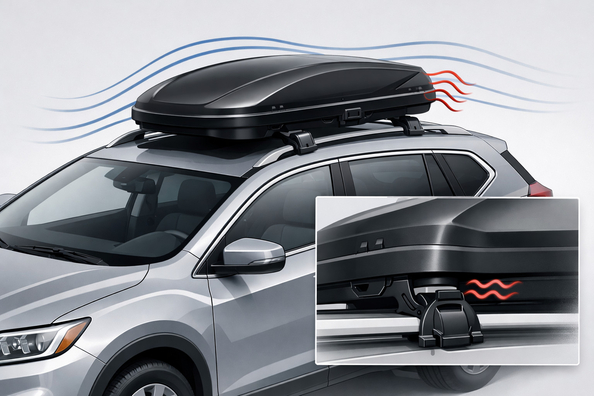
Whistling from a roof box on the highway is almost always caused not by a “bad box”, but by the airflow: separation over the crossbars, gaps in the mounts, or an unfortunate position on the roof. The good news is that in many cases the noise can be noticeably reduced without replacing the entire setup.
What works best isn’t one “magic” trick, but a step-by-step check: fastening, end caps, alignment, crossbar spacing, shifting the box rearward and, if needed, changing the crossbar profile. Below is a practical way to quickly find the source of the whistle and what actually delivers results.
Whistling is usually a high-frequency noise that appears when air passes through a narrow gap or flows around an element with an unfavorable profile. With a roof box this is typical at highway speeds, but the exact threshold depends on roof shape, crossbars, wind, and how tightly everything is installed.
In practice, three things are most often to blame: crossbars, joints/gaps, and the box position. The box itself can also be a noise source, but often it only amplifies an existing aerodynamic issue on the roof.
Start with simple tests that don’t require tools. First check whether the sound changes when you briefly change speed, then whether there’s a difference after slightly repositioning the box or checking the end caps. If the noise drops sharply after stopping or repositioning, the source is almost certainly aerodynamic rather than suspension- or engine-related.
The most useful diagnostic method is to change only one parameter at a time. Don’t do everything at once: shift the box, check; then the end caps; then the crossbars. If you temporarily tape over a suspected gap and the noise disappears, that’s a strong clue where to look for a final fix.
| Symptom | Likely cause | What to do |
|---|---|---|
| High-pitched whistle on the highway | Gap, open channel, loose end cap | Check all joints, end caps, rubber inserts; temporarily cover the suspected spot |
| Noise increases after installing crossbars | Crossbar profile or orientation | Check correct installation direction; consider aero-profile crossbars |
| Whistling appears only with the box installed | Box position or contact with a turbulent zone | Shift the box rearward, keeping clearance to open the tailgate |
| Noise is louder with an empty box | Resonance of the empty shell | Test with cargo; for short trips it’s sometimes easier to remove the box |
| Whistling doesn’t change after removing the box | Source is the roof rails or roof elements | Check raised rails, trim, seals, sunroof |
| Symptom | Likely cause | What to do |
|---|---|---|
| Whistling starts around city speeds or slightly higher | Flow separation on the crossbars or near the rails | Check crossbar profile, end caps, installation direction |
| Volume jumps sharply at 80–110 km/h | Roof aerodynamics, box position, small gaps | Shift the box rearward, check mount tightness, reduce speed for testing |
| Noise appears only in windy weather | Sensitivity to crosswind | Compare the sound on a different route, check protruding elements |
| After opening the sunroof, noise increases sharply | Sunroof interaction with the airflow from the crossbars | Don’t use the sunroof with crossbars or a roof box installed |
| After temporarily taping a gap, the whistle disappears | Source found | Replace the end cap, restore the factory seal, or correct the installation |
The most effective actions are those that remove the root cause of the whistle rather than masking it. What works: correct box alignment, tight fit of all end caps, closed channels, correct crossbar orientation, and an aerodynamic crossbar profile. If possible, shifting the box rearward often makes a noticeable difference too.
Another practical point is testing without load. If the box is empty and noisy, for a short trip it may be easier to remove it altogether. If you have to drive with it all the time, it’s better to invest in the right crossbar profile and quality end caps rather than random “noise dampers” without knowing the cause.
More details on selection and compatibility can be found in the roof boxes section.
Don’t expect miracles from random stickers, foam, “universal noise killers”, or crudely blocking part of an air channel without understanding where the whistle is created. Such fixes sometimes reduce noise for a few days, but then it returns or shifts frequency.
A wind fairing/deflector doesn’t always save the day either. On some vehicles it really removes the noise, but on others—especially with certain boxes and crossbars—it can create a new resonant whistle. That’s why it makes sense only after basic diagnostics, not instead of it.
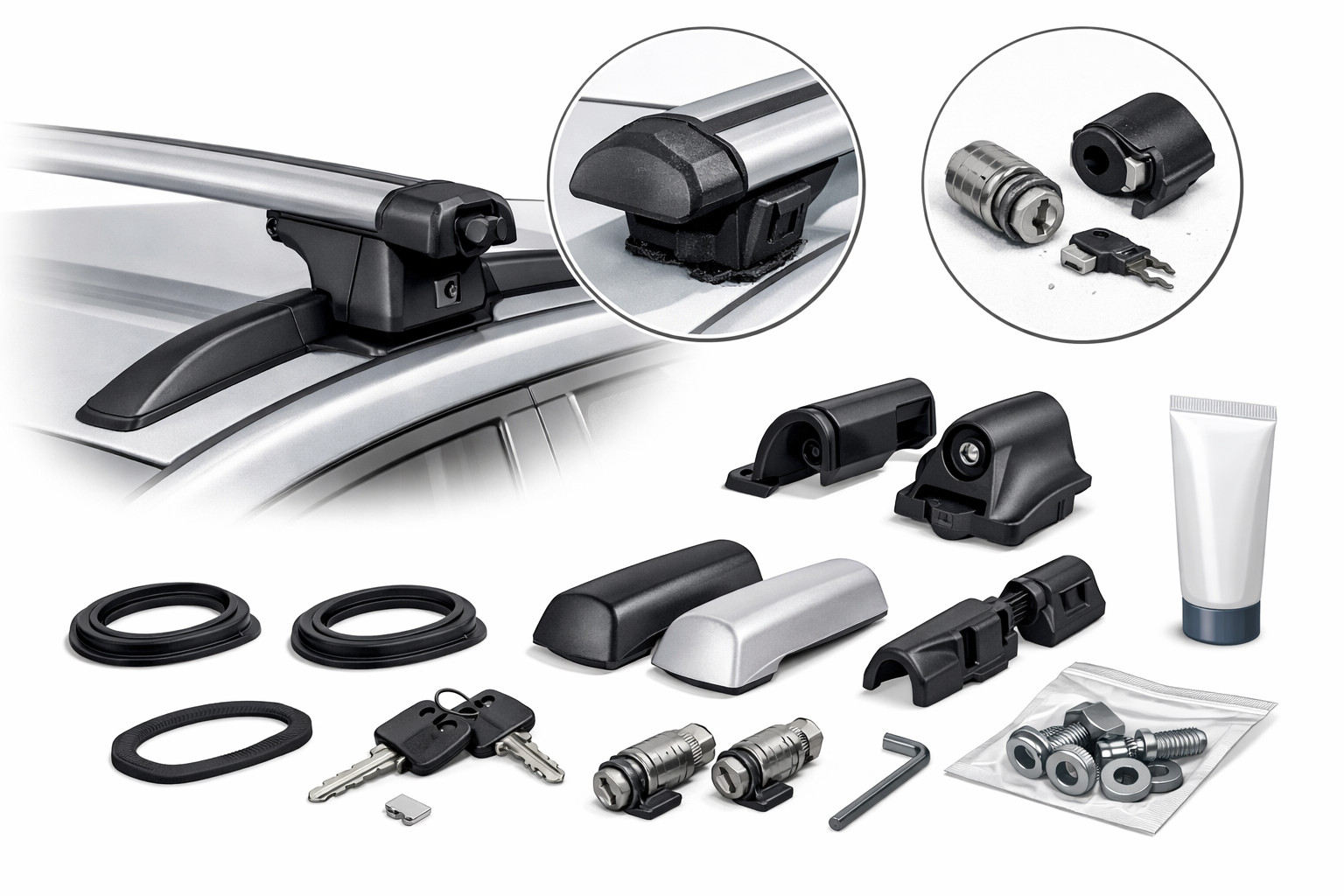
If the basic checks don’t help, then it makes sense to look at accessories. First of all, aero-profile crossbars, which are often quieter than box-section bars, as well as rubber inserts for T-slots and quality end caps. They won’t solve every issue, but they reduce the chances of airflow separation.
Replacing parts is worth considering when the noise repeats consistently at the same speed and repositioning the box or checking the mounts doesn’t help. In that case, the issue is likely in the geometry of the specific setup, not a minor installation flaw.
| Solution | When it works | When it’s not worth spending money |
|---|---|---|
| Tight end caps and checking the mounts | When the whistle comes from small gaps or open channels | If the source is the crossbar profile itself or the vehicle body |
| Shifting the box rearward | When the noise depends on roof position | If shifting causes contact with the tailgate |
| Aero-profile crossbars | When the existing crossbars are clearly noisy at speed | If the cause is the sunroof, seals, or another roof element |
| Wind deflector | When it’s matched to the specific geometry and there’s already experience that it works on this vehicle | If the setup is already resonance-prone and there’s a risk of a new whistle |
| Replacing the entire box | When the old shell has inherently poor aerodynamics or worn elements | If the problem is installation-related rather than the product itself |
If a roof box is noisy on the highway, first look not for a “bad model” but for a specific point where the airflow separates: the crossbars, end caps, box position, or roof elements. Most often, correct installation, tight joints, shifting the box rearward, and aero-profile crossbars help. Universal noise dampers rarely produce a stable effect on their own.
The practical verdict is simple: diagnose first without buying new parts, then replace only what’s truly at fault. If the noise doesn’t go away after all checks, the problem is likely not a single accessory but the interaction of the box with your specific roof and its fittings.
To choose compatible solutions and mounting options, you can return to the roof box catalog and compare the configuration with what’s already installed on your vehicle.
| ✔ | Often, the whistling can be reduced without replacing the entire roof box: it is enough to check the fastening, plugs, and gaps in the mounts. This is practical because there is no need to buy new parts right away. |
| ✔ | The article provides a consistent diagnostic scheme: change one parameter at a time and immediately check the result. This approach helps you find the specific source of the noise faster instead of acting by guesswork. |
| ✔ | Simple mechanical correction works well — leveling the box, shifting it back, and ensuring a tight fit of the elements. This gives a chance to eliminate the whistling without complex modifications. |
| ✔ | The author directly points out useful solutions that really reduce noise: aero-profile crossbars, new plugs, and rubber inserts in T-channels. This provides a clear list of priorities for improvement. |
| ✘ | The noise does not always come from the roof box itself, so sometimes you have to check the rails, the sunroof, and even the roof trim elements. This makes it harder to find the cause and takes more time. |
| ✘ | Not every solution provides a stable effect: universal noise dampers, stickers, or foam may help only temporarily. The article clearly says that the whistling may return or change frequency. |
| ✘ | A wind deflector is not a universal way to fight whistling and, on some cars, can наоборот create a new resonance. That is, it cannot be installed without prior diagnostics. |
| ✘ | Shifting the box backward does not always help, because it may interfere with opening the trunk lid. In such a case, a useful solution becomes limited by the design of a specific car. |
Shipping to EU
Wholesale and retail
Own warehouse
Опис продукту
Подарунки не надаються при оформленні покупки у кредит під 0,01% або при покупці частинами.