10.05.2026
443
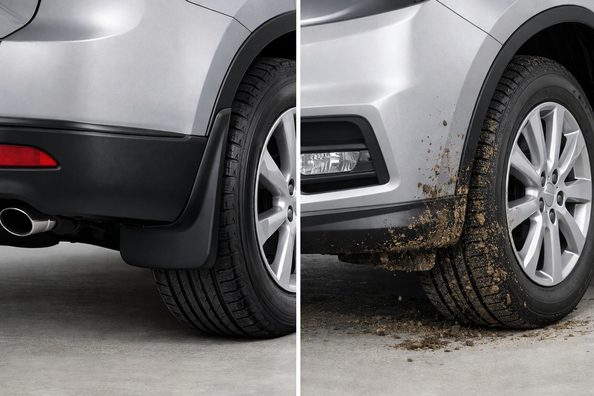
Yes, you can start with a single set, and for most passenger cars it makes more sense to start with front mud flaps. The front wheels throw water, sand, and dirt at the sills and the lower part of the doors most actively, so you’ll feel a real practical effect right after installing the front pair.
A full set front and rear isn’t necessary for everyone. It’s justified where there’s winter with road salt, frequent highway driving, gravel, towing, or constant load use. At the same time, rear mud flaps are harder to install on some models, and sometimes they also interfere with other trims or arch liners/arch protection.
The choice here isn’t between “right” and “wrong”, but between sufficient and maximum protection. The front pair takes the main hit to the sills, the lower edge of the doors, and the area in front of the rear wheel arch. The rear pair works more to reduce dirt spray behind the car and partly takes on snow, salt, and fine gravel thrown from under the rear wheels.
So for city driving, asphalt, and normal highway use, front mud flaps are often enough. A full set makes sense when the car actually drives in harsh conditions, not just “just in case”.
| Option | Strengths | Weaknesses | Who it’s for |
|---|---|---|---|
| Front only | Best price-to-benefit ratio, often easier installation, good protection for sills and the lower part of the doors | Less protection for the rear bumper and less effect in snow, salt, and on gravel | City, highway, daily asphalt driving, limited budget |
| Rear only | Helps reduce spray behind the car, can be useful for winter and load/utility scenarios | Hardly solves the main issue of dirty sills, often doesn’t deliver the most noticeable effect as a first purchase | For those who already have front ones installed, or for anyone whose priority is controlling dirt behind the car |
| Full set | Best overall protection, logical for winter, salt, gravel, long trips, and heavy use | Higher price, more mounting points, higher risk of catching a curb or ice | For those who often drive out of town, drive in winter, or want maximum protection right away |
DD Tuning expert comment: the most common mistake is buying long universal mud flaps “to cover more”, and then trimming them after the first curb. The second typical issue is not checking whether the rear pair conflicts with the wheel-arch liner, arch extensions, or other trims. If there’s any doubt, the safer start is a precise front pair, and adding the rear after a season of use.
This is the most sensible starting point for most drivers. The front wheels create the main flow of dirt onto the sides of the body, so the front pair delivers visible results fastest: less sandblasting on the sills, less wet grime on the rear doors, and easier washing of the lower body.
Another plus is that on some models, OEM sets are sold only as a front pair. That indirectly shows where the manufacturer sees the main risk area. The downside is simple: if you have lots of salt, snow, or gravel, front mud flaps alone may not be enough.
As a first set, this is a niche scenario. The rear pair is useful when you need to reduce spray behind the car, when the vehicle often drives in wet slush, or when the front ones are already installed and you want to add symmetrical protection.
But if the body suffers most at the sills and the lower edges of the doors, rear mud flaps won’t solve that problem. That’s why for a typical passenger car, it’s rarely the best first step.
This option is for those who want not the minimally sufficient, but the most complete protection. It works best where the car regularly sees salt, slush, gravel, broken shoulders, long trips, or tows a trailer. In such conditions, the difference between a front pair and a full set shows up faster.
The weak point isn’t just the price. On some cars the rear pair is less convenient to install, and overly long or poorly fitted parts can rub, bend, or catch. If ground clearance is small, you need to factor that in before buying.
If you have a normal city routine, standard tires, and most of your mileage is on asphalt, the front pair covers the main need. This is the case where it doesn’t make sense to overpay for a maximum you’ll hardly use.
If the car regularly drives on bad roads, often runs in winter, or works under load, a full set is justified. Buying the rear pair separately makes sense either as a second stage after the front, or in narrow scenarios where the priority is less dirt behind the car.
| Scenario | Best choice | Why |
|---|---|---|
| City, parking lots, asphalt, standard daily driving | Front mud flaps | Provides the main protection for the most vulnerable area without extra cost |
| Winter with salt, slush, frequent intercity trips | Full set | Better contains dirt and salt from both axles, less impact on the lower body |
| Gravel, rural roads, shoulders | Full set | In these conditions the rear pair adds real value, not just “for looks” |
| Low car or stiff suspension | Short model-specific front; rear only if they definitely don’t eat into ground clearance | Lower risk of catching and rubbing as the suspension moves |
| Towing, commercial use, frequent loads | Full set, preferably model-specific | You need stable protection and less spray in real heavy-duty use |
A more expensive set makes sense when you care not just about having a mud flap, but about precise fitment, decent durability, and installation without unnecessary compromises. In that case, it’s better to look not at random universal flaps, but at the mud flaps categories, compare original mud flaps separately, and only then decide whether universal options will work.
The extra cost is justified if the car often drives in winter, on gravel, or you don’t want to risk drilling and trimming. In these cases, it’s better to take a precise set for the front axle than a cheap full kit with questionable fit. And if the usage really is heavy-duty, then it’s logical to buy a full model-specific set right away.
From a customer’s experience: an SUV owner wanted a full set right away, but in reality drove mostly in the city and only occasionally went onto dirt roads. They started with the front pair because the sills were constantly getting sandblasted. After a season it was enough, and he bought the rear pair before winter trips out of town.
You can start with one set, and in most cases it’s better to start with front mud flaps. It’s cheaper, easier to install, and gives the most noticeable result in everyday use. The rear pair alone should be considered as an add-on or a solution for a specific scenario.
A full set is justified where conditions are harsher: winter, salt, gravel, long trips, towing, commercial use. The final choice should be made not by the principle of “the more, the better”, but by installation, ground clearance, fit quality, and your real driving routine. The material is based on real selection experience, practical know-how, and real use scenarios.
| ✔ | You can start with one set, and for most passenger cars the best first choice is front mud flaps. They immediately reduce dirt on the sills and the lower part of the doors, where the problem is most noticeable. |
| ✔ | The front pair is usually cheaper and easier to install than a full set. This is convenient if you want to test the benefit without extra expense or a complicated installation. |
| ✔ | For city driving, asphalt, and normal everyday use, front mud flaps are often enough. In such conditions, there is no point in overpaying for the rear pair if the car is not used in harsh conditions. |
| ✔ | A full set provides better protection in tough conditions: winter, salt, gravel, long trips, or towing. It better contains dirt from both the front and rear axles. |
| ✔ | Some models come with factory kits only as a front pair, which confirms the priority of this position. This is a practical argument in favor of starting with front mud flaps. |
| ✘ | As a first purchase, rear mud flaps often do not solve the main problem — dirt on the sills and lower edges of the doors. That is, the effect may be less noticeable than with the front pair. |
| ✘ | A full set costs more and may require more complicated installation. On some cars, rear mud flaps are inconvenient to fit or require additional adjustment. |
| ✘ | Long or poorly chosen elements can reduce ground clearance and catch on curbs, ice, or wash guides. This is especially dangerous for low cars. |
| ✘ | There is a risk of incompatibility with wheel arch liners, arch trims, or other exterior protection. Because of this, a universal set may turn out to be problematic without checking the fit. |
Shipping to EU
Wholesale and retail
Own warehouse
Опис продукту
Подарунки не надаються при оформленні покупки у кредит під 0,01% або при покупці частинами.