19.05.2026
400
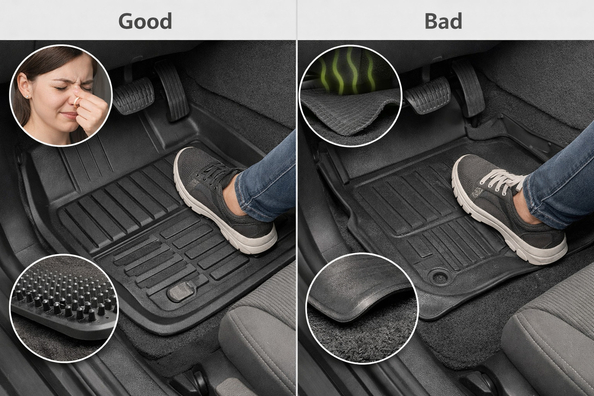
If you need mats with no smell, no slipping, and no annoying gaps, look less at the material name and more at three things: pattern accuracy, OEM-style fixation, and real floor coverage. In practice, the least trouble comes from vehicle-specific all-season liners or high-quality EVA/3D mats made specifically for your car.
Universal options look attractive on price, but they’re also the ones most likely to leave exposed areas near the pedals, sill, or tunnel—and to shift around more often. If the car lives mostly in a dry city, carpet mats give more quiet and comfort; if you deal with rain, snow, salt, frequent trips, or kids in the cabin, it’s more logical to look toward vehicle-specific all-season solutions.
Three requests—no smell, don’t slip, no gaps—are solved by different characteristics. Smell depends on material and manufacturing quality: cheap rubber or PVC often smells stronger, while quality multi-layer or thermoplastic solutions are usually more neutral in the cabin.
Slipping is almost always about fixation rather than the material itself: whether there are OEM holes, clips, a textured underside, and whether the shape matches the floor. Unwanted gaps appear where the mat isn’t vehicle-specific or is made from an inaccurate pattern. That’s why the best choice isn’t “rubber vs. EVA,” but the right format for your real use case.
| Option | Strengths | Weaknesses | Who it suits |
|---|---|---|---|
| Carpet | Quiet, soft, pleasant in a dry cabin, looks more tidy | Absorb moisture, worse for snow, salt, and mud, require drying | City, dry climate, daily comfort matters more than maximum protection |
| Universal rubber or PVC | Inexpensive, not afraid of water, easy to buy quickly as a temporary solution | Often slip, leave gaps, can smell, rarely fit well in the driver’s area | A temporary option or a very tight budget |
| Vehicle-specific all-season liners | Precise fit, high edges, hold water and dirt better, more stable underfoot | More expensive, sometimes stiffer, not everyone likes the look in the dry season | Fall, winter, highway use, family car, frequent trips |
| High-quality EVA/3D mats | Lightweight, quick to wash, often more neutral in smell, can be a good compromise between practicality and comfort | Depend heavily on pattern accuracy and mounts; weaker versions can shift, leave gaps, or cause issues around the seat rails | Those who want a vehicle-specific fit and easy care without heavy rigid liners |
DD Tuning expert comment: the most common mistake is choosing mats by photos, color, or edge height without checking the mounts and the shape of the driver’s area. The second typical story is buying EVA on the principle of “the material is good, so it’ll fit,” and then getting a hole in the wrong place or interference near the seat rails. Before buying, always look at how the mat sits by the pedals, the sill, and the tunnel.
Their main advantage is quietness. They’re softer underfoot, don’t create the feeling of a rigid plastic tray, and are better for a car that’s driven mostly in the city in normal weather. If you rarely bring in wet shoes, this is the most comfortable option.
The downside is simple: water, snow, and salt are a bad scenario for carpet. It absorbs moisture, takes longer to dry, and loses its neat appearance faster. So carpet is good not “in general,” but specifically for dry use.
They’re bought because of the low price and straightforward logic: dirt isn’t scary—wash it and go. But this is where compromises most often start: cut-down size, exposed floor edge, sliding forward, poor compatibility with OEM retainers.
If you choose this option, do it only with a clear understanding that it’s a budget or temporary solution. For the driver’s side, a universal mat is the riskiest, because the wrong shape there is more critical than on the passenger side.
This is the most practical format for rain, snow, salt, trips, and regular dirt. They cover the floor edges better, have raised sides, proper geometry around the pedals, and are more often compatible with OEM fixation points. That’s why they slip less and protect the factory carpeting better.
The weak spots are price and stiffness. Not everyone likes how such a mat looks in a clean summer cabin, and in some cars you have to slide it carefully under the trim. But if you need a working result rather than maximum comfort, this is one of the strongest options.
Here, build quality decides everything. A good set is lightweight, washes quickly, looks neat, and can be a very successful compromise between protection, weight, and daily upkeep. Multi-layer 3D solutions can also be better for noise than rigid liners.
But you shouldn’t buy EVA “blind.” If the pattern is inaccurate, gaps appear; if the mounts are shifted, the mat can creep toward the pedals; if the seat rails aren’t accounted for, you get constant rubbing or skewing. In winter, it’s also important how convenient it is to clean the cells from snow and ice.
For a quiet city car that rarely sees slushy snow, carpet makes more sense than any “practical” material—it’s simply nicer in everyday contact. But if you often get into the car in wet shoes, carry kids, drive to the countryside, or spend a lot of time parked in winter, the comfort of carpet ends after the first real bad weather.
Vehicle-specific all-season liners win where the cabin needs to be protected, not just covered. High-quality EVA/3D makes sense when you want cleanliness and easy maintenance, but without heavy rigid shapes. Universal rubber isn’t “always bad,” but it’s almost always a compromise you notice every day.
| Scenario | Best choice | Why |
|---|---|---|
| Dry city, short trips | Carpet | Less noise, more comfort, practical enough without constant moisture |
| Fall and winter with water, snow, and salt | Vehicle-specific all-season liners | Hold dirt and water better, fewer chances of exposed floor areas |
| Family car, kids, out-of-town trips | Vehicle-specific all-season or high-quality EVA/3D | Easier to clean the cabin after wet shoes, snacks, and constant dirt |
| Frequent highway driving and long trips | High-quality EVA/3D or quiet vehicle-specific liners | Not only edge height matters here, but also underfoot stability and decent acoustic comfort |
| Taxi, delivery, work vehicle | Higher-end vehicle-specific liners | Quick washing, long service life, and better floor protection justify the extra cost |
| Need it cheap and right now | Universal rubber or PVC | Lowest entry budget, but you must accept the risk of gaps, smell, and slipping |
Paying extra is justified when the mats work every day: winter use, a new or well-kept interior, family trips, commercial workload, frequent highway driving. In these conditions, a more expensive vehicle-specific set pays off not by “premium-ness,” but by covering the floor better, moving less, and washing faster.
If you’re looking at lightweight vehicle-specific solutions, start with EVA cabin mats and judge them not by the pattern but by the templates and mounts. If you’re unsure how much edge protection you need, it’s also worth separately reviewing mats with raised sides vs. without. And when you need a purchase for several seasons, it’s useful to cross-check your choice with the article about the most durable car mats.
From customer experience: a frequent request is to replace universal rubber mats that constantly slide toward the pedals and leave dirt by the sill. In most such cases, people switch to vehicle-specific all-season liners or quality EVA with clips and notice not a “wow effect,” but a simple everyday difference: the interior is easier to wash, and the driver’s mat stays where it should. If the second car is used only in the city, carpet is often chosen, with the practical solution kept only for the winter season.
In short, the lowest chance of smell, slipping, and gaps comes from vehicle-specific all-season liners or high-quality EVA/3D mats with accurate patterns and OEM-style fixation. Carpet mats remain the most comfortable for a dry city, while universal rubber only makes sense as a budget or temporary option.
Before buying, check not the marketing, but the shape of the driver’s area, compatibility with mounts, coverage by the sill and tunnel, and whether the mat interferes with the pedals. This material is based on real selection experience, practice, and real use scenarios, so the main takeaway is simple: what matters isn’t the label on the material, but the quality of fit in your specific car.
| ✔ | Model-specific all-season liners and high-quality EVA/3D mats solve three issues at once: odor, slipping, and gaps. The article emphasizes that the key factors are precise templates, factory mounting points, and full floor coverage. |
| ✔ | Carpet mats provide more quietness and comfort in dry city driving. They feel softer underfoot and are a better fit if the cabin is rarely exposed to moisture. |
| ✔ | Model-specific all-season liners are well suited for rain, snow, salt, and frequent trips. They have high edges, hold dirt and water better, and shift less often. |
| ✔ | High-quality EVA/3D mats can be a good compromise between practicality and comfort. They are lightweight, easy to clean, and are often less prone to odor than cheap rubber or PVC options. |
| ✔ | For daily use, it is important that more expensive model-specific solutions are easier to clean and better protect the factory floor covering. The article states directly that this extra cost pays off in winter, in a family car, or in a commercial vehicle. |
| ✘ | Universal rubber or PVC mats often have an imprecise fit. Because of this, the edges near the pedals, sill, or tunnel remain exposed, and the mat itself may shift. |
| ✘ | Cheaper rubber or PVC more often have an initial odor. The author separately notes that this is especially noticeable in a small cabin or when the car is parked in the sun. |
| ✘ | Carpet mats handle water, snow, and salt poorly. They absorb moisture, dry more slowly, and lose their neat appearance faster. |
| ✘ | EVA/3D mats depend heavily on the quality of the templates and fasteners. If the shape is inaccurate or the seat rails are not taken into account, gaps, misalignment, or rubbing near the pedals may appear. |
Shipping to EU
Wholesale and retail
Own warehouse
Опис продукту
Подарунки не надаються при оформленні покупки у кредит під 0,01% або при покупці частинами.