22.05.2026
328
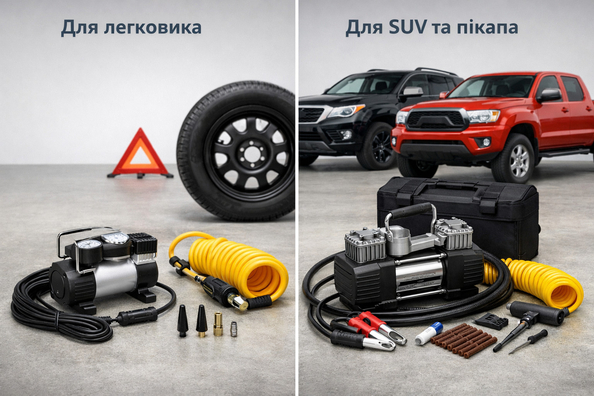
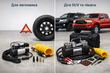
Choosing a compressor isn’t decided by the words “passenger car,” “crossover,” or “pickup,” but by your tire size and how often you actually top up the tires. For a city passenger car, a compact 12V pump from the socket is usually enough; for a crossover with 31–33-inch wheels, a noticeably more practical option is one with battery clamps or a light onboard compressor; and for a pickup, off-road driving, and regular airing down, it makes sense to look at twin systems.
You should compare not only maximum pressure, but first of all airflow in L/min, duty cycle, power type, hose length, noise, installation convenience, and service life. And one more detail that’s often ignored: after highway driving, it’s better to check pressure on a cold tire, because a hot tire can easily give an error of about 0.3 bar.
Classifying by vehicle type is useful only as a quick reference. In reality, you choose a compressor based on three things: your tire size, whether you air down before dirt or sand, and how many wheels you need to inflate in one go.
On a passenger car with tires up to around 225/60R18, a compact pump with about 35–40 L/min still works without noticeable discomfort. On a crossover or SUV with 31–33-inch wheels, it becomes important that power doesn’t come through the cabin socket, but via clamps or a hardwired connection. On a pickup with 33–35-inch wheels, especially after off-road, the decisive factors are inflation speed and the compressor’s ability not to overheat during a set of four tires.
| Option | Strengths | Weaknesses | Who it’s for |
|---|---|---|---|
| Compact 12V from the socket | Lightweight, cheaper, takes minimal space, sufficient for regular pressure corrections on a passenger car | Current limitation, slower on large wheels, doesn’t like long consecutive runs | City use, one passenger car, emergency kit in the trunk |
| Portable 12V with clamps | Inflates faster, handles load better, suitable for 31–35-inch tires without complex installation | You need to open the hood each time, more wires and bulk | Crossover, SUV, pickup without constant off-road use |
| Hardwired single compressor | Always ready to work, stable power, convenient for frequent use and additional pneumatics | Requires installation, space under the hood or in the bed, higher price | Anyone who travels often and regularly works with tire pressure |
| Twin hardwired or brushless portable | Very high speed, better endurance in long runs, headroom for big tires and demanding scenarios | More expensive, heavier, more demanding on power, often overkill for city use | Pickup, regular off-road, multiple large tires in one cycle |
DD Tuning expert comment: Most often, a buyer chooses a compressor “with pressure headroom,” but without airflow headroom, and then wonders why a 33-inch tire takes forever to inflate. The second mistake is ignoring the connection method: a socket-powered model is convenient in the city, but on a big tire voltage drop and heat take away all the comfort. If you plan regular airing down, look at clamps or a hardwired installation right away.
This is the class for a passenger car, a small crossover, and the situation of “adjust pressure, get to the tire shop, keep a backup in the trunk.” A good benchmark here is models around 35–40.5 L/min with power draw of about 10–15 A. They really are convenient: small, relatively quiet, and they don’t require access to the battery. But as soon as the wheel gets bigger and you need to top up not one but four tires, the time increases very noticeably.
This is already the practical minimum for most crossovers and moderately heavy pickups. Around 65 L/min and power via clamps gives a completely different stability than a cabin socket. This type still doesn’t require a hardwired install, but it already lets you inflate 31–35-inch wheels normally without feeling like you’re stuck next to the vehicle forever.
If you travel often, regularly play with pressure, or plan air lockers, a single hardwired compressor is a logical step. A reference point here is around 87 L/min with a 50% duty cycle in a mode of 30 minutes on and 30 minutes off. It’s faster than portable models, always at hand, and doesn’t require you to lay out wires each time. The downsides are fair too: installation, space, thermal load, and cost.
This is no longer a “just in case” solution, but one for a specific use case: big tires, frequent trips, multiple vehicles, or the desire to quickly return to road pressure after off-road. A twin hardwired class delivers about 174 L/min and can run much longer without slowing down, while brushless portable systems reach up to 260 L/min, are better protected from dust and water, and are less demanding to maintain. But they’re heavy, expensive, and for a normal city passenger car they simply don’t earn their price back.
If you have one passenger car, only need to correct pressure occasionally, and compactness in the trunk matters, there’s no point overpaying. A good small compressor solves the task cheaper and takes less space.
For a crossover or SUV that’s used on highways, dirt roads, and family trips, the smartest middle ground is a portable compressor with clamps. It’s already fast enough, but it doesn’t force you to modify the vehicle for a hardwired system.
A hardwired single makes sense when you need a compressor not once a season, but constantly. You don’t carry a case, you don’t pull out wires, and you don’t think about where to put it after a muddy trip. This is a choice for someone who actually uses the function, not just wants a “just in case” backup.
The twin option is justified where time is already more important than price: a pickup with large tires, regular airing down, towing a trailer, expedition trips, multiple vehicles in a group. In the city, its advantage is hardly converted into real comfort.
| Scenario | Best choice | Why |
|---|---|---|
| City passenger car, seasonal pressure correction | Compact 12V from the socket | Minimum space and cost, enough airflow for factory tire sizes |
| Crossover, highway trips and weekend house runs | Portable compressor with clamps | Works faster with larger wheels and doesn’t run into the limits of the cabin socket |
| SUV 31–33 inches, occasional airing down | Portable with clamps or hardwired single | The first is cheaper and more flexible, the second is more convenient for regular use |
| Pickup 33–35 inches, frequent off-road trips | Twin hardwired | You need headroom in speed and endurance for four large tires back-to-back |
| One compressor for several family vehicles | Portable compressor with clamps | Easy to move between vehicles without installing one in each |
| Want maximum performance without hardwired installation | Brushless portable twin | Delivers very high speed, but without integrating the system into the vehicle |
Paying extra for a hardwired or twin compressor is justified not when you want to “get the top one,” but when a simple option starts stealing time and nerves. This happens with 33–35-inch tires, with regular airing down, when towing a trailer, traveling in a group, or when the compressor is also needed for additional pneumatics.
If you want to filter out the basic class first, take a look at tire inflator pumps. To understand the differences between form factors, it’s convenient to go through the materials how to choose a car compressor and which pump is better for a car. If after that you still see your scenario in frequent cycles, big wheels, and the desire to have a system always ready, the more expensive class really makes sense.
From a customer’s experience: an owner of a pickup with 33-inch wheels first bought a compact socket-powered pump because he liked the compactness. For seasonal top-ups it was enough, but after the first trip with reduced pressure on all four tires he switched to a portable compressor with clamps. Inflation time dropped noticeably, and the process stopped being stressful, so for his use case it turned out to be a sensible maximum without complex installation.
In short: for a passenger car and the city, get a compact 12V compressor; for a crossover and moderately larger wheels, choose a portable one with clamps; for frequent off-road use and a pickup with big tires, go with a hardwired single or twin depending on intensity. Don’t overpay for a class whose capabilities you can’t use, but don’t save where you’ll have to inflate four large tires in a row.
This material is based on real selection experience, hands-on practice, and real usage scenarios: what’s convenient in the trunk, what actually works with a big wheel, and what looks good only on the spec sheet. If you start from tire size, top-up frequency, and power method, it’s much harder to make the wrong choice.
| ✔ | For a city passenger car, a compact 12V compressor is enough: it takes up little space, costs less, and handles regular pressure adjustments in standard tires well. |
| ✔ | A portable compressor with battery clips is a practical compromise for a crossover or SUV: it is faster than a plug-in model and is not limited by the cabin power supply. |
| ✔ | A stationary single compressor is convenient for frequent use: it is always ready to work, does not require taking out and connecting cables every time, and is suitable if there is additional pneumatic equipment. |
| ✔ | Dual systems offer the best reserve of speed and durability for pickups and off-road use, especially when several large wheels need to be inflated in a row after pressure drops. |
| ✔ | The article clearly separates options by usage scenarios: passenger car, crossover, pickup, several cars in the family, or regular off-road use, making it easier to choose a compressor for the actual task. |
| ✘ | A compact plug-in compressor works slowly on large wheels and does not handle long runs well, so for crossovers and pickups it often turns out to be too small. |
| ✘ | Models with clips or stationary solutions are less convenient in small details: you have to open the hood, pull cables, or put up with installation and additional space for mounting. |
| ✘ | More expensive twin systems can be excessive for city use: they are heavier, noisier, more expensive, and do not provide a noticeable benefit if the compressor is needed only occasionally. |
| ✘ | For large tires, not only maximum pressure matters, but also output and duty cycle, so a weak compressor can overheat and force you to take breaks exactly when it is inconvenient. |
Shipping to EU
Wholesale and retail
Own warehouse
Опис продукту
Подарунки не надаються при оформленні покупки у кредит під 0,01% або при покупці частинами.