
01.07.2026
601
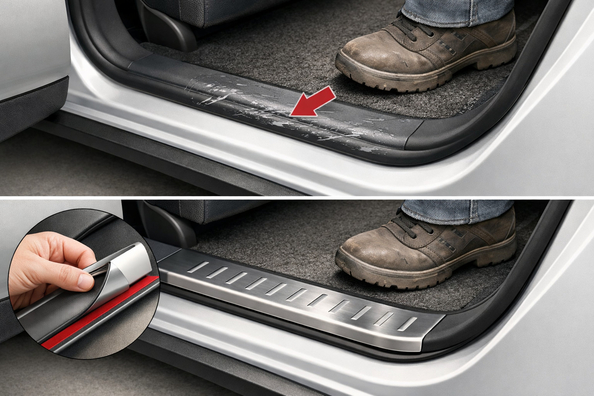
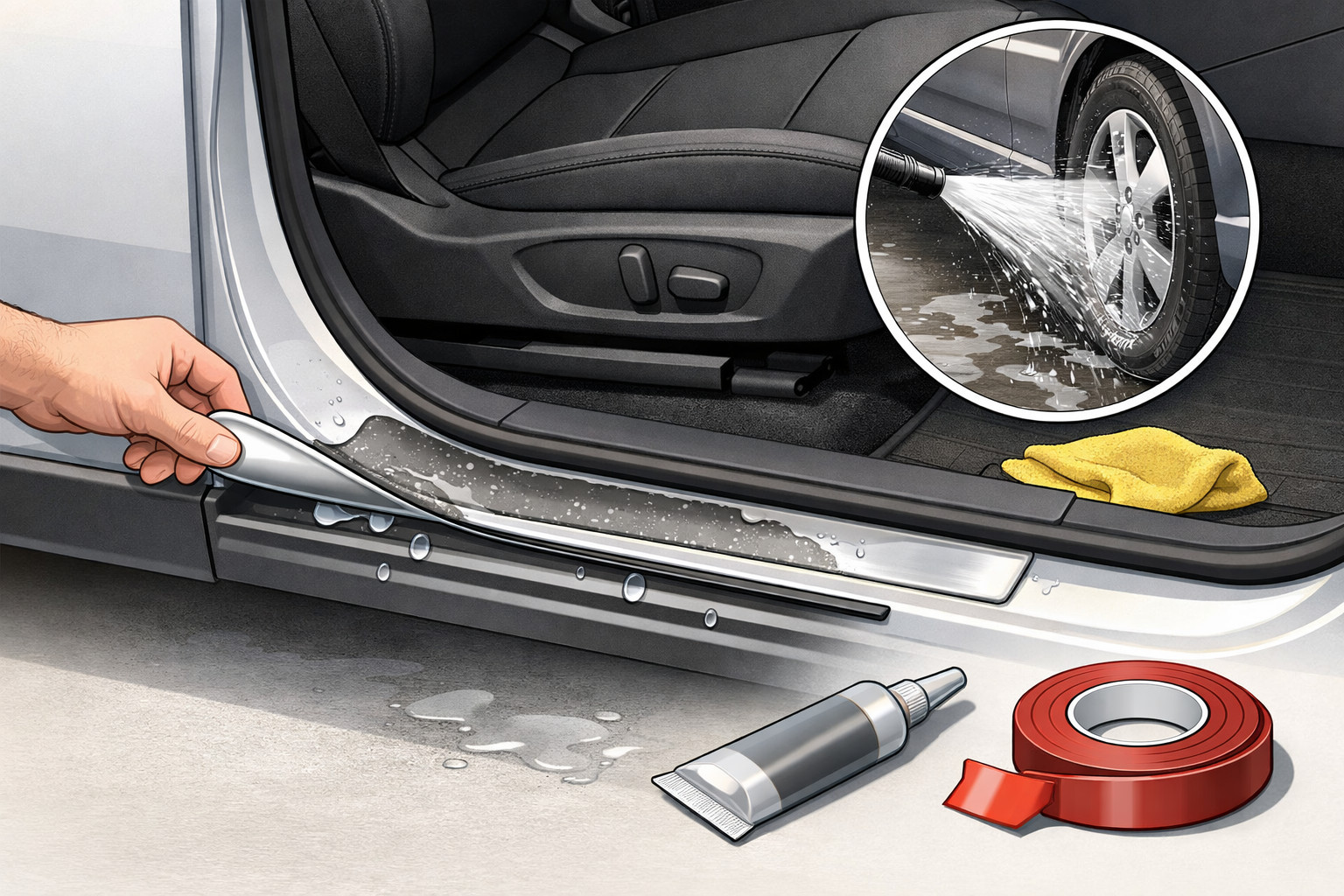
Interior door sills get scratched quickly not because the finish is “weak”, but because this is one of the most heavily loaded zones in a car. Abrasives work here constantly: shoe soles, sand, road salt, wet mud, pet paws, bags and luggage. If nothing protects this area, marks appear very early—especially on dark and glossy surfaces.
Two approaches actually work: a thick protective film or a rigid protector matched to the sill’s shape. But both options deliver results only when the surface is cleaned and degreased, installation is done at a normal temperature, and the adhesive layer is given enough time to fully bond.
The sill sits exactly where your foot often slides when getting in, rather than simply stepping over. If the vehicle has a high step-in height, a narrow door opening, or you sit down while turning your body, contact with the sill becomes regular. Within a few weeks it shows up as dull streaks, and later as scratches.
Fine dirt makes it worse. Sand and salt work like sandpaper, and some of that abrasive also accumulates near the door seal. Then the sill gets scratched not only by shoes, but also by constant rubbing of trapped dirt as the door opens and closes.
DD Tuning expert comment: the most common mistake is applying protection onto a scratched sill that hasn’t been fully cleaned, hoping the new protector will hide everything. The second typical issue is installation in a cold garage or right after a wash, when moisture remains along the edges. In these conditions even good material bonds worse and starts lifting at the edges.
| Symptom | Likely cause | What to do |
|---|---|---|
| A dull stripe in the same place | The sole regularly rubs the sill when getting in | Cover the area with a rigid protector or thick film along the entire contact path |
| Scratches appear even after washing | Sand and dirt accumulate near the seal | Rinse the edge, clean the seal, then install protection only on a clean surface |
| Marks are worse in winter | Salt, moisture, and hard dirt on shoes | Wash the entry area more often, don’t delay protection, and ensure it’s dry before installation |
| There is clear protection, but it’s covered in scuffs itself | The film is too thin for this load | Switch to a thicker material or a rigid protector |
| Protector edges have lifted | Poor degreasing, cold installation, or washing too soon | Reinstall correctly: clean surface, warm temperature range, and adequate time for the adhesive to set |
The best result comes from protection that covers the actual contact zone, not something that just “looks nice” on the sill. If the car is used actively and often carries kids, pets, or luggage, a rigid protector is more practical. It handles impacts better and shows fine marks less.
Thick protective film also works, especially when you want to preserve a painted surface without changing the look. For film, cleanliness, degreasing, and normal installation temperature are critical. For different kits, the working range is usually about 15–43 °C, sometimes narrower—around 21–32 °C. After application, it’s better not to load the area immediately: give it at least 1–2 hours undisturbed, allow up to a day for full bonding, and postpone washing for a few days.
Simple prevention also helps: regularly wash dirt from the sill edge and from under the seal. This doesn’t replace protection, but it removes abrasive grit that keeps bringing the problem back.
Polishing textured plastic hardly solves the problem. If the texture is already worn down or the mark has soaked in, it’s usually only masked or covered. A thin clear film also performs poorly on sills that are heavily scraped by shoes every day: it protects the paint, but quickly becomes visually worn itself.
It’s also a bad idea to stick anything onto a cold, damp, or dusty sill. At first it seems to hold, then the edges start lifting. Another pointless scenario is expecting a protector to restore an already beaten-up part. It stops new damage, but it won’t bring back the factory look where scratches are deep.
If marks are just starting to appear or the car is still fresh, it makes sense to install door sill protectors right away, without waiting for deep damage. This is the easiest way to cover the zone where abrasives actually do the work.
For a family or work car where sills are often rubbed by shoes, luggage, and pets, it’s better to look at plastic door sill protectors. A textured surface is more practical in daily use and doesn’t show scuffs as obviously.
If the problem is made worse by sand and wet dirt from shoes, it’s worth installing rubber floor mats at the same time. They don’t protect the sill directly, but they significantly reduce how much abrasive you bring into the entry area.
Replacing the part itself makes sense when the plastic is already badly damaged and its texture can’t be properly restored. In other cases, it’s cheaper and smarter to cover the wear area with protection.
| Solution | When it works | When it’s not worth spending money |
|---|---|---|
| Rigid vehicle-specific protector | Daily heavy use, kids, pets, luggage, high sill | If you need fully invisible protection or the protector’s shape presses on the seal |
| Thick protective film | New or well-preserved painted sill, when it’s important not to change the appearance | If the area is already heavily scratched or shoe wear is constantly harsh |
| Cleaning and degreasing before installation | Always—without this even good material can lift | There’s no point skipping this step to save time |
| Replacing a damaged plastic part | When the texture is destroyed and scratches are deep and always visible | If the surface can simply be covered with a protector without losing functionality |
| Cheap universal protector without a precise fit | Only as a temporary compromise on a simple flat surface | When you need long service life, a neat look, and proper seal function |
From a customer’s experience: a typical situation—after winter, the driver was looking for a way to remove new marks on a dark sill because regular washing no longer helped. After inspection it turned out the main wear came from shoes plus sand near the seal, so rigid protectors were chosen instead of thin clear film. As a result, new scratches stopped accumulating, and small old marks simply stopped standing out.
Quick scratches on door sills are almost always a story of abrasive friction, not one “bad” part. If marks come from shoes and daily entry, a rigid protector works better; if you need to preserve a painted surface without changing the look, thick film will do—but only with correct installation. This material is based on real selection experience, practical work, and real usage scenarios, so the main advice is simple: first understand what exactly scratches the sill in your car, and only then spend money on protection.
| ✔ | A rigid model-specific trim works well for cars used actively every day, especially when the sill is often hit by shoes, luggage, or children’s things. It better absorbs impacts and shows fewer minor marks. |
| ✔ | A dense protective film preserves the look of a painted sill if it is important not to change the interior appearance. It is a practical option for new or well-preserved elements. |
| ✔ | Cleaning and degreasing before installation really affect the result, because without this even a good material can start lifting at the edges. This reduces the risk of having to reinstall the protection. |
| ✔ | Regularly washing dirt from the sill edge and from under the seal reduces the amount of abrasive that constantly scratches the surface. Such maintenance does not replace protection, but it noticeably slows wear. |
| ✔ | Choosing protection for a specific problem gives better results than a universal “just in case” solution. For example, for heavily loaded sills, the author recommends rigid trims instead of a thin film. |
| ✘ | A thin transparent film on heavily used sills quickly becomes worn itself, even if it protects the paint. In such an area, it cannot withstand daily rough rubbing from shoes. |
| ✘ | Installing it in cold weather or on a damp or dusty surface worsens adhesion, which causes the edges of the trim or film to start lifting. After that, the protection looks worse and lasts less. |
| ✘ | Polishing textured plastic hardly solves the problem if the texture is already worn down or a mark has soaked in. In such cases, the damage is usually only hidden or covered on top. |
| ✘ | A cheap universal trim without a precise fit is only suitable as a temporary compromise. If a neat appearance and proper seal operation are needed, it may turn out to be a poor choice. |
Shipping to EU
Wholesale and retail
Own warehouse
Опис продукту
Подарунки не надаються при оформленні покупки у кредит під 0,01% або при покупці частинами.