
30.06.2026
484
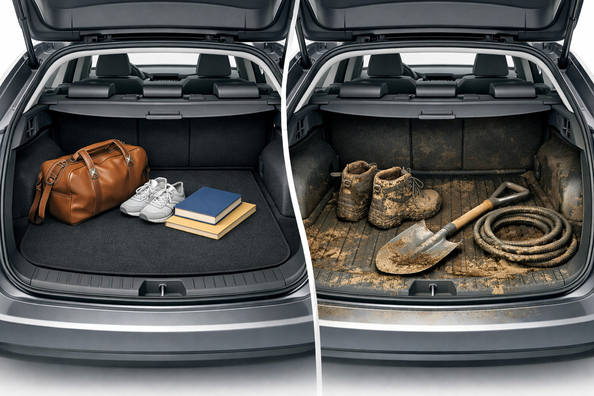
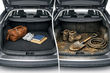
A textile trunk mat is not universal protection. It makes sense when you mostly carry dry items and want to keep the trunk floor tidy without hard plastic under your cargo. But if wet bags, snow, dirty tools, stroller wheels, or gear after rain regularly end up in the trunk, textile quickly shows its limits.
The main mistake is simple: people often expect a flat carpet mat to do what only a waterproof tray with raised edges can actually do. That’s why before buying, it’s important to look not only at the material, but also at the floor layout, the number of seats, cutouts for hooks, and how exactly you use the trunk every day.
The issue appears not because textile is “bad”, but because there’s a mismatch between your usage pattern and the type of protection. For dry suitcases, shopping bags, totes, and boxes, textile works fine: it doesn’t scratch items, looks neat, and doesn’t make the trunk feel “work-truck”. But when water, sand, or dirt gets in, the fabric starts absorbing moisture, and a flat edge doesn’t stop spills from spreading around the perimeter.
The second reason is fitment. The same body can have a fixed floor, an adjustable deck, a double floor, or a different configuration for 5- and 7-seat versions. If the mat doesn’t follow the contour precisely, gaps, shifting, and covered hooks appear—and you lose half of its usefulness.
DD Tuning expert comment: Most often, people choose a mat by photos and don’t check the floor configuration, hook cutouts, and the real usage scenario. The second common mistake is expecting textile to provide the same protection as a tray with raised edges. If your trunk sees water or dirt at least once a week, choose the material based on that—not by color or pile thickness.
| Symptom | Likely cause | What to do |
|---|---|---|
| Damp under the mat after rain | Wet cargo, snow, or moisture is retained in the textile | Remove and fully dry the mat and the base; if it repeats, switch to a waterproof tray |
| Items slide in turns | Smooth surface, weak fixation, inaccurate size | Look for a model with anti-slip backing, a precise contour, and use the factory mounting points |
| Dirt gets past the edges onto the factory lining | Flat format with no raised edges or gaps around the perimeter | You need a tray with a lip or a more precise mat for your trunk configuration |
| A musty smell appeared | Moisture remains in the pile or underneath | Dry completely, check the moisture source, don’t carry wet items without a separate container |
| The mat blocks access to the underfloor storage or hooks | Incorrect compatibility with the floor or vehicle version | Select an option specifically for your floor, seat count, and factory cutouts |
| The trunk threshold gets scratched even though the floor is clean | The problem isn’t the mat, but the loading area | Add separate threshold protection or a bumper protector |
The best results come from an honest choice based on your use case. If your trunk lives a dry life, a textile mat is genuinely appropriate: it’s quieter, softer, and keeps a tidy look. If water, soil, or snow shows up often, you should move straight to a different type of protection.
The second thing that really helps is precise compatibility. For a trunk, it’s not just the make and model that matters, but also the floor type, seat count, the presence of hooks, rails, or a double floor. That’s exactly why two mats that look similar can behave completely differently.
Third is separating dry and wet cargo. If you like textile but occasionally need to carry something dirty, it’s easier to put such items in a separate box or tray than to force the pile to work like a tray.
Fourth is not letting moisture build up. In cold and wet seasons, it’s worth lifting the mat from time to time and checking the base. If it’s dry underneath, the solution is chosen well. If not, the issue is no longer maintenance—it’s the protection format itself.
Finally, for real liquid containment, raised edges matter. A small lip of about 20 mm already makes sense for minor spills, while a dirtier regime needs a higher edge. Thicker pile doesn’t replace that.
If your trunk is mostly dry and your main goal is a tidy floor and a soft surface under your items, it makes sense to look at textile trunk mats. They’re suitable where cleanliness, quietness, and a decent-looking trim matter—without constant contact with water.
When the trunk works as a work zone, it makes sense not to torture textile and switch right away to rigid trunk protection. This is especially justified for stroller wheels, plants, tools, jerry cans, and anything that can leave wet marks or spread dirt around the edges.
If the floor suits you but the loading edge constantly suffers, it’s worth separately checking bumper protective covers. They don’t solve moisture issues, but they protect the exact area most often scratched by suitcases, boxes, and strollers.
| Solution | When it works | When it’s not worth spending money |
|---|---|---|
| Basic textile mat | Dry suitcases, bags, totes; everyday city use without dirt and water | If the trunk regularly sees snow, wet items, soil, or a pet after a walk |
| Denser textile with precise fit and proper backing | When you want a better look, a softer surface, and less minor noise in the trunk | If the main problem is spills, dampness, and dirt around the perimeter |
| Reversible mat | Mixed use: dry most of the time, but occasionally wet or slippery cargo | If wet use is constant and you need raised edges, not just a different surface |
| Waterproof tray with raised edges | Rainy season, snow, tools, plants, a stroller, active out-of-town use | When you only carry dry items and want a soft, tidy surface without hard plastic |
| Cheap universal option “just so there’s something” | Only as a temporary measure for a short period | For daily use, complex trunk geometry, and a requirement for real protection |
From a customer’s experience: the person initially looked specifically for textile because they carried suitcases and kids’ items and didn’t want hard plastic in the trunk. After checking, it turned out that during the rainy season the floor regularly got damp from stroller wheels, so keeping textile as-is didn’t make sense. In the end, they kept the soft solution for the dry season, and switched to waterproof protection for wet use—and that combination proved practical.
A textile trunk mat is worth buying when your cargo is mostly dry and your priority is a neat look, a soft surface, and protection from dust and light dirt. But if water, snow, soil, or slippery items often end up in the trunk, you shouldn’t try to “force” textile to work by extra care or thicker pile—it’s better to switch straight to a waterproof solution with raised edges.
The key to a good choice is simple: assess your own usage pattern, verify compatibility with your floor, and don’t expect a flat mat to perform the functions of a tray. This material is based on real selection experience, practice, and real-world scenarios, so the main takeaway isn’t theoretical: textile is great in its role, but only where it truly belongs.
| ✔ | Suitable for dry items: suitcases, bags, totes, and boxes, when the main goal is to keep the trunk floor neat without hard plastic. |
| ✔ | The soft textile surface does not scratch items and is usually quieter in everyday use than a rigid tray. |
| ✔ | Helps maintain a tidy look in the trunk, especially if you do not carry dirty or wet cargo. |
| ✔ | With a precise fit and a proper base, the mat stays in place better and interferes less with the factory mounting points. |
| ✔ | If you need mixed use, you can separate dry and wet cargo: keep the textile mat for everyday items and place dirty items in a separate box or tray. |
| ✘ | Poorly suited for wet bags, snow, dirty tools, a stroller after rain, or any other damp cargo — the fabric absorbs moisture. |
| ✘ | The flat, sidewall-free design does not contain spills at the edges, so it does not replace a waterproof tray with a raised lip. |
| ✘ | If the mat is not matched precisely to the floor, third row, hooks, or double floor, gaps and shifting appear, and part of the benefit is lost. |
| ✘ | For constantly wet gear, garden items, or a dog without a separate box, the textile quickly develops a damp smell and dirt under the mat. |
Shipping to EU
Wholesale and retail
Own warehouse
Опис продукту
Подарунки не надаються при оформленні покупки у кредит під 0,01% або при покупці частинами.