06.07.2026
201
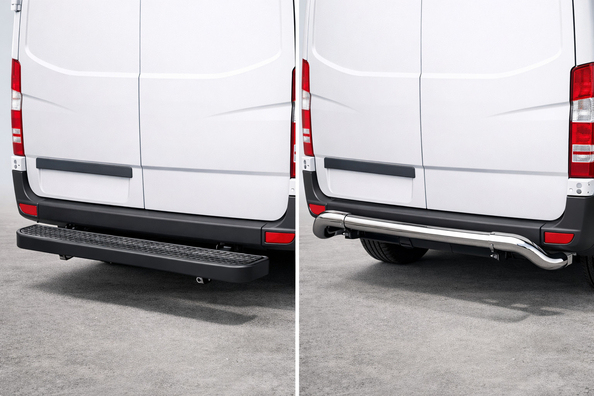
If a van or panel van is constantly worked from the rear doors, in most real-life scenarios a rear step is more useful. It gives you a solid foothold where the sill is high, the floor is wet or dirty, and you have to open the cargo area many times a day. A rear bar wins in a different task: when you don’t so much need to climb inside as protect the bumper and the body edge from minor contacts.
The mistake is always the same: choosing by looks. The right approach is simpler: start with your work scenario, then check compatibility with the towbar, sensors, camera and doors, and only after that look at the design and price.
A rear step solves a practical access problem. On some vans the sill height is such that without support, constant loading, unloading or grabbing tools quickly becomes annoying and tiring. If the vehicle carries parcels, equipment, parts or is used as a service van, a step usually delivers more noticeable day-to-day benefit.
A rear bar works differently. It doesn’t make getting into the cargo area more convenient, but it takes some of the minor parking contacts, scuffs and bumps at the rear. For an urban vehicle that’s rarely loaded but often maneuvered in tight yards or near loading ramps, this can make more sense.
There’s also a third case: when you need both a step and rear protection, and sometimes you also can’t lose towing capability. Then you don’t look at a separate step or bar, but at combined systems. They cost more and don’t always make sense.
| Option | Strengths | Weaknesses | Who it suits |
|---|---|---|---|
| Rear step | Makes access to the cargo area easier, works better in rain and mud, useful when doors are opened frequently | May conflict with a towbar, camera, sensors or a bike platform; doesn’t provide pronounced contact protection | Delivery, service vans, campers, vehicles with a high sill |
| Rear bar | Takes minor parking contacts, protects the bumper and body edge, often installs without drilling | Doesn’t replace a towbar, doesn’t make loading easier, can sometimes be noisy at speed | Urban vans, vehicles that maneuver in tight spaces, bodies with a vulnerable rear end |
| Combined system | Combines access, protection and, in some versions, towing compatibility | Most expensive, heavier, more demanding in installation and selection | Those who truly use the vehicle for loading, towing and working in tough conditions |
DD Tuning expert comment: The most common mistake is focusing on the shape of the tube or platform but not confirming compatibility with the towbar and sensors. On vans this is critical: a good kit may fit physically, but block the camera, distort parking sensor operation, or prevent the doors from opening properly. For daily work, bracket stiffness and a comfortable step matter more than the shine of stainless steel.
This is the choice for those who truly use the rear opening as a work zone. A wide step provides solid support across the full width, and compact models with a stepping depth of around 150 mm can also be sufficient if you only need a brief foothold. On a working van the difference is felt immediately: fewer unnecessary movements and it’s easier to climb inside with a box or tools.
In terms of noise and service life, simple fixed designs behave most predictably. Folding or more complex systems aren’t always convenient: they’re mechanically more complicated, heavier, and over time more often require tightening or maintenance. If the vehicle is driven daily and works in dirt, the simpler the design, the more predictable the operation.
The main downside is compatibility. The step most often conflicts with the towbar, camera, parking sensors or a bike platform. So here you need to look not generally at the van model, but at the specific configuration of the vehicle.
The term “rear bar” can mean different things in sales, but for a van it usually refers to protection for the rear bumper or the lower edge of the body. Typical solutions are made from tubing around 60.3 mm, often install into factory points and don’t require drilling. That’s a plus for those who don’t want to вмешательство in the body.
The practical benefit of a bar is narrower but clear: minor bumps when parking, contact with a curb, ramp or another vehicle are softer on the bumper. At the same time, the bar does not become a towing unit and does not replace a towbar. If the task is to pull a trailer, a bar alone doesn’t solve it.
The weak point of a bar is that it hardly helps with day-to-day loading. Also consider possible noise at speed: if the design is poorly matched or the brackets don’t clamp properly, vibrations or whistling can appear.
More expensive combined assemblies aren’t for everyone. They make sense when the vehicle simultaneously works with cargo, regularly drives in tight places, and also has to keep towing compatibility. In this case, you’re paying extra not for looks, but for a set of functions in one kit.
For a courier, service or installation van, a step is almost always better. When the doors are opened dozens of times a day, bumper protection matters less than proper access inside.
For a family minibus or camper, a step is also more often useful: it’s easier for kids to climb in, to load bags, secure cargo or retrieve items from deep inside.
For a vehicle that’s rarely loaded but often parked in tight spaces, a bar looks more logical. It doesn’t add convenience when getting in, but works as a sacrificial barrier between the bumper and minor contact.
If there’s a towbar, you should look not at the accessory name but at specific compatibility. Some steps work with certain types of flange-mounted units, some bars have a cutout for the towbar, and some aren’t compatible with it at all.
| Scenario | Best choice | Why |
|---|---|---|
| Courier van | Rear step | Provides quick and safer access with constant door opening |
| Service vehicle with tools | Rear step | Easier to climb into the body, rearrange and retrieve equipment |
| Urban vehicle with frequent close-quarters parking | Rear bar | Better takes light contacts and rear scuffs |
| Van with a towbar and occasional towing | Compatible step or combined system | You need to keep towing function and avoid bracket conflicts |
| Camper or family minibus | Rear step | Makes access to items and boarding easier with a high sill |
| Work on poor roads and near ramps | Rear bar or combined system | Rear-end protection becomes the priority, not just step convenience |
Paying extra is justified when it solves a specific problem. For a step, that can mean a wider working platform around 1.37–1.40 m, a better anti-slip surface, stiffer brackets, or compatibility with the towbar and sensors. For a bar, it’s proper geometry, installation into factory points, a cutout for the towing unit, or combining it with a step and additional equipment.
If you’re already selecting a solution for a real body configuration, it makes sense to start from a basic rear step, then separately look at model-specific steps for Fiat Ducato and rear bars for Mercedes Sprinter W906. That makes it quicker to see whether the needed configuration exists for your body, towbar and usage pattern.
From a customer’s experience: for a service van we first looked for a rear bar, because the main concern was scuffs in parking lots. After clarifying the scenario, it turned out the rear doors are opened many times a day and the vehicle often works in rain and mud. In the end we chose a fixed step compatible with the existing rear setup, and the biggest effect came from everyday convenience rather than protection as such.
For most working panel vans and vans, a rear step is more useful because it saves movements every day and makes access to the cargo area easier and safer. A rear bar is better where loading is less frequent but there’s a constant risk of minor rear contacts. If you need protection, a step and towing compatibility, then you look at more expensive combined systems.
The key is not to buy an accessory “by eye.” This material is based on real selection experience, practice and real usage scenarios: they show best what’s more useful for your van— a step, a bar, or a combined solution.
| ✔ | A rear step really makes access to the cargo area easier, especially when the threshold is high or the floor is wet and dirty. For vans that are opened dozens of times a day, this brings a noticeable daily saving of effort. |
| ✔ | A simple fixed step is usually quieter and more reliable in daily use than more complex mechanisms. Fewer moving parts mean less chance of play, rattling, or the need for maintenance. |
| ✔ | A rear bar better protects the bumper and the edge of the body from minor parking contacts, scuffs, and snags. This is useful for city vehicles that often maneuver in tight spaces. |
| ✔ | Many rear bars are installed in factory mounting points without drilling, which reduces interference with the body. For the owner, this is more convenient and safer in terms of installation. |
| ✔ | A combined system can simultaneously provide access, protection, and in some versions compatibility with towing. This is a practical option if the vehicle really works in several scenarios at once. |
| ✘ | The rear step often conflicts with a tow bar, camera, parking sensors, or a bike platform. Because of this, it needs to be selected not only by vehicle model, but also by the specific rear configuration. |
| ✘ | A rear bar almost does not help with daily loading and does not make entry into the body more convenient. If the vehicle often works through the rear doors, its usefulness in everyday use is limited. |
| ✘ | The bar does not replace a tow bar and does not solve towing tasks. If you need to pull a trailer, a compatible towing unit will have to be installed separately. |
| ✘ | Combined solutions are more expensive, heavier, and more demanding in terms of installation and selection. It makes sense to buy them only when several functions are really needed at the same time. |
Shipping to EU
Wholesale and retail
Own warehouse
Опис продукту
Подарунки не надаються при оформленні покупки у кредит під 0,01% або при покупці частинами.