07.07.2026
303
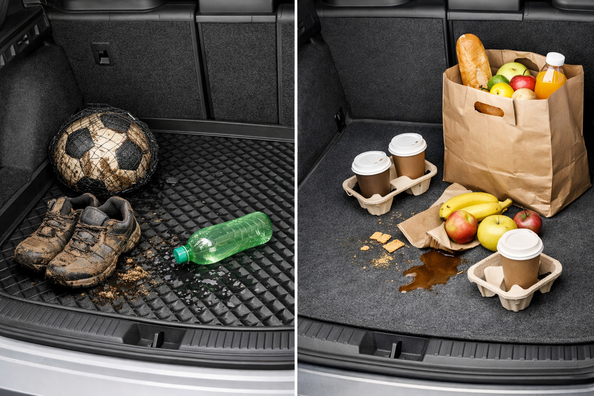
For everyday use, an EVA trunk mat is usually more practical if you regularly carry wet bags, a stroller, tools, shoes after rain, snow, sand, or loose small items. If the trunk is mostly dry and what matters more is silence, a softer surface, and an OEM-like look, it makes more sense to consider textile.
The main mistake is reducing the choice to the material alone. In daily use, just as important are the accuracy of the patterns, fastening, access to the lower compartment, noise from cargo, cleaning speed, and whether the mat absorbs moisture or keeps it on the surface.
In essence, you’re choosing between two different usage scenarios. EVA performs better where dirt and water appear often: the cells trap small debris and moisture, making it easier to shake out or rinse. Textile is better where the main load is dry bags, suitcases, groceries, and items you don’t want to place on a stiffer, more “technical” surface.
So the question isn’t which material is “better in general”, but what your trunk sees every week. For a cottage, winter, family trips, and a private house, EVA more often wins. For a dry city routine, where neatness and less noise matter, textile is often nicer day to day.
| Option | Strengths | Weaknesses | Who it’s for |
|---|---|---|---|
| EVA trunk mat | Holds water, sand, and small dirt better; washes faster; usually lighter; handles winter and shoulder seasons more calmly | Less soft; can look more technical; cells need regular cleaning; on some cars, fit accuracy is critical | Those who often carry wet, dirty, winter, or loose items, a stroller, tools, garden equipment |
| Textile trunk mat | Quieter; softer; neater-looking; well suited for a dry city routine | Absorbs moisture; takes longer to dry; loses neatness faster in rain and winter; care is usually more time-consuming | Those whose trunk is mostly dry and who prioritize comfort, silence, and an OEM look |
DD Tuning expert comment: Most often, the mistake isn’t the material but the shape of the mat. If it blocks access to the underfloor compartment, doesn’t sit along the sides, or slides around the trunk, even good EVA or textile will quickly become annoying. Before ordering, it’s worth checking the car generation, body type, and whether there’s an organizer or a double floor.
EVA mat is strong where the trunk regularly comes into contact with moisture and dirt. The cell structure holds sand, snow, and small debris, so less of it spreads across the trunk lining. In everyday use, this means a simpler routine: shake it out, rinse it, dry it — and keep going.
But EVA isn’t the same across all manufacturers. Material thickness, cell depth, stiffness, edges, and the fixing method all matter. If the mat is made from inaccurate patterns, it may fit poorly around the wheel arches, interfere with opening the lower compartment, or make noise together with the load. So for EVA, fit matters no less than the material itself.
Textile mat wins in another way: it’s quieter, softer, and often blends better with the OEM interior. If you usually carry dry bags, a laptop, sports gear, groceries, or a suitcase, textile really does feel nicer day to day. This is especially noticeable in cars where neatness matters more than a “workhorse” trunk character.
The weak point of textile is moisture. Even if the backing has a protective layer, the pile itself dries longer, picks up dirt faster, and can lose its tidy look in the cold season. So textile is good not when you need to handle daily dirt, but when that kind of load is almost absent.
In terms of longevity, the picture is simple: with constantly wet and dirty use, EVA usually retains practicality longer, while textile keeps a comfortable look in a dry routine. As for price, there’s no universal rule, but in many cases textile starts cheaper, while quality EVA or dense, model-specific textile costs more due to precise patterns and construction.
If the car works daily as a family or utility vehicle, EVA more often matches the need more accurately. It forgives wet bags, dirty shoes, a stroller after a walk, snow from a sled, and sand from luggage. In this mode, you think less about perfect neatness and more about cleaning up the aftermath of a trip quickly.
Textile wins where the trunk is used carefully and predictably. If it’s mostly dry and the cargo isn’t dirty, it delivers a quieter and more pleasant-feeling scenario. For many sedan and urban crossover owners, that’s more than enough.
A compromise that truly works is two sets by season. EVA covers autumn, winter, and trips with dirty cargo, while textile stays for the dry warm period. It’s not always necessary, but for those who want both practicality and a neat look, the approach is justified.
| Scenario | What to choose | Why |
|---|---|---|
| Daily shopping, dry city driving, suitcases | Textile trunk mat | Less noise, a softer surface, a neater look without needing frequent washing |
| Rain, snow, shoulder seasons | EVA mat | Holds water, sand, and dirt better; cleans faster after a trip |
| Family car with a stroller, scooter, kids’ items | EVA mat | Easier to handle wet wheels, crumbs, sand, and regular rough use |
| Car for long trips with tidy luggage | Textile trunk mat | More comfortable to use; feels less like a utilitarian solution |
| Cottage trips, tools, garden equipment, building materials | EVA mat | Faster to clean; less risk that dirt and moisture get into the pile |
| Mixed use throughout the year | Two sets | Gives practicality in the wet season and a quieter, neater trunk in the dry season |
Paying extra is justified when the trunk has complex geometry, an underfloor compartment, an organizer, or when you carry items that truly bring moisture and dirt every day. In that case, precise patterns, proper fixation, and quality material matter more than formal savings. If you want to dive deeper into how to tell a good EVA mat from just a nice picture, it’s worth checking the guide to choosing an EVA trunk mat.
More expensive textile makes sense when silence, a denser material, and the most OEM-like look are truly important to you, and the trunk is almost always dry. If you’re torn between different surface types, a comparison of EVA, rubber, and carpet mats will help. And if you want to better understand in which conditions textile loses or wins on practicality, see the breakdown of textile vs rubber mats.
From a customer’s experience: for a family crossover, we were looking for a mat for a stroller, scooter, and supermarket bags. At first we chose textile for its neat look, but after a few rainy weeks we switched to EVA because it’s easier to shake out and rinse, and moisture doesn’t stay in the pile. We kept textile as a second set for the dry season, and in that mode both solutions work without disappointing each other.
For everyday hauling, an EVA trunk mat is more practical in most cases: it holds water, sand, and small dirt better, cleans faster, and handles winter and shoulder seasons more calmly. Textile is worth choosing when the trunk is mostly dry and the priority is less noise, a softer surface, and a neater look.
The most accurate choice isn’t made by the material name, but by the real scenario: what you carry, how often you clean the trunk, whether you use the underfloor compartment, and how important silence is to you. This article is based on real selection experience, practice, and real-world usage scenarios, so the short recommendation is simple: for dirty daily work, go with EVA; for a dry, tidy trunk, go with textile; and for maximum convenience, it can sometimes be worth having two sets by season.
| ✔ | EVA mat is better suited for everyday use if the trunk often carries wet bags, snow, sand, or dirty shoes. Its cells hold water and small debris, so cleaning usually comes down to shaking it out or rinsing it off. |
| ✔ | EVA cleans up faster after trips and is more practical in the rainy season and in winter. This is convenient for a family car, trips to the dacha, tools, or garden equipment. |
| ✔ | A textile mat is quieter and softer in daily use. For a dry trunk with suitcases, shopping, or sports gear, it gives a more comfortable and neater look. |
| ✔ | Textile often blends better into the factory interior and feels less like a technical solution. This can be a plus for city use, where the trunk is kept clean and free of heavy dirt. |
| ✔ | In mixed use, you can combine two sets by season. This approach lets you have EVA for the wet season and textile for the dry one without sacrificing comfort or practicality. |
| ✘ | An EVA mat is less soft and may look more technical. For those who want the most factory-like trunk appearance, this can be a downside. |
| ✘ | On some cars, EVA requires a very precise fit; otherwise, it may block access to the underfloor compartment, interfere with the organizer, or rattle together with the cargo. Here, it’s not only the material that matters, but also the shape. |
| ✘ | Textile absorbs moisture and dries longer than EVA. If the trunk often carries wet or dirty cargo, the pile quickly loses its neat look. |
| ✘ | In the cold season and during rainy weather, textile picks up dirt faster, and cleaning it usually takes longer. For regular dirty loads, it is a less convenient option. |
Shipping to EU
Wholesale and retail
Own warehouse
Опис продукту
Подарунки не надаються при оформленні покупки у кредит під 0,01% або при покупці частинами.