
27.08.2026
109
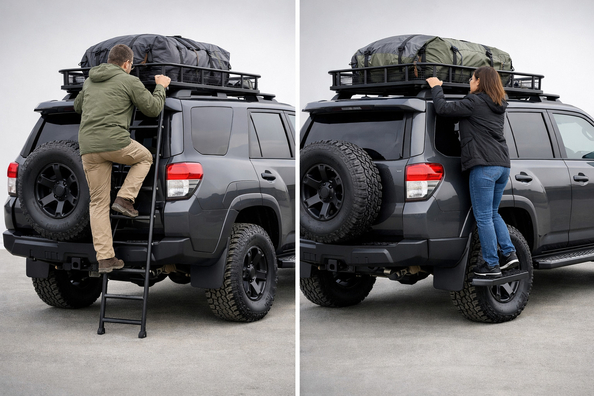

If you only need access to roof cargo from time to time and the vehicle carries a family or passengers every day or works around town, side steps more often win. They provide a lower foothold along the entire side, help with getting in, and are often more useful not only for the roof, but also in everyday use.
A rear ladder makes sense when you regularly work specifically with the roof: opening a roof box, using an expedition rack, carrying jerry cans, skis, or running a roof tent. In this scenario, what matters is not versatility, but a stable, repeatable climbing point in one place.
The key difference is simple: side steps improve access to the roof from the side of the vehicle, while a rear ladder provides a vertical climb from the back. For long roof boxes and items you need to reach from the side, a rear ladder isn’t always convenient. For a tall roof, an expedition basket, or a roof tent, it’s often the more logical option.
The second point is what you want to get besides roof access. Side steps can also help with boarding and partially shield the sills from minor contact. A ladder hardly solves everyday tasks, but works better as a dedicated tool for climbing.
Installation. Some model-specific ladders and steps install without drilling, but it depends on the exact kit. For a new vehicle, this matters: less risk to the body and easier to return the car to stock. If it’s fold-out electric steps, the design is more complex and installation requirements are higher.
Noise and aerodynamics. On the highway, noise is often caused not by the mere presence of a ladder or steps, but by the overall roof setup: crossbars, rack, roof box. So you should assess the entire configuration, not the accessory name.
Service life. With fixed solutions, it comes down to bracket rigidity, coating quality, and corrosion resistance. With folding steps, you also add hinges, actuators, and sensitivity to dirt. In winter, wide side platforms also collect snow and ice.
Practicality. Side steps are more convenient in the city and for family use. A ladder is better when you need to climb onto the roof frequently. If there’s already an awning, spare wheel, or another rear-mounted accessory, a ladder can conflict with the layout.
Price. What’s usually more expensive is not the type itself, but the build level: model-specific no-drill kits, heavy-duty solutions, and automatic folding steps. A simple fixed solution is almost always cheaper to maintain than complex mechanics.
| Option | Strengths | Weaknesses | Who it suits |
|---|---|---|---|
| Rear ladder | Stable climb to the roof, convenient for a box, basket, or tent; some models install without drilling | Less convenient for side access; can interfere with rear accessories; adds little everyday usefulness | Those who regularly work with the roof and want a dedicated climbing point |
| Side steps | Everyday convenience, side access to the roof, helps passengers, partial sill protection | Do not replace rock sliders in harsh off-road use; can collect snow and ice; effectiveness depends on vehicle height | Those who need versatility for city driving, travel, and family use |
DD Tuning expert comment: the most common mistake is buying a ladder “just in case” even though roof access is needed once a month. The second typical story is expecting regular side steps to have the strength of rock sliders. Before choosing, honestly answer two questions: how often do you use the roof, and will the vehicle actually be driving into rocks or deep ruts.
The ladder’s strong point is predictability. You always climb in the same spot, you don’t have to look for where to place your foot, and you don’t lean your body over the side. In specific model solutions, load capacity can reach about 113–118 kg, and installation sometimes takes around an hour without permanent body modifications.
The downside is that it’s a narrowly specialized accessory. If the main load sits closer to the sides of the roof, access from the rear is less natural. Also keep in mind that rear doors, an awning, an additional wheel, or other accessories can limit compatibility.
Their advantage is versatility. You get a lower step along the side, not just at one point. On tall SUVs, this truly reduces step-in height—not only for reaching the roof, but also for everyday boarding. In sturdy kits, load ratings can vary widely: from about 136 kg per individual step to 270 kg per side in heavier systems.
The weak spot is that not all side steps are suitable for off-road driving. If the vehicle actually lands its sills on obstacles, you need a different product class. Another nuance is that wide platforms must be cleaned in winter, and folding versions are more complex and more sensitive to operating conditions.
For city use, kids, elderly passengers, and frequent in-and-out, side steps are almost always more practical. They’re used daily even when you don’t touch roof cargo.
For long trips with a roof box, expedition rack, or tent, the ladder wins—especially if you need to access items often and with a fully loaded vehicle. For moderate touring without hardcore off-road, good side steps are the most balanced option. For heavy off-road, the question should be framed differently altogether: not “ladder or steps,” but “ladder plus rock sliders or not.”
| Scenario | Best choice | Why |
|---|---|---|
| Daily city driving, family, kids | Side steps | Work every day, make boarding easier, and provide side access to the roof |
| Frequent trips with a roof box or tent | Rear ladder | Provides a stable climb at one point without constantly repositioning |
| Tall SUV, but roof access only from time to time | Side steps | More everyday benefit with a similar roof-access need |
| The rear is already occupied by an awning, spare wheel, brackets | Side steps | Lower risk of layout conflicts |
| Hard off-road with risk of impacts to the sills | Not regular steps, but rock sliders; ladder as needed separately | Everyday or decorative steps aren’t designed to serve as protection |
Paying extra makes sense not for “status,” but for a specific scenario. If you often work with the roof while traveling, it’s logical to look at model-specific ladders with neat no-drill installation. If the vehicle is a daily driver and convenience for all passengers matters, quality side steps with properly rigid brackets and a non-slip platform are justified.
A separate case is real off-road driving. There, a more expensive solution is needed not for roof access, but for the survival of the sills—so you should be looking at rock sliders. And automatic fold-out steps only make sense if you want maximum day-to-day convenience and you’re ready for a more complex design and a higher price.
From a customer’s experience: a typical story is a large SUV owner initially looking for a ladder because they planned a roof box for vacations. After clarifying the scenario, it turned out the box is installed only a few times a year, while daily family boarding is uncomfortable. In the end, they chose side steps—and they proved useful every single day, not only during the travel season.
In short, for most owners of SUVs and large crossovers, side steps will be more practical: they provide roof access, help with boarding, and deliver more day-to-day value. A rear ladder wins when the roof is used regularly and you need a stable climb specifically to a box, basket, or tent.
Choose based on the scenario, not looks: how often you climb onto the roof, whether there’s off-road use, what’s mounted at the rear, and how important easy installation is. This material is based on real selection experience, hands-on practice, and real-world use cases—so the main takeaway is simple: for daily use—steps; for frequent roof work—a ladder; for hard off-road—a different class of products.
| ✔ | Side steps provide everyday convenience: they make it easier to get in and out of the vehicle, not just reach the roof. For city use and family driving, they are more practical than a narrowly specialized ladder. |
| ✔ | The rear ladder is convenient when the roof is used regularly — for a cargo box, expedition rack, or tent. It provides a stable climbing point in one place, which makes handling rooftop cargo easier. |
| ✔ | Some model-specific solutions can be installed without drilling, which reduces the risk to the body and makes it easier to return the vehicle to stock condition. This is especially important for a new car. |
| ✔ | Side steps can partially protect the sills from minor contacts and reduce the step height on tall SUVs. This is useful not only for roof access, but also in everyday use. |
| ✔ | Simple fixed solutions are usually cheaper to maintain than complex mechanisms with hinges or drives. This makes them more predictable for daily use. |
| ✘ | The rear ladder is less convenient if the main cargo is located closer to the sides of the roof. In that case, access from the rear is not the most natural option. |
| ✘ | Side steps are not a substitute for rock sliders in serious off-road use. If the vehicle actually rests its sills on obstacles, a different solution is needed. |
| ✘ | Wide side platforms collect snow and ice in winter, and foldable systems are more sensitive to dirt and more complex in design. This adds hassle in the cold season. |
| ✘ | The ladder may conflict with already installed rear accessories — an awning, spare wheel, or brackets. Because of this, it cannot always be fitted without layout restrictions. |
Shipping to EU
Wholesale and retail
Own warehouse
Опис продукту
Подарунки не надаються при оформленні покупки у кредит під 0,01% або при покупці частинами.