06.09.2026
254
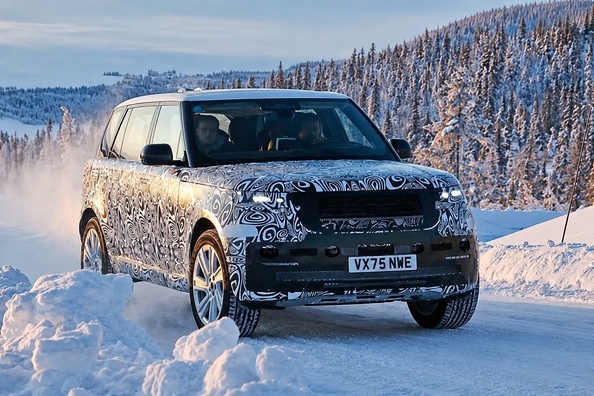
Range Rover Sport Electric 2027 is not a concept car or an early teaser, but an officially confirmed electric project from the brand, already shown as a first preview at the Goodwood Festival of Speed in the UK. The formal confirmation from the manufacturer appeared on 16 July 2026, and visually this is already a prototype very close to the production car.
There is no full technical spec sheet yet, so it’s important not to mix facts with assumptions. The model itself, the platform, and production have been officially confirmed, while the figures for power, battery, and range should for now be treated as preliminary data from pre-production runs rather than final specs of the customer car.
I’d define the model’s current status like this: an officially shown prototype on the edge of pre-production. This isn’t a stand-only show car, because the vehicle has already appeared publicly and looks almost production-ready, without heavy camouflage. The manufacturer explicitly says it will reveal full details later in 2026.
The first official photos matter because they confirm the overall body architecture, proportions, and that the brand didn’t go for a radical redesign. In other words, this isn’t a separate exotic electric line-up—it’s an electric Range Rover Sport with the familiar model logic.
Officially confirmed by the manufacturer: Sport Electric is built on the MLA platform and will be produced in Solihull. This is an important detail, because it’s not a separate EV-only architecture, but a flexible longitudinal base adapted for different powertrains.
In practice, that means familiar ergonomics, familiar proportions, and likely fewer design compromises than on some “pure” EVs. But there’s another side: weight will almost certainly be high, and battery packaging and space may not be as free as on models developed exclusively as EVs.
Only the main point is officially confirmed: this is a fully electric version of the Range Rover Sport. At the same time, the Sport line-up itself isn’t abandoning other options—there will still be hybrids, mild hybrids, and six-cylinder or V8 versions for certain markets. So the EV doesn’t replace the whole family; it complements it.
According to preliminary data, the prototype uses two electric motors, permanent all-wheel drive, an 800-volt architecture, and a battery with 118.5 kWh usable capacity. Power figures vary in market materials: 404 kW and 850 N·m are mentioned most often, but there are also figures of 444 and 542 hp, so I assume the brand is preparing not one but at least two powertrain calibrations. A conventional gearbox likely won’t be used—an single-speed reduction is expected, as on most large EVs.
DD Tuning expert comment: The most common mistake with new launches like this is treating numbers from test drives as the final spec sheet and buying accessories in advance “because the body is the same.” In reality, a pre-production car can still see changes to the trunk shape, floor-mat mounts, and even window geometry. The right approach is to wait for production part numbers, a VIN, or at least official photos of the finished interior.
On the outside, Sport Electric seems set to keep the essentials: a low-for-the-class seating position, a long hood, clean flanks, and a sportier vibe than the big Range Rover. In my view, the changes will be targeted: more closed-off areas up front, different aero wheels, small bumper revisions, and its own logic for cooling the battery and power electronics.
The interior hasn’t been officially revealed in detail yet, but I expect the architecture of the current Range Rover Sport to be largely retained, with new energy-use screens, navigation with battery preconditioning for charging, and an overall quieter presentation. If the brand doesn’t start experimenting with cabin form, that will be a big plus: buyers in this segment usually value not “space-age” design, but a familiar comfortable seating position and a well-isolated space.
It’s important not to carry over the figures from gasoline and hybrid Sport versions to the electric prototype. For the EV, we currently have only the officially confirmed fact of the model’s existence and unofficial or pre-production numbers regarding the hardware.
| What’s known | What’s expected | What’s unknown |
|---|---|---|
| The model is officially confirmed, shown as an almost production-ready prototype | The production look will be very close to the shown vehicle | The exact date of the full premiere of the production version |
| BEV, MLA platform, production in the UK | Two motors, AWD, 800 V, 118.5 kWh | Final battery chemistry, rated capacity, and charging power in kW |
| Full technical details promised later | 531–612 km range, 0–100 km/h around 4.4 s, top speed around 209 km/h | Certified WLTP or EPA range, towing capacity, and curb weight in spec |
In my view, what matters more for this model isn’t peak power, but how it combines mass, silence, air suspension, and body control. If the preliminary numbers are true, there’s already enough pulling power here, and the real benchmark will be behavior at speed and on rough roads.
In production form, Range Rover Sport Electric will go straight into the expensive segment of electric luxury SUVs, where buyers already have options. The closest rivals aren’t gasoline crossovers, but established premium EVs already on sale with clear specifications.
| Competitor | How Sport Electric responds | A strength the production competitor already has |
|---|---|---|
| BMW iX | Closest in format, dynamics, and premium everyday usability | Long on the market, proven electric platform and clear trims |
| Mercedes-Benz EQS SUV | Plays on comfort, ride quietness, and a status segment | A very strong focus on cabin comfort and passenger tech |
| Lotus Eletre | Pressures from the side of power, handling, and a more vivid sporty image | More aggressive positioning and stronger brochure numbers in fast versions |
Range Rover’s position will most likely not be about becoming the fastest or the longest-range. Its trump card is the combination of premium isolation, confident chassis tuning, and real off-road pedigree—still rare in this class.
The brand’s official plan is to reveal more details later in 2026. But based on market expectations, some countries could receive real deliveries as early as 2027, and that looks realistic: first the home and key European markets, then other regions.
Official pricing hasn’t been announced yet. Preliminary estimates put the start around £100,000, and well-equipped versions will easily go higher. So this is not an electric alternative to a “mainstream” SUV, but a direct player in the upper premium segment.
From a customer’s experience: an owner of a current Range Rover Sport contacted us, planning to switch to the electric version and wanting to immediately understand compatibility of mats and wind deflectors. We compared the available prototype photos and explained that without production part numbers, buying in advance is risky. In the end, he kept accessories for his current car, and decided to return for EV fitment after sales start, to avoid mistakes with fit and mounting points.
At this stage, Range Rover Sport Electric looks not like an experiment, but like an almost finished production product. If the manufacturer preserves the brand’s signature ride quietness, precise body control on air suspension, and true all-road functionality, the model will hold a very strong position even without record-breaking brochure numbers.
The main risks are obvious: high weight, high price, and the fact that competitors are already selling in production form. But the overall picture is positive so far: this will likely be one of the few electric SUVs bought not only for the battery and acceleration, but for the complete Range Rover Sport character. The material is based on real selection experience, practice, and real-world usage scenarios—not on formally rewriting the announcement.
| ✔ | The prototype has already been officially unveiled, and it looks almost production-ready without heavy camouflage. This gives an idea of the final proportions and overall architecture even before the full debut. |
| ✔ | The car is built on the MLA platform and will be produced in Solihull. For the buyer, this means a Range Rover-style layout without a radical departure from the familiar model. |
| ✔ | It has been officially confirmed that this is a fully electric version, and preliminary data indicate two motors, all-wheel drive, and an 800-volt architecture. Such a setup should deliver strong traction and fast charging if these figures are confirmed. |
| ✔ | Visually, the model will likely retain the traditional Range Rover Sport stance and more athletic proportions. This matters for those who do not want an exotic design for the sake of design. |
| ✔ | In the large luxury EV segment, it is positioned not only as a fast electric crossover, but as a vehicle with Range Rover off-road heritage. For some buyers, this may be a stronger advantage than the raw spec-sheet figures. |
| ✘ | A full technical spec sheet is still not available, and some of the claimed specifications are still based on pre-production data. As a result, the final power, battery, and range figures may change. |
| ✘ | The prototype is built on the flexible MLA platform rather than a dedicated pure-electric architecture. This may mean greater weight and less flexible battery packaging compared with EVs built from the ground up for electric power. |
| ✘ | The exact date of the production debut and market launch has not yet been announced. The only thing known is that more details are promised later in 2026, while deliveries are expected in 2027. |
| ✘ | There is no official price, and early estimates start at around 100 thousand pounds. This immediately places the model in a very expensive segment and makes it unaffordable for most buyers. |
| ✘ | Rivals such as the BMW iX, Mercedes-Benz EQS SUV, and Lotus Eletre are already on sale in production form. That means the Range Rover Sport Electric is entering the market later than competitors that already have proven versions and a clear reputation. |
Shipping to EU
Wholesale and retail
Own warehouse
Опис продукту
Подарунки не надаються при оформленні покупки у кредит під 0,01% або при покупці частинами.