10.10.2026
12
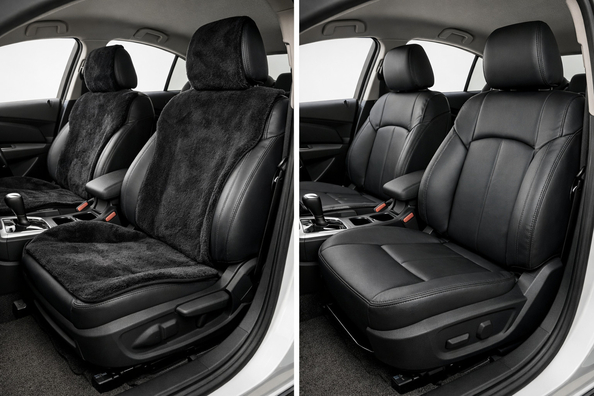
If you need a truly quick way to protect the interior—for workouts, the beach, kids, a dog, or dirty work clothes—a seat cover cape is the more practical choice. You can put it on and take it off without lengthy installation, it’s easier to clean, and in everyday use it doesn’t tie the cabin to a permanent set.
A full seat cover makes sense in a different scenario: when you need protection every day, for the long haul, and with more coverage. But then it’s not just the material and price that matter—compatibility with the seat configuration, headrests, belts, child-seat anchors, heating, ventilation, and side airbags becomes critical.
The key difference is simple: a cape solves “quickly cover the seat,” while a full cover solves “keep the seat covered permanently.” That’s why, for fast interior protection, the cape wins—even if it doesn’t provide as complete coverage as a tailored seat-cover set.
Problems start when these formats get mixed up. If you buy a full set of covers for occasional trips, you’ll overpay—both in money and in installation time. If you use a simple cape for long-term daily protection, part of the upholstery will still remain exposed and will wear out.
| Option | Strengths | Weaknesses | Best for |
|---|---|---|---|
| Seat cover cape | Fast to install and remove, easier maintenance, convenient for moisture, sand, pet hair, and kids’ mess | Incomplete coverage, sometimes depends on having a headrest, may require minor adjustment | Those who need protection not all the time, but for specific trips |
| Full seat cover | More complete coverage, better fit, longer-lasting everyday protection, neater look with tailored sets | More complex installation, higher price, risk of noise or play if the fit is poor, compatibility must be checked carefully | Those who want permanent protection and are willing to pay for the right fit |
In plain terms: a cape wins on speed and flexibility, while a cover wins on long-term protection and coverage. So the question isn’t what’s “better overall,” but whether you need protection for one trip or for every day.
DD Tuning expert comment: The most common mistake is buying a full set of seat covers when you really just needed to protect the driver’s seat after workouts, trips with kids, or traveling with a pet. The second typical issue is not checking side airbags, headrests, and access to belt buckles. If the scenario is occasional, a cape is almost always more practical; if it’s permanent, you need to verify the seat configuration down to the details.
This is the strongest option when protection isn’t needed all the time, but for a specific trip. Wet sports clothes, sand after the beach, hair after a walk, kids’ mess—put the cape on, handle the situation, take it off. Speed is the whole point.
Many of these solutions are easier to maintain: they’re simpler to clean, and some can be machine-washed without complicated disassembly. For those who don’t want to live with permanent covers in the cabin, that’s a major plus.
The weak spot is incomplete coverage. Side bolsters, part of the backrest, or lower areas may remain exposed. Also, some quick capes anchor to the headrest, so if there’s no headrest or the seat has non-standard geometry, compatibility should be checked before purchase.
A cover makes sense when you need to protect the interior permanently: a new car, a work vehicle, daily passengers, regular dirt, or a risk of rapid upholstery wear. A good tailored set covers the seat better and usually looks tidier.
But the entry threshold is different. Installation can take from an hour and a half to several hours, and on complex seats it sometimes requires partial disassembly. If the fit isn’t precise, you get wrinkles, play, squeaks, and the feeling that the cover constantly needs tightening.
Safety and seat functions are a separate topic. For cars with side airbags, heating, ventilation, armrests, integrated belts, or a complex backrest design, the cover must be chosen specifically for your configuration. A universal set is most often the mistake here.
For occasional dirt and moisture, a cape is almost always the smarter choice. You don’t spend hours installing it, and you use protection only when you actually need it.
For daily work, a family car with heavy use, or a car you want to keep looking neat for longer, a tailored cover set wins. Here, it’s not seconds to install that matter, but coverage, durability, and a stable fit.
If the seats are complex in shape or equipment, don’t think only in terms of “cheaper or more expensive.” In such cars, a temporary cape is often easier as a short-term solution, and a full cover should be purchased only after confirming exact compatibility. Sometimes a combination works too: a basic cover set for daily use plus a cape for the season of mud, pet hair, or wet clothes.
| Scenario | What to choose | Why |
|---|---|---|
| Trips after sports, the beach, fishing, or work in wet/dirty clothes | Seat cover cape | You can put it on quickly for that specific trip and remove it just as fast for cleaning |
| Dog, kids, occasional mess in the cabin | Seat cover cape | Gives the needed protection without a permanent full-cabin set |
| Work or commercial vehicle with daily use | Dense tailored seat cover | Better withstands constant dirt, friction, and regular use |
| A new car you want to keep in neat condition for a long time | Full tailored seat cover | Provides fuller coverage and works as permanent protection, not a temporary measure |
| Seats with heating, ventilation, side airbags, or a complex shape | Tailored cover only with verified compatibility | Here, precise patterning, correct installation, and compatibility with seat functions are decisive |
A more expensive cover is justified when the car deals with dirt, moisture, tools, kids, or passengers every day, and you need to protect the factory upholstery for years. Here you’re paying back not only for better looks, but also for a more accurate cut, more durable material, fuller coverage, and better compatibility with seat functions.
Another case is complex seats with heating, ventilation, armrests, or non-standard geometry. A cheap universal set often loses precisely here: it either fits poorly, interferes with use, or quickly becomes annoying due to noise. If you want to solve the issue first without complex installation, take a look at seat cover capes. If you need permanent protection, also check car seat covers. And before buying a budget set, it’s useful to verify whether a universal seat cover might become a false compromise.
From a customer’s experience: we were looking for protection not on a permanent basis, but for trips after the pool, workouts, and outings with the dog. At first we looked at covers, but turned away because of the complex installation and because the main load was occasional. In the end we chose a cape that’s easy to remove and clean, and that turned out to be more useful than a permanent set.
In short, for quick interior protection it’s better to choose a cape. It goes on faster, comes off more easily, cleans up quicker, and matches “one-off but messy” scenarios more precisely.
Full seat covers are justified where protection is needed permanently, where a better fit and fuller coverage make sense, and where you’re ready to spend more on selection and installation. This material is based on real fitting experience, practice, and real-life use cases: the main mistake isn’t choosing the wrong material—it’s choosing the wrong format for the job.
| ✔ | The seat cover doesn’t fully cover the seat, so part of the upholstery remains exposed and still wears out. |
| ✔ | In some versions, it depends on the headrest or seat shape, so compatibility should be checked in advance. |
| ✔ | For long-term daily protection, the seat cover is not as suitable as a full cover and is not designed for years of constant use. |
| ✔ | It may shift on the seat, although in a temporary use case this is less critical. |
| ✔ | The seat cover can be put on and taken off quickly without lengthy installation, so it is convenient for one-off trips after sports, to the beach, or with kids and a dog. |
| ✘ | It is easier to clean: the seat cover is easier to remove, shake out, or wash than a full cover. |
| ✘ | For occasional interior protection, the seat cover is more practical and does not require keeping a permanent set in the car. |
| ✘ | The entry cost is usually lower than for a quality model-specific cover, so it is more cost-effective for irregular use. |
| ✘ | The seat cover is less tied to complex seat-configuration compatibility and is suitable when quick protection is needed rather than full coverage. |
Shipping to EU
Wholesale and retail
Own warehouse
Опис продукту
Подарунки не надаються при оформленні покупки у кредит під 0,01% або при покупці частинами.