28.08.2026
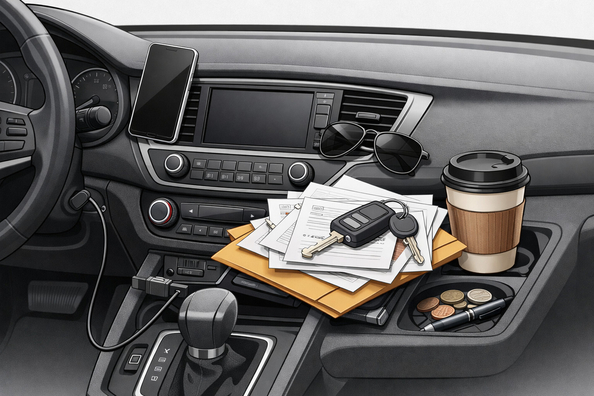
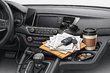
Clutter on the dashboard doesn’t appear because you suddenly have more stuff, but because there are no proper dedicated places for it. The phone gets put on top of the plastic, documents get shoved into a random cubby, receipts and small items roll around in corners. As a result, the driver starts searching for what they need while driving — and that’s not a minor issue, it’s a distraction.
A proper solution here isn’t to stick on yet another universal pocket. A simple setup works: a separate shelf or organizer for the phone and small items, a separate place for documents, and the right mounting base if the dash is textured or gets very hot.
In many cars, the upper part of the dashboard is wide, but it isn’t designed for storing items. It has an angle, a texture, or just smooth plastic that makes objects slide during braking, acceleration, and over bumps.
The second common story is piling items with different usage logic into one spot. You need your phone quickly, glasses only sometimes, while documents should be kept organized and without bends. When all of that sits together on the dash, it won’t be convenient even in a spacious cabin.
There’s also a technical factor: a textured dash, heat under the windshield, proximity to vents, and surface curves. Because of this, universal suction cups, sticky pads, and shallow trays often work worse than they seem at the time of purchase.
First, look at what exactly creates the mess. If the phone keeps sliding, the issue is fixation or the surface. If papers get lost, the problem isn’t the dashboard itself but the lack of a separate document holder. If the mount falls off, look at the dash material, temperature, and mounting spot.
Next, test everything on a parked car. Put the phone or case where it usually lies and gently push it forward and sideways by hand. If the item moves across the plastic with no resistance, the dash isn’t suitable for storage without side walls or an anti-slip layer. If the mount holds in the morning but weakens after parking in the sun, the cause is most often base overheating, not the phone’s weight.
Evaluate the geometry separately. If the organizer blocks a vent, sensor, button, or prevents you from placing a large phone properly, it doesn’t fit your configuration. Another simple marker: if at least once a day you have to reach for documents over the steering wheel or rummage through small items, your storage system is already organized incorrectly.
DD Tuning expert comment: the most common mistake is trying to solve everything with one accessory. People want one sticky pad to hold the phone, glasses, and receipts at the same time, then they’re surprised when it falls off in the heat or starts blocking visibility. A different approach works in practice: a separate shelf for small items, a separate place for documents, and a correctly selected mounting base for the specific dash texture.
| Symptom | Likely cause | What to do |
|---|---|---|
| The phone slides on turns | Flat or slippery dash without side walls | You need a shelf with side walls, a deeper organizer, or a separate reliable mount |
| Documents get wrinkled, lost, or mixed with receipts | All papers are kept in a common area with small items | Move documents to a separate holder in the glovebox or on the sun visor |
| Suction cup or adhesive base falls off after heat | Textured dash, overheating, or a poorly prepared surface | Use a mounting base for difficult surfaces or move the mount to another spot |
| Items rattle during braking | Tray is too shallow or there’s no anti-slip surface | Choose a deeper solution with side walls and don’t overload it |
| After removal, marks remain on the plastic | Wrong adhesive type or mounting on a sensitive finish | Don’t stick things randomly onto a delicate surface; use a protective base or another mounting method |
| The organizer seems to fit, but it’s inconvenient to use | Poor sizing, blocked cutouts, vents, or access to controls | Measure the area again, consider phone size, and choose a vehicle-specific solution for your dashboard |
The best approach is splitting into three zones. On the top of the dashboard, keep only what you use while driving: the phone, sometimes glasses, or a gate remote. Documents and insurance shouldn’t live there — a separate holder in the glovebox or on the sun visor is better.
If the dashboard is wide and constantly tempts you to place things on top, a vehicle-specific shelf or organizer that follows the shape of the dash is useful. The main advantage of such solutions isn’t just having a shelf, but the side walls, depth, and a more predictable placement of items.
For a textured dashboard, not only the holder matters but also the mounting method. If the surface is hard, grainy, and heats up strongly, a bare suction cup often loses. Then you either install the right mounting base, or you stop trying to mount everything on the dash at all.
Another thing that truly helps is removing the extra stuff from the dashboard. If there’s a wallet, keys, cables, small papers, and two cards lying there, no organizer will make it convenient. Only quick-access items should remain on the upper part of the cabin.
An anti-slip mat as the only storage system is a temporary compromise. For a single phone or glasses it can still be useful, but for documents, small papers, and several items at once it’s a weak solution.
Cheap universal sticky pockets on a hot dashboard often disappoint as well. Either they don’t hold for long, or they leave marks, or they start peeling at the edges precisely when the car regularly sits in the sun.
Trying to put everything into one deep cubby doesn’t work very well either. Yes, items stop rolling around, but another problem starts: you have to rummage through a pile. The mess just changes shape, it doesn’t disappear.
If your car has a long upper surface and small items slide on the plastic every day, it makes sense to look at dashboard shelves. For vehicles where the dash shape allows a model-specific solution, it’s usually more useful than universal mats because you get side walls and a clearly defined area for items.
In large cabins, model-specific options work especially well, where the shape follows the dashboard itself, for example for Sprinter W906 or for Fiat Ducato. Buying an accessory is justified when it doesn’t block vents, visibility, or access to controls, and the clutter problem repeats every day.
But if you simply have nowhere to put one document or one card, a large shelf may be unnecessary. In that case, it’s more logical to organize the glovebox or replace a worn mounting base if what bothers you is the mount falling off, not the lack of space.
| Solution | When it works | When it’s not worth spending money |
|---|---|---|
| Vehicle-specific dashboard shelf | When the dash is wide, items constantly slide, and you need a dedicated area with side walls | When the problem is only one document, or the shelf blocks visibility, sensors, or vents |
| Separate document holder | When insurance, registration, and passes get mixed with small items | When you have minimal documents and they already sit properly in an organized glovebox |
| Anti-slip mat | When you need to temporarily place one light item on a smooth surface | When you plan to put many things on it or the car often sits in extreme heat |
| Mount with a mounting base | When the dash is textured and a regular suction cup won’t hold | When the surface is delicate, very hot, or the mount still has to go in a poor location |
| Universal tray or pocket | When the dash shape is simple and the load is small | When you need precise fitment, significant depth, or there’s a risk of adhesive marks |
| Replacing a worn base or old mount | When the location is already chosen correctly but the part has lost rigidity or stickiness | When the main cause is the wrong storage logic, not part wear |
From a customer’s experience: the owner of a minibus first tried to get by with a small mat because he just wanted to keep the phone off the slippery dash. After a few trips, it turned out the problem wasn’t only the phone: passes, receipts, and glasses were constantly lying next to it. After installing a vehicle-specific shelf and moving documents to a separate place, only quick-access items remained on the dashboard, and there was no longer any need to search for them during the route.
Dashboard clutter isn’t solved with a single sticker, but with the right logic of item placement. In short: the phone needs a stable zone, documents need a separate organized holder, and a textured dash needs an appropriate mounting method — not a random suction cup.
It makes sense to buy an accessory only when it fixes a specific cause: sliding, lack of depth, poor mounting, or mixing items together. This material is based on real selection experience, practice, and real usage scenarios, so the main advice is simple: don’t pile everything onto the dashboard — assign items to their proper places.
Shipping to EU
Wholesale and retail
Own warehouse
Опис продукту
Подарунки не надаються при оформленні покупки у кредит під 0,01% або при покупці частинами.