
19.09.2026
93
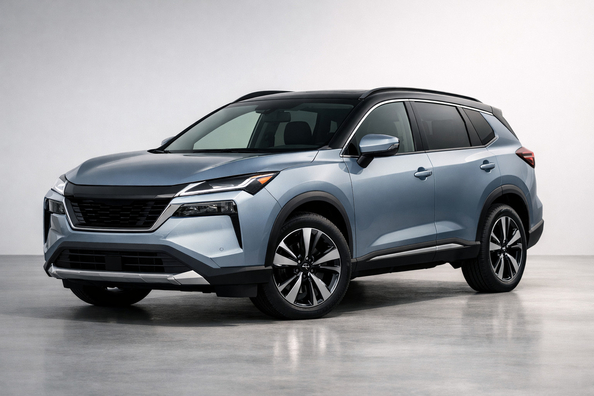
The 2027 Nissan Rogue Hybrid matters not because it’s just another crossover in a crowded segment, but because for the U.S. it brings a different hybrid logic: the gasoline engine doesn’t drive the wheels directly here—it works as a generator for two electric motors. On paper, that delivers what people love about EVs in the city—smooth pull-away, quick pedal response, and quiet cruising at an easy pace—without relying on charging infrastructure.
So far the model looks strong in concept and equipment: standard all-wheel drive, a claimed city rating of 40 mpg, cargo space around 1104 L, and a starting price from $35,490. But there’s an important nuance: some specs for the U.S. version still haven’t been finalized publicly, so it’s best to approach this model without romanticizing it—big potential, final verdicts after the full specification is released.
The Rogue Hybrid enters the hottest class of family crossovers, where buyers usually choose between practicality, efficiency, and winter versatility. Its direct market benchmarks are the Toyota RAV4, Honda CR-V, Hyundai Tucson, and Kia Sportage. Nissan’s difference isn’t size or body format, but the type of hybrid system.
This model suits those who drive mostly in the city and suburbs, often sit in traffic, want a calm, smooth ride, but aren’t ready to move to a full EV. It makes less sense for those who do a lot of high-speed highway driving, are sensitive to any engine noise under load, or want the simplest, long-proven hardware.
For the U.S., the 2027 Rogue Hybrid is essentially a new chapter for the model: sales start in late fall 2026 with a limited run of SR with the Technology package, while other trims are expected in early 2027. So the timeline is straightforward: model year 2027, real market launch on the 2026–2027 boundary.
The key news here isn’t only the hybrid itself, but the third generation of the e-POWER system. Globally, this architecture is no longer an experiment, but for the American Rogue it’s a new page. So the story is best read on two levels: the evolution of the Rogue itself and the arrival of mature, already refined e-POWER technology in the U.S.
The powertrain is unusual for the mass buyer: the gasoline engine works only as a generator, while two electric motors handle propulsion. That means there’s no traditional gearbox in the usual sense—and that’s what creates a more linear, EV-like surge without shift events.
As for the hardware, there’s one important point. The full technical spec sheet for the U.S. Rogue Hybrid hasn’t been disclosed yet, but the architectural reference is the third-generation e-POWER with a 1.5-liter three-cylinder turbo engine-generator. Total output is also not pinned down: public materials mention both “over 200 hp” and an estimate around 225 hp, so it’s correct to treat that number as preliminary for now.
| Parameter | What we know so far |
|---|---|
| Sales start | Late fall 2026 for the first limited batch; main versions in early 2027 |
| Powertrain type | Third-generation e-POWER, where the gasoline engine works as a generator |
| Gasoline engine | Official architectural reference: 1.5 L, 3 cylinders, turbo engine-generator; exact data for the U.S. version is still pending |
| Total output | Preliminarily over 200 hp; early reviews often mention around 225 hp |
| Drivetrain | Standard dual-motor all-wheel drive for all trims |
| Transmission | No traditional transmission |
| Fuel economy | Claimed 40 mpg city for SR with all-wheel drive, about 5.9 L/100 km; final certified figures haven’t been published yet |
| Seating | 5 |
| Cargo | 39 cu ft, about 1104 L behind the rear seatbacks |
| Battery warranty | 8 years or 160,934 km |
| Starting price | From $35,490 to $43,490 depending on trim |
There’s a typical pre-launch issue with the body: the official dimensions for the 2027 Rogue Hybrid haven’t been published yet. As a practical reference, you can look at the related X-Trail e-POWER: 4690 × 1840 × 1720 mm, wheelbase 2705 mm. But that’s a guideline, not confirmed dimensions for the U.S. Rogue Hybrid.
Ground clearance, approach and departure angles, and towing capacity also haven’t been revealed yet. What is already clear is something else: this isn’t an off-road story, but about everyday confidence on wet pavement, in snow, and on slick inclines thanks to standard dual-motor all-wheel drive. The 1104 L cargo area looks like a strong argument for family use—a stroller, travel bags, and everyday shopping.
Inside, the Rogue Hybrid looks grown-up even against pricier rivals. Even in the base model logic, dual 12.3-inch displays are claimed, and in higher versions—a pair of 14.3-inch screens, 3D surround view, Qi2 wireless charging, and expanded multimedia capabilities.
For a family, the small details matter more than the screens: five LATCH child-seat anchors, two rear USB-C ports, good cargo volume, a panoramic roof, heating and ventilation for the front seats, driver seat and mirror memory. If Nissan keeps sensible control ergonomics, this will be one of those cabins that’s easy to live with every day, not just admire for its options list.
In the city, e-POWER should work very convincingly. At low and medium speeds, this layout typically delivers smoothness, instant response, and a feeling of lightness that conventional gasoline crossovers with traditional automatics often lack. For the driver, that means fewer jerks in traffic and a calmer daily rhythm.
But there’s a second side. Under hard acceleration or on the highway, the gasoline engine-generator can become more noticeable acoustically than someone expects after the first “electric” impression. It’s also not worth automatically expecting record efficiency at high speeds: related e-POWER models in real-world use tend to shine most in the city, not on fast highway runs.
On the practical side, a plus is that the battery has a separate long warranty of 8 years or 160,934 km. That doesn’t eliminate questions about the long-term reliability of a configuration that’s new for the U.S., but it reduces the anxiety around the hybrid part for those buying the vehicle for several years rather than a single season.
| Side | What it means for the owner |
|---|---|
| Plus | Electric-motor driving character: smooth pull-away, quick response, calm city manners |
| Plus | Standard all-wheel drive with no extra charge across the lineup—useful in winter and rain |
| Plus | Practical format: 5 seats, many child-seat anchor points, large cargo area |
| Plus | Strong cabin equipment right from launch |
| Minus | Some specs are still preliminary: no full official spec sheet for dimensions, ground clearance, and some fuel-economy numbers |
| Minus | Under load, the sound of the gasoline generator may not match expectations of an “almost EV” |
| Minus | Real-world highway economy may not be as impressive as city driving |
| Minus | The first model year of a new configuration always brings more unknowns regarding minor early issues |
If you boil it down to a simple conclusion, the Rogue Hybrid’s strength is the city-and-family use case. The weak point is the uncertainty of the launch period and the fact that some buyers may expect more quietness and lower highway consumption from e-POWER than they’ll get in real life.
For a model like this, sensible tuning isn’t about decoration—it’s about protection and convenience. The new Rogue Hybrid is best complemented with items that truly work every day: protection for the floor, cargo area, lower doors, and sills against dirt, salt, and wet shoes. Since the 2027 version is only coming to market, accessories should be chosen with verified compatibility for the body and mounting points.
If you need an even more practical setup, it then makes sense to look at roof cargo solutions and protection for the tailgate sill. But the basic daily-use set usually starts exactly with mats and mud flaps.
The 2027 Nissan Rogue Hybrid looks like one of Nissan’s most interesting family crossovers in years: it promises city efficiency, an EV-like driving feel, standard all-wheel drive, and a strong equipment set. At the same time, it’s not a model you should judge only by the marketing idea: before buying, it’s better to wait for final data on dimensions, ground clearance, final consumption figures, and the first real owner feedback.
If your scenario is city driving, family needs, winter, daily trips, and the desire for a calmer driving character without plugging in, the Rogue Hybrid looks very logical. But if long highway trips, full predictability from day one, or exact certified numbers for every small detail are the top priority, it’s better to wait a bit. This piece is based on real selection experience, practical know-how, and real usage scenarios—not abstract marketing promises.
| ✔ | The e-POWER powertrain has an electric-car feel in the city: smooth starts, quick pedal response, and calm driving without shifting. For everyday commuting in traffic, it delivers a more comfortable feel than a regular gasoline crossover. |
| ✔ | Standard all-wheel drive comes on every trim. That’s practical for winter, wet roads, and slippery climbs without paying extra for a higher-spec version. |
| ✔ | The claimed cargo area of around 1104 l looks very useful for family use. It should fit a stroller, large shopping trips, and travel bags. |
| ✔ | The cabin immediately looks well equipped: two 12.3-inch displays, and in higher trims 14.3-inch screens, 3D around-view monitoring, and Qi2 wireless charging. That’s convenient not only for comfort but also for everyday use. |
| ✔ | The battery comes with an 8-year or 160,934 km warranty. That lowers the risk for those planning to keep the car for several years and worrying about the hybrid system. |
| ✘ | Some technical data for the American version have not yet been fully revealed, including dimensions, ground clearance, and final consumption figures. Because of that, it’s difficult to assess the model accurately before the full specification is released. |
| ✘ | Under hard acceleration or on the highway, the gasoline engine-generator may be more audible than expected from a “almost electric car.” This may not suit those who expect near-complete silence. |
| ✘ | Real-world efficiency at higher speeds will likely be more modest than in city driving. In other words, this car shows its best side in the city, not on long high-speed trips. |
| ✘ | The model is entering the market in a new configuration, so minor teething issues are possible at launch. For the buyer, that means more unknowns than with long-established competitors. |
Shipping to EU
Wholesale and retail
Own warehouse
Опис продукту
Подарунки не надаються при оформленні покупки у кредит під 0,01% або при покупці частинами.